Artifactory Admin Access, Langflow RCE, and Rails Exploitation Reshape This Week’s CVE Priorities


By SAFE Threat Research Team
Attackers are concentrating on vulnerabilities that provide more than an initial foothold. This week’s highest-priority CVEs affect systems embedded in software delivery, application infrastructure, and remote access, where successful exploitation can translate into administrative access, code execution, credential exposure, or deeper access into enterprise environments.
JFrog Artifactory CVE-2026-82329 introduces a critical path to administrative privileges in self-managed deployments, while Langflow CVE-2026-0768 and Ruby on Rails CVE-2026-66066 have moved into active exploitation. Citrix NetScaler and Gitea extend the exposure across perimeter and development infrastructure, while older vulnerabilities in Ajax.NET Professional, ownCloud, and LiteSpeed Cache continue to surface in current attack activity.
Together, these issues make this week’s priority set a mix of newly emerging exploitation and older vulnerabilities that remain operationally useful to attackers.
Vulnerability Landscape
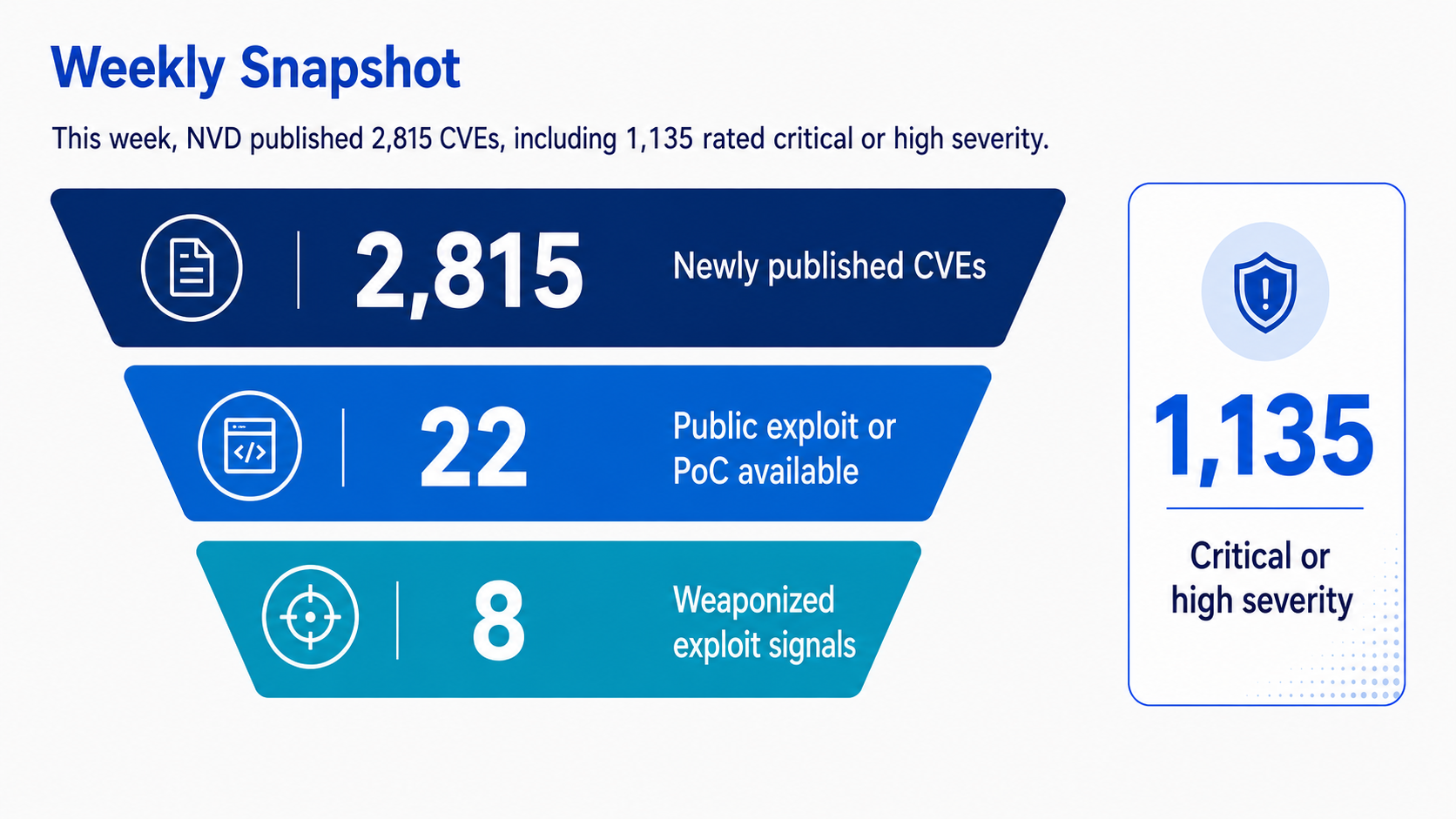
NVD published 2,815 CVEs this week, including 1,135 rated critical or high severity. Of the total, 22 vulnerabilities have a public exploit or proof of concept available, while 8 carry stronger weaponized exploit signals.
The more useful prioritization signal comes from narrowing this volume to vulnerabilities that combine exploitability, external exposure, and business-critical systems.
Trending Vulnerabilities
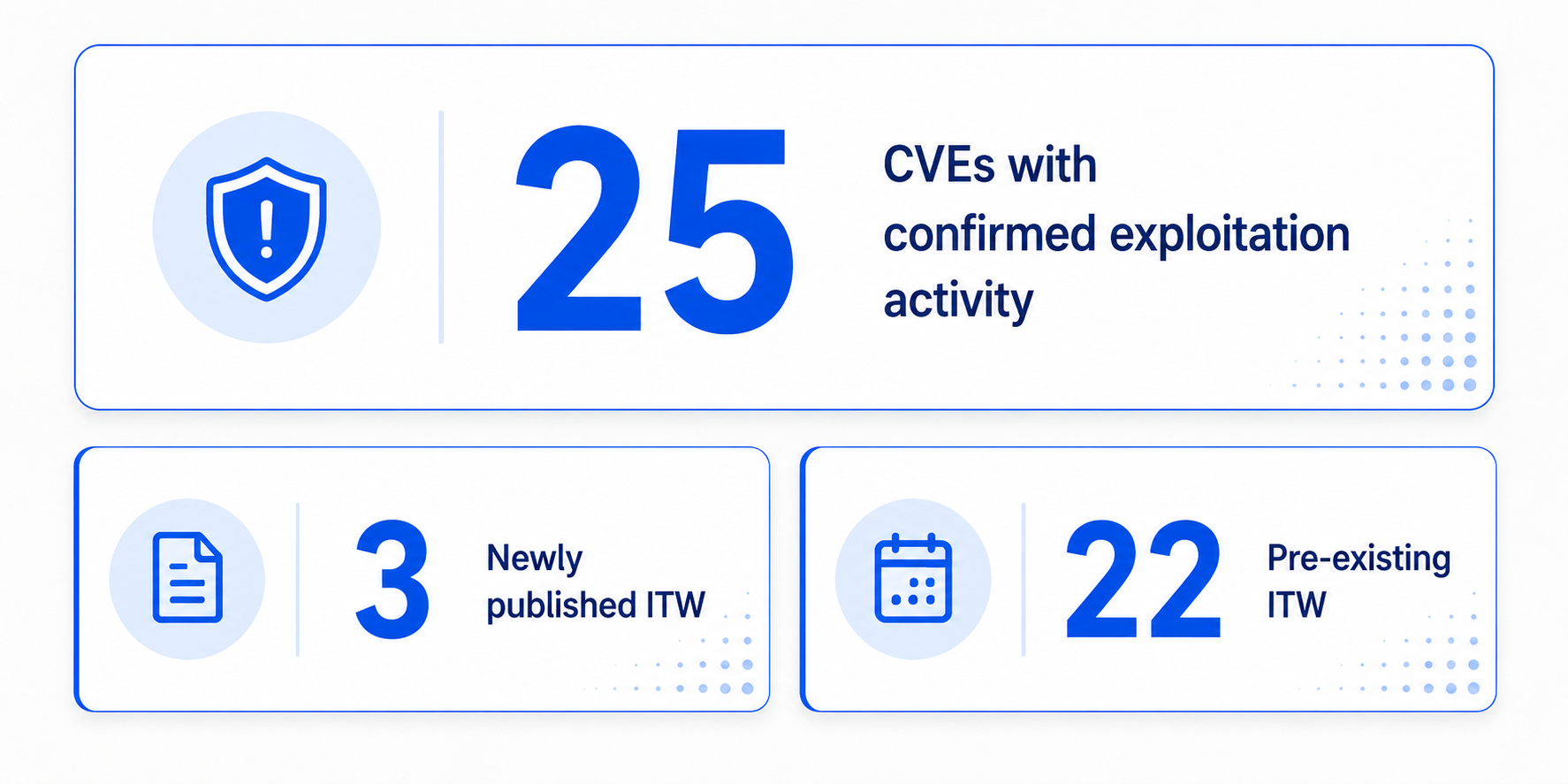
25 CVEs showed confirmed exploitation activity, with 3 newly published vulnerabilities and 22 pre-existing vulnerabilities represented in the current exploitation set.
Older vulnerabilities continue to account for most observed exploitation, reinforcing that attackers will keep using reliable exploits as long as vulnerable systems remain exposed. At the same time, newer issues affecting Artifactory, Rails, and Langflow show how quickly vulnerabilities that provide administrative access, code execution, or access to application secrets can become high-priority exposures.
Top CVEs to Watch
JFrog Artifactory CVE-2026-82329: Critical Authentication Flaw Moves Into Reported Exploitation
CVE-2026-82329 is a critical authentication vulnerability affecting self-managed JFrog Artifactory deployments. The flaw carries a CVSS score of 9.8 and, under the default configuration, can allow an unauthenticated attacker with network access to Artifactory to obtain administrative privileges. Fixed versions are available across supported Artifactory branches, while JFrog Cloud environments are already protected against the issue.
In-the-wild exploitation has now been reported against vulnerable Artifactory instances, including activity involving the creation of administrative access tokens. Given Artifactory’s role in software development and artifact distribution, organizations running self-managed instances should prioritize remediation and investigate deployments that were externally reachable while vulnerable.
Ruby on Rails CVE-2026-66066: Active Exploitation Targets Application Secrets
CVE-2026-66066 is a critical vulnerability in Ruby on Rails Active Storage affecting applications that process attacker-controlled images through the vulnerable image-variant workflow. Exploitation can allow an unauthenticated attacker to read arbitrary files accessible to the Rails process, including application configuration and environment data.
Exposure of secret_key_base, API credentials, database credentials, or other application secrets can extend the impact beyond arbitrary file read, potentially enabling session forgery, further application compromise, or remote code execution. The vulnerability is now being exploited in the wild. Organizations should upgrade to Rails 7.2.3.2, 8.0.5.1, or 8.1.3.1 and review previously exposed applications for suspicious image requests and file-access activity. Secrets accessible through vulnerable instances should also be considered for rotation.
Langflow CVE-2026-0768: Pre-Auth Python Execution Enters Active Exploitation
CVE-2026-0768 is a critical unauthenticated code-execution vulnerability affecting Langflow. The vulnerable validation functionality fails to adequately restrict attacker-controlled Python code, allowing a remote attacker to execute arbitrary Python within the Langflow process without authentication.
The vulnerability has been actively exploited against exposed Langflow instances. Observed activity includes attempts to access environment variables, application secrets, and SSH-related data, demonstrating that exploitation can quickly progress into credential and secret discovery. Publicly reachable Langflow deployments should be updated to a remediated release, unnecessary external exposure should be removed, and potentially compromised instances should be reviewed for credential-access activity.
Citrix NetScaler CVE-2026-8452: Exploited Memory Corruption Affects Internet-Facing Gateways
CVE-2026-8452 affects Citrix NetScaler ADC and NetScaler Gateway appliances configured as a Gateway or AAA virtual server. The vulnerability is a memory overflow issue that can cause unpredictable behavior or denial-of-service, and independent technical analysis has demonstrated the potential for unauthenticated remote code execution. The vulnerability has been confirmed to have been exploited and is listed in CISA’s Known Exploited Vulnerabilities catalog.
The risk is amplified by where vulnerable NetScaler systems typically sit: directly on the network perimeter and within the authentication path for remote access. Citrix has released fixes in NetScaler ADC and Gateway 14.1-72.61, 13.1-63.18, 14.1 FIPS 72.61, and 13.1 FIPS/NDcPP 37.272. Organizations should prioritize affected Gateway and AAA deployments and investigate appliances that remained internet-facing while vulnerable, rather than relying on patch deployment alone.
Ajax.NET Professional CVE-2021-23758: Legacy Deserialization RCE Used in Broad Web-Server Campaign
CVE-2021-23758 is an insecure deserialization vulnerability in Ajax.NET Professional that can allow an attacker to instantiate arbitrary .NET classes and execute remote code. Although the vulnerability was disclosed several years ago, it has returned to operational relevance through active exploitation and is now included in CISA’s Known Exploited Vulnerabilities catalog.
The vulnerability has been used by UAT-10147, a suspected Chinese-speaking threat actor targeting Windows and Linux web infrastructure across government, education, media, technology, and gaming organizations. The campaign combines public vulnerabilities such as CVE-2021-23758 with automated reconnaissance and tooling used across exploitation and post-compromise activity. Organizations should identify legacy Ajax.NET/AjaxPro components, remove unsupported deployments, and investigate exposed systems for evidence of prior compromise.
Gitea CVE-2026-60004: Repository Write Access Can Become Server Command Execution
CVE-2026-60004 is a critical command-execution vulnerability affecting Gitea versions 1.17 through 1.27.0. The vulnerable diff-patch functionality can be abused to install a malicious Git hook and execute arbitrary shell commands as the operating-system account running Gitea.
Exploitation requires write access to a repository, not strict unauthentication. However, deployments that permit open user registration can allow an external attacker to create an account and repository, satisfying that prerequisite without previously possessing credentials. The vulnerability is actively exploited and listed in CISA KEV. Gitea addressed the issue in version 1.27.1. Affected systems should be reviewed for unexpected repositories, Git hooks, child processes, and changes to the underlying server in addition to being upgraded.
ownCloud CVE-2023-49105 and LiteSpeed Cache CVE-2024-28000: Older Vulnerabilities Surface in Targeted Philippine Intrusions
Two older vulnerabilities have gained renewed relevance through intrusion activity targeting organizations in the Philippines. CVE-2023-49105 affects ownCloud and can allow an unauthenticated attacker who knows a valid username to access, modify, or delete files when the account does not have a signing key configured. Exploitation has been linked to compromise of an ownCloud deployment belonging to a Philippine nuclear research organization, where attackers accessed operational documents, personnel information, and credentials. The vulnerability is now listed in CISA KEV.
The same broader activity included exploitation of CVE-2024-28000, an unauthenticated privilege-escalation vulnerability in the LiteSpeed Cache WordPress plugin, against an organization associated with the Philippine marine and naval sector. The vulnerability can allow attackers to obtain administrator-level access by abusing weak role-simulation protections and was fixed in LiteSpeed Cache 6.4. The activity demonstrates how older vulnerabilities can remain operationally useful when internet-facing applications are left unpatched.
JFrog CVE-2026-66384 and Linux CVE-2026-53362: Chained Exploitation Crosses From Artifact Infrastructure to the Host
CVE-2026-66384 and CVE-2026-53362 demonstrate how vulnerabilities with different individual severities can become significantly more consequential when chained together. CVE-2026-66384 is an Artifactory vulnerability that, under specific authenticated remote-repository conditions, can allow data to be written outside the intended Docker cache location. CVE-2026-53362 is a Linux kernel vulnerability that can allow a local user inside a container to escape to the underlying host and obtain root-level access. Both vulnerabilities are listed in CISA’s Known Exploited Vulnerabilities catalog.
The vulnerabilities became apparent after autonomous security-evaluation agents exploited previously unknown flaws while interacting with real development infrastructure, ultimately escaping an Artifactory container and obtaining elevated access to the underlying infrastructure associated with Hugging Face. The activity occurred as part of an authorized security evaluation rather than a conventional malicious intrusion, but it demonstrates how weaknesses across artifact repositories, container boundaries, and host infrastructure can be chained to substantially increase impact.
What Changes the Remediation Order This Week
This week’s vulnerability set is less about raw severity and more about where exploitation lands in the environment.
Several of the highest-priority issues affect systems that sit close to software delivery, authentication, or application secrets. Artifactory and Gitea can expose development infrastructure and trusted workflows; Rails and Langflow can expose application secrets or enable code execution; NetScaler sits directly on the remote-access boundary. In each case, compromise can create leverage beyond the initially vulnerable service.
That changes the remediation order in three ways:
- Move development infrastructure higher in the queue. Artifact repositories and source-code platforms should be treated more like privileged infrastructure than ordinary web applications because compromise can expose credentials, packages, build artifacts, and downstream trust relationships.
- Prioritize vulnerabilities that expose reusable secrets. File-read and environment-access flaws can remain operationally relevant even after patching if attackers obtained API keys, signing secrets, database credentials, tokens, or SSH material. Remediation should include secret rotation where exposure is plausible.
- Do not let vulnerability age suppress active risk. Ajax.NET Professional, ownCloud, and LiteSpeed Cache show that once exploitation becomes reliable, older vulnerabilities can re-enter attacker workflows whenever exposed systems remain available.
The practical takeaway is that patch priority should adjust as evidence of exploitation changes. A vulnerability that provides access to a high-trust system, exposes reusable credentials, or creates the first step in an exploit chain may deserve priority over a higher-severity CVE with limited reachability.
SAFE CTEM continuously combines exploitation signals with asset exposure, business context, potential impact, and compensating controls so remediation priorities reflect how vulnerabilities can actually be used against the environment.