How CTEM Turns Vulnerability Data Into Risk Reduction


Series: Understanding CTEM and Why It Matters | Part 2 of 3: Scoping, Discovery, and Prioritization
In the first blog of this series, we talked about why 25 years of vulnerability management hasn’t actually made organizations more secure. Scanners generate more findings than teams can act on, CVSS scores get treated as a priority list instead of a severity rating, and security teams end up busy without necessarily being effective. Continuous Threat Exposure Management (CTEM) is evolving.
Gartner’s answer to this is a five-phase program. This part of the blog post series will cover the first three phases – Scoping, Discovery, and Prioritization and how we’ve operationalized them while building SAFE CTEM. Blog 3 picks up Validation and Mobilization. For each phase, we’ll cover the practitioner expectation we’re really pointing at, and the SAFE CTEM differentiator that solves it – for the use case itself, and for how easily a team can adopt it.
SAFE operationalizes this model through the SAFE CTEM AI Co-Worker, which is a command center for 100+ AI Agents. With built-in workflows, agents work in parallel across your CTEM projects, completing weeks of work in days.
Phase 1: Scoping – Start With What Matters
Practitioner Expectation: Identifying and prioritizing the business areas, attack surfaces, and technology domains a CTEM program should cover.
The Practitioner Problem:
- Asset inventories are fragmented across CMDBs, cloud platforms, vulnerability scanners, endpoint tools, and SaaS applications that were never designed to talk to each other.
- Legacy and on-prem tools often sit outside all of them, tracked in spreadsheets or siloed exports nobody remembers to update.
- Getting a usable inventory typically means weeks of manual reconciliation before anyone can even start scoping.
- Without the right scoping, teams default to organizing exposure management around technology – servers, endpoints, cloud – rather than around what’s meaningful to the business, spreading remediation effort evenly across assets that matter very differently.
How SAFE CTEM Solves It: Industry’s First Cyber Risk Quantification-Based Asset Scoping Engine
- Grouping Assets by Business Units: Leverage SAFE’s industry-leading Cyber Risk Quantification to align scoping with actual business units and financial impact, rather than just technology layers. Create custom asset groups for critical business functions (e.g., “Manufacturing Operations” or “Payment Operations”) to view all relevant assets, vulnerabilities, and findings in one centralized dashboard.
- Out-of-the-box integrations across cloud providers, CMDB platforms, vulnerability management tools, EDR platforms, attack surface management tools, and security control technologies – an achievable starting point across RBVM, SaaS security posture, external attack surface, cloud infrastructure, critical business services, internet-facing assets, and CMDB-categorized assets.
- The Flex Connector closes the gap API integrations can’t – legacy, on-prem tools feed CSV or JSON exports into SAFE, turning static, siloed findings into live, usable data instead of leaving them out of scope.
- AI-powered asset criticality infers criticality directly from CMDB and telemetry data – ownership, environment, business function – and validates and classifies assets and findings automatically, with nothing to configure.
- Deduplication with no manual intervention – SAFE’s AI/LLM models handle it end to end, with no rules engine for a team to maintain it
- Get a working, business-prioritized inventory in place of weeks or months of manual reconciliation – and because it scales to ingest and process up to millions of assets and billions of findings continuously, the inventory stays current instead of going stale between reviews
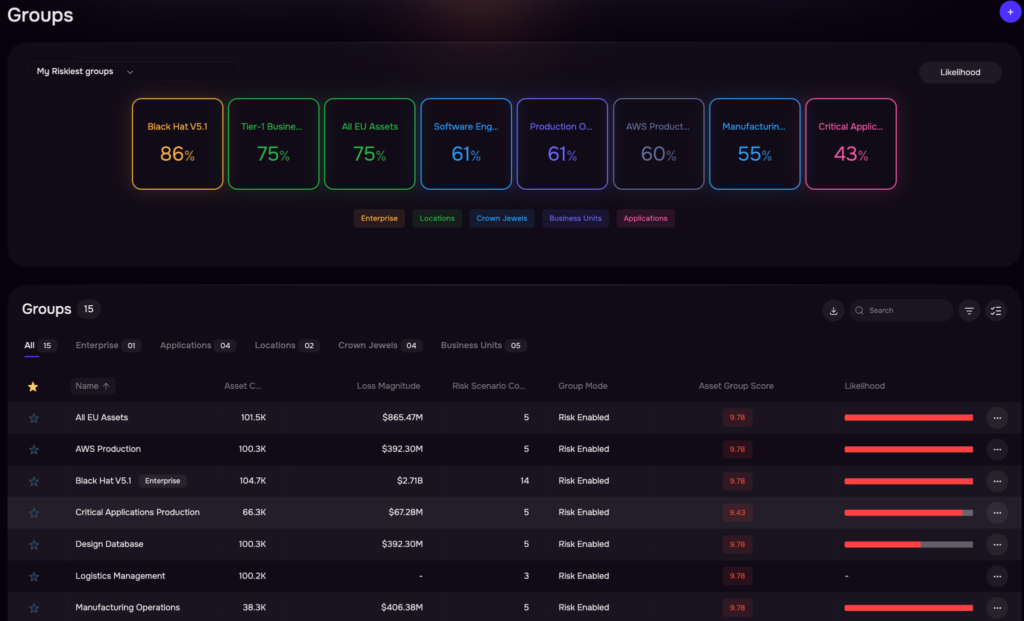
Industry’s First Cyber Risk Quantification – Classify Business Units
- 25% lower insurance premiums
- 2x insurance coverage
Phase 2: Discovery – Build a Complete, Correlated Exposure Inventory
Practitioner Expectation: Building visibility into assets, vulnerabilities, misconfigurations, and risk across the scoped environment.
The Practitioner Problem:
- Visibility usually isn’t the issue – most organizations already have plenty of tools generating plenty of data. Correlation is the real problem.
- Each tool sees the same asset through a different lens: ServiceNow sees a CI record, Wiz sees a cloud resource, Tenable sees an IP address, CrowdStrike sees an agent ID.
- Without correlation, that isn’t one asset seen four ways – its four fragmented records with four different risk pictures for the same box.
- Pulling data from fragmented tools like this creates blind spots, gaps, and mismatches – nobody trusts the numbers, and nothing gets done.
How SAFE CTEM Solves It: Industry’s First Zero Drop Architecture with Zero Data Loss Guarantee
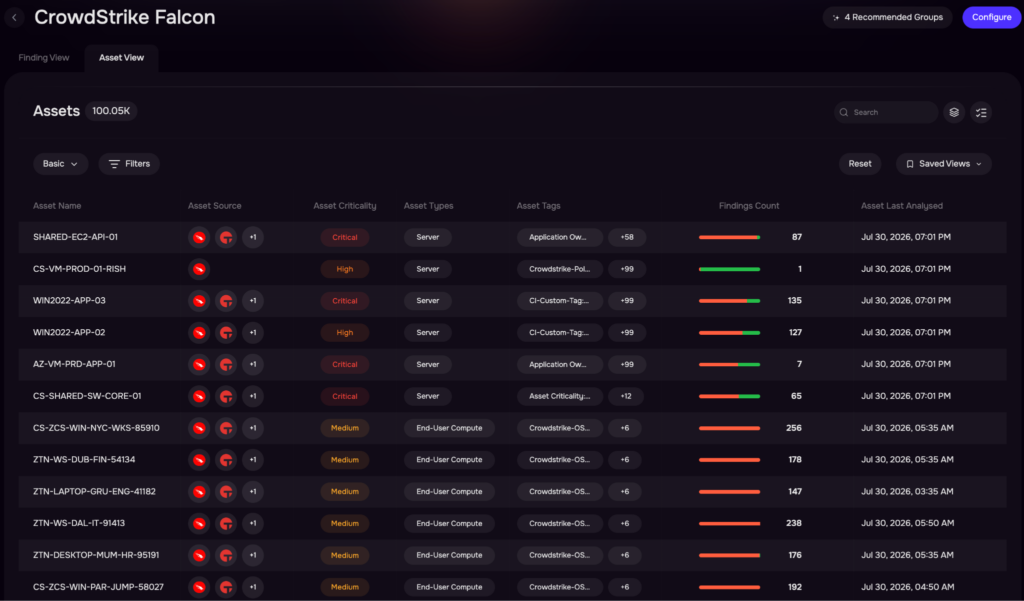
- Zero Drop Ingestion Architecture – Every asset and finding remains traceable from its source through normalization, enrichment, and prioritization-without silently disappearing inside the data pipeline.
- The industry’s first – so customers can actually trust what they’re looking at.
- End-to-end traceability: assets and findings can be traced from the source system through ingestion, processing, enrichment, and risk prioritization.
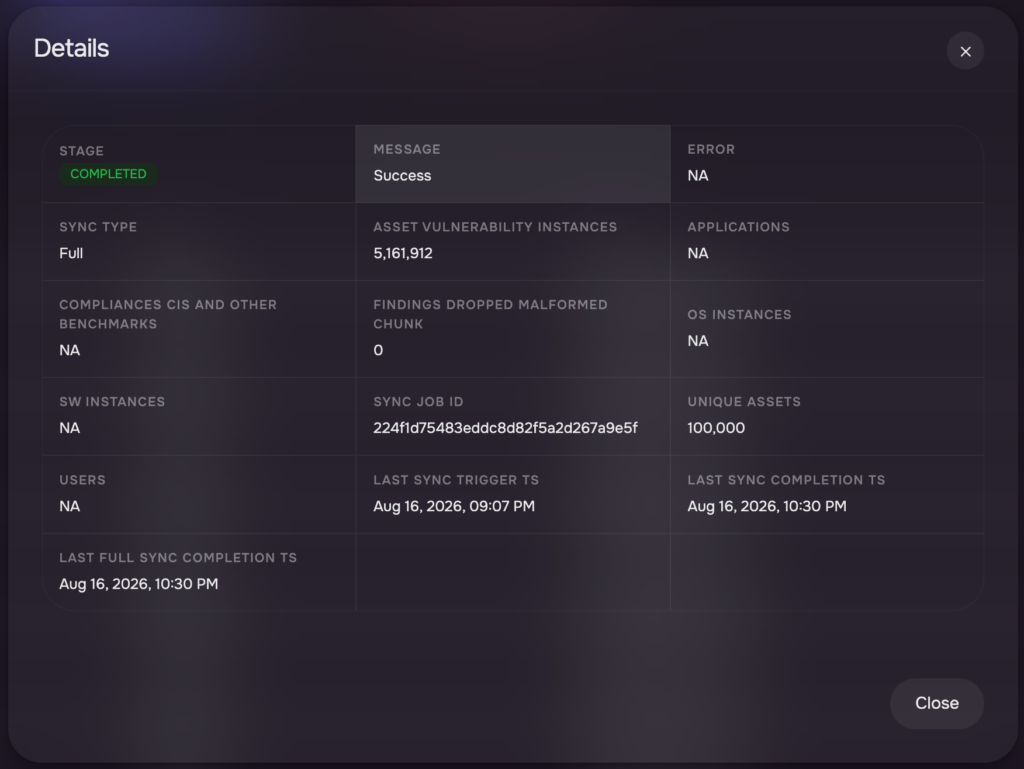
- Sync transparency: SAFE’s UI shows integration status, last successful sync, failures, delays, and ingested asset & findings counts.
- No black-box processing: teams can validate why a record exists, when it changed, and which source or process updated it.
- A single cyber knowledge graph – SAFE brings all assets and findings together, fully deduplicated, via a robust ingestion layer that continuously correlates fragmented, multi-source data across cloud, internal infrastructure, external attack surface, endpoints, containers, applications, SaaS, and identity systems.
- AI-powered correlation and enrichment, running continuously as new data arrives, turns that ServiceNow CI, Wiz resource, Tenable IP, and CrowdStrike agent ID into one correlated asset profile – no one manually matching records.
- 300+ contextual attributes per asset, including criticality, type and subtype, cloud metadata and network information, OS details and software inventory, business service mapping and CMDB ownership, internet exposure and patch status, tags, and security control coverage.
- Security control discovery captures what’s already defending an asset – EDR coverage, endpoint policies, firewall policies, hardening controls, and mappings to MITRE ATT&CK and D3FEND – the input Prioritization can’t work without.
- SafeX, our AI agent, proactively uncovers hidden risks – SAFE analyzes your software and OS inventory to pinpoint security gaps that standard scanners might miss. These insights appear as SafeX findings, helping you prioritize critical issues that are often overlooked by other tools.
- No manual matching, no reconciliation spreadsheets, and no need to take the data on faith – and at enterprise volume, SAFE processes roughly a million findings in under two hours while keeping full enrichment intact, so the inventory is current, not a stale snapshot.
Phase 3: Prioritization – Focus on the Exposures That Actually Matter
Practitioner Expectation: Ranking exposures by actual risk to the business, not by technical severity alone.
The Practitioner Problem:
- Most vulnerability programs still lead with CVSS – a CVSS 9.8 on a non-critical internal system can carry far less real risk than a CVSS 6.5 on an internet-facing production system that ransomware operators are actively targeting.
- Attackers don’t prioritize by CVSS; programs that do are optimizing for the wrong thing.
- Multiple tools reporting the same set of findings creates significant complexity and inefficiency for remediation owners.
- Without accurate prioritization, analysts are stuck making sense of a pile of tool-specific scores with no shared context – chasing the wrong fires while the ones that matter go untouched.
How SAFE CTEM Solves It: Industry’s Most Comprehensive Prioritization Engine with 25+ Parameters. Fully Dynamic
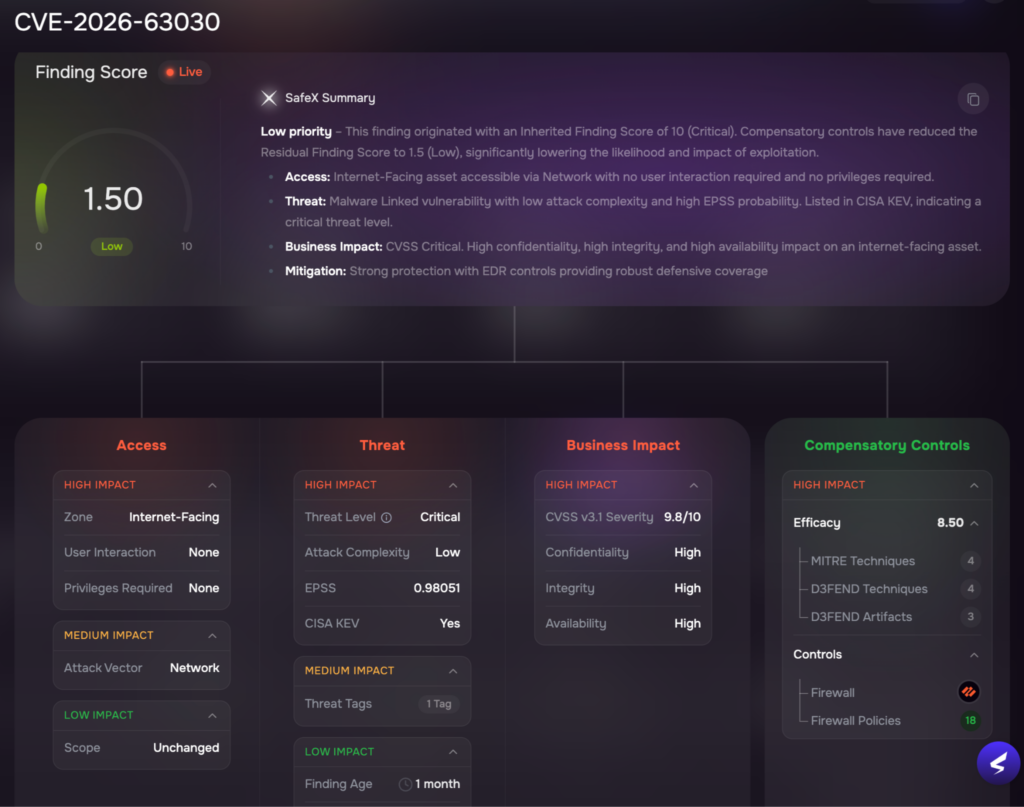
- A dynamic Finding Score, replacing static severity scores – continuously weighing business impact alongside exploitability as telemetry, threat, and context signals change, evaluated across 25+ parameters.
- Business context first – asset criticality, business service impact, ownership, internet exposure, network accessibility, and environment – so a finding touching a critical business service is treated that way instead of ranking equally with a dev-box finding at the same CVSS.
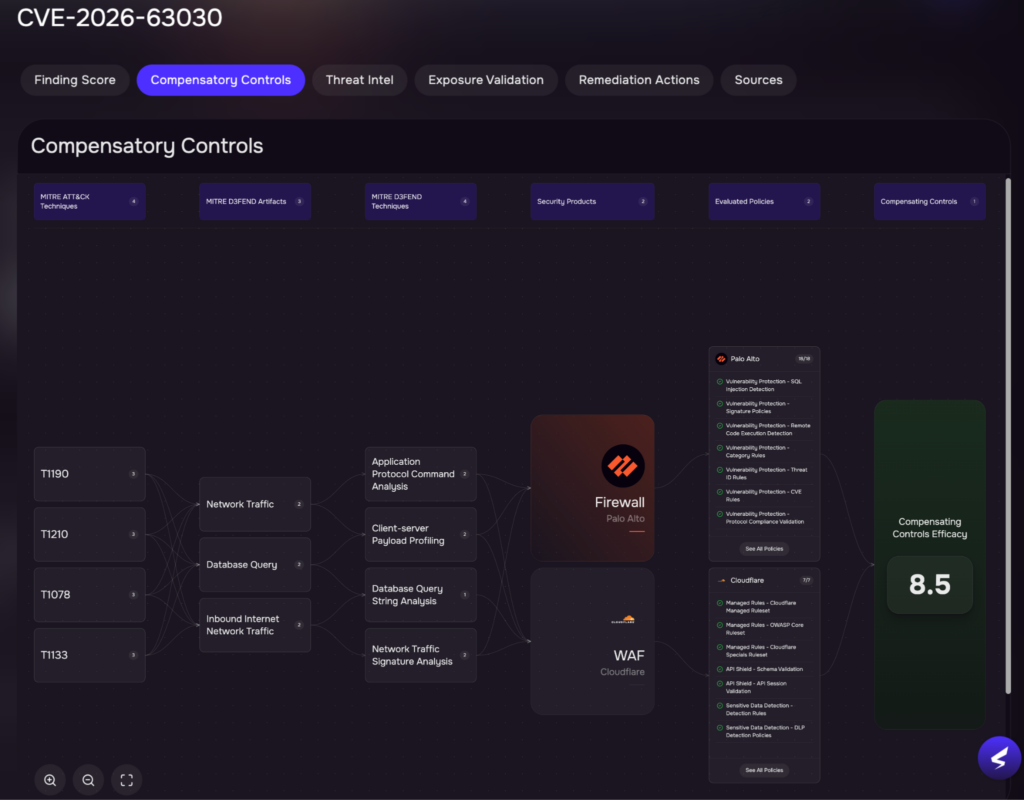
- Compensatory control analysis answers one question for every finding: if this were exploited today, would something already stop it? SAFE CTEM traces each finding through a single, explainable chain rather than just checking a box for “EDR deployed” or Firewall deployed:
- Finding – what’s actually vulnerable.
- MITRE ATT&CK Technique -determines how an attacker could potentially exploit or abuse the vulnerability.
- MITRE D3FEND Artifact & Technique – what kind of defensive technique and artifact capable of countering that attack behavior.
- Evaluate Security Product – assesses whether deployed tools like EDR, Firewalls, WAFs, and system hardening configurations are active and capable of providing the necessary defense.
- Relevant Policy – whether that security product’s actual configuration and policies are enabled and capable of preventing or detecting the activity.
- The result: a critical finding that’s already substantially mitigated doesn’t compete for the same urgency as one sitting wide open.
- Threat intelligence from multiple sources – CISA KEV, public and proof-of-concept exploits or weaponized, active ransomware campaigns and botnet activity, known threat actors and malware families, and mappings to CWE, MITRE ATT&CK, and D3FEND – tells a team not just what’s vulnerable, but what’s actually being exploited right now
- SAFE CTEM automatically aligns your remediation strategy with CISA BOD 26-04 guidelines. We prioritize vulnerabilities by focusing on the critical risk factors that matter most, moving beyond generic severity scores:
-
- Asset Exposure: We identify if the asset is internet-facing, where the risk is highest.
- CISA KEV Status: We instantly check if a vulnerability is listed in the CISA Known Exploited Vulnerabilities (KEV) Catalog.
- Exploit Automation: We flag vulnerabilities with readily available, weaponized exploits, allowing you to act before attackers do.
- Technical Impact: We analyze whether a potential exploit could result in ‘Total’ vs. ‘Partial’ control of your systems, helping you prioritize the most damaging threats first.
By integrating these factors, SAFE CTEM ensures your remediation efforts are driven by real-world exploitability and business risk, rather than severity alone.
- Explainable scoring – every Finding Score breaks down across four dimensions: Access, Threat, Impact, and Compensatory Controls, so an analyst, a remediation owner, and a CISO are all looking at the same reasoning.
- Direct links to remediation – every finding traces back to the vulnerable software component, giving a straight line from score to affected assets, business owner, and remediation path.
- Defensible list of what to fix first with the reasoning already attached – once everything is factored in together, only a small fraction of findings come out the other side as genuinely high priority, instead of a spreadsheet nobody has time to interpret.
Next in this series: In our final post, we will dive into Validation and Mobilization. We will show how SAFE CTEM proves real-world exploitability, accelerates remediation, and unites first-party exposure management with cyber risk quantification.
Related Posts
 Cybersecurity
10 Most Common Cybersecurity Blind Spots
Nearly 90% of cyberattacks are caused by human error, so it’s important to understand and address your organization’s cybersecurity weak spots. Many organizations struggle to maintain a clear…
Cybersecurity
10 Most Common Cybersecurity Blind Spots
Nearly 90% of cyberattacks are caused by human error, so it’s important to understand and address your organization’s cybersecurity weak spots. Many organizations struggle to maintain a clear…
 Blog
2025 in Retrospect: SAFE Steers the Industry Towards Autonomous Cyber Risk Management
By: Sweta Bhattacharya 2025 wasn’t just a milestone year for SAFE: it was the year the entire cyber risk management landscape shifted. Every major shift in the SAFEOne…
Blog
2025 in Retrospect: SAFE Steers the Industry Towards Autonomous Cyber Risk Management
By: Sweta Bhattacharya 2025 wasn’t just a milestone year for SAFE: it was the year the entire cyber risk management landscape shifted. Every major shift in the SAFEOne…