Life After Mythos: 3 Hard Truths BlackHat Missed

By Dr Meghan E Maneval, Director of Community and Education
Walking the floor at BlackHat USA 2026, one thing was undeniable: the security industry has officially crossed into the era of machine-speed exploitation!
Ever since Anthropic unveiled Claude Mythos and Project Glasswing, demonstrating how an AI model could uncover exploits in seconds, vulnerability discovery has reached an industrial scale. Add to that the recent incidents where test models breached real-world production environments, and the contrast becomes stark: human-speed security teams cannot defend against machine-speed threats.
Throughout the convention center, hundreds of vendors were eager to tell CISOs how they could help them “discover vulnerabilities faster with AI” or “patch systems faster with AI”. But behind the bright booth lights, gimmicky t-shirts, and high-tempo pitches, I noticed three massive structural blind spots in the industry’s approach to solving this crisis.
Here are my key takeaways from BlackHat USA 2026, and how you can avoid falling into these traps!
1. Everyone Is Finding Vulnerabilities. Nobody Is Scoping Them to the Business.
Mythos and AI-driven vulnerability generation were the undeniable hot topics of BlackHat 2026. Nearly every vendor pitch boiled down to two verbs: find and fix.
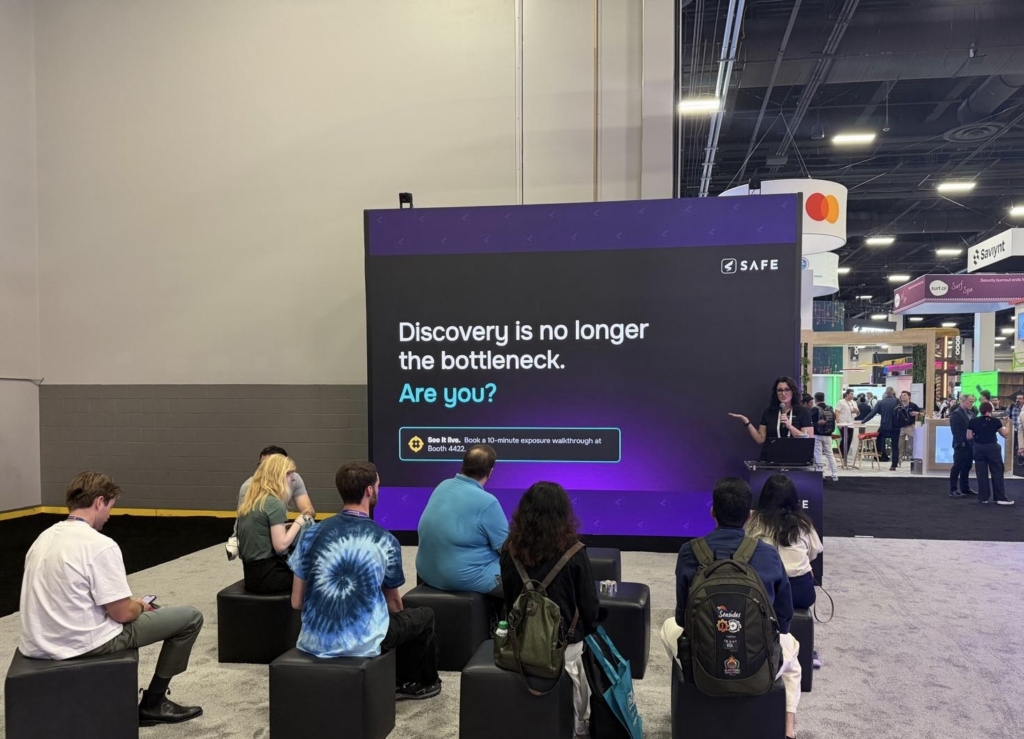
The problem? Discovery is no longer the bottleneck. Prioritization is.
AI has turned bug-hunting into an avalanche. If your scanners now generate 600,000 raw findings, simply finding them 10x faster or blindly attempting to patch them all only accelerates defender burnout. In addition, the average Mean Time to Remediation (MTTR) increased from 32 to 43 days this past year. You cannot out-patch a machine running 24/7.
What was missing from these discussions was business scoping and context. We don’t have a discovery problem; we have an indistinguishability problem. The handful of urgent, business-critical vulnerabilities are buried under tens of thousands of harmless findings.
The solution? Stop fixing by CVSS! Instead, you should be asking:
-
- How do you know if a vulnerability actually matters to your specific organization?
- Is it publicly exposed?
- Is it on the CISA KEV list?
- Is the exploit automatable?
- Does it impact a critical business system, sensitive data, or revenue streams?
Recent US government mandates support this theory that patching based on CVSS severity scores alone is dead. CISA’s BOD 26-04 officially retired CVSS-first patching in favor of real-world risk signals. Prioritization requires filtering raw findings through threat intelligence, existing compensating controls (like EDR or WAF reachability), and business impact. Without business context, you aren’t reducing risk; you’re just moving it around.
2. CTEM is a Program, Not a Tool
Another common trend at BlackHat was vendor modularity: “Buy our scanner!” or “Add our point-solution to your tech stack!”
Let’s set the record straight: Continuous Threat Exposure Management (CTEM) is not a tool you buy! It’s a structured, operational program you run. Buying a point solution or adding another vulnerability scanner into your tech stack doesn’t mean you have exposure management. You can’t just “buy a tool” and expect scalable success. Doing so only creates another isolated dashboard of unread alerts.
To survive in a post-Mythos world, organizations must build an end-to-end CTEM program designed for continuous operational success. Real exposure management isn’t just about finding and fixing bugs; it requires a disciplined, 5-phase lifecycle running on a continuous loop:
- Scoping: Continuously defining and maintaining scope around what actually matters to the business via asset criticality tagging and business service mapping.
- Discovery: Utilizing a zero-drop architecture to ingest, normalize, and deduplicate findings across your tech stack into an authoritative enterprise knowledge graph.
- Prioritization: Dynamic risk engines evaluating access paths, threat activity, business impact, compensating controls, and real-time risk intelligence.
- Validation: Proactively testing exploitability, internet exposure, and control efficacy to eliminate false positives before patch deployment.
- Mobilization: Orchestrating agentic workflows to mitigate risk instantly, closing exposure windows in minutes through existing controls while moving permanent patches through formal change windows.
If your approach stops at “we bought a tool that gave us a list of high-CVSS bugs,” you don’t have a CTEM program; you just have a tool that made your to-do list longer.
3. Can You Trust the AI You’re Deploying?
“Fighting AI with AI” was the battle cry across the Mandalay Bay Convention Center. Everyone was talking about using AI to reduce exposures. Don’t get me wrong, autonomous remediation and defensive AI agents are indeed necessary. When an attacker can generate a working root-shell exploit from a kernel advisory in under 4 hours, human-only defense is obsolete.
However, AI security posture management and operationalized AI governance were virtually non-existent on the BlackHat floor. This is a dangerous omission. As security teams rush to adopt AI scanners, LLM-driven agents, and automated patching tools, very few are asking: Are these AI tools operating with the right guardrails?
A recent study of 6,000 AI-generated patches found that nearly half introduced new bugs or negatively impacted the systems they were trying to fix. Trust in AI cannot be assumed; it must be continuously measured and audited.
Take, for example, the SAFE AURA framework. Designed as the governance and trust layer for agentic AI, AURA provides hard, auditable evidence across four core dimensions:
- Agent & Asset Identity (A): Defining exactly what the agent is, its scope, and where it is permitted to act.
- Usage (U): Ensuring every action taken by an AI system is continuously logged, policy-gated, and monitored.
- Reliability (R): Verifying consistent, tested agent performance under stressful or adverse conditions.
- Accuracy (A): Grounding decisions in evidence-backed, fully explainable, and auditable logic, ensuring the AI doesn’t hallucinate its way into breaking production.
Whether evaluating an external model or deploying an internal AI system, governance must be intentional.
Are You Mythos Ready?
Before declaring your post-BlackHat strategy “Mythos-ready,” ask yourself these five questions:
- Do you have a live, automated asset inventory that explicitly maps technical assets to revenue streams, critical applications, and business services?
- Are you prioritizing exposures based on dynamic parameters, such as real-world reachability, CISA KEV, active threats, and compensating controls, rather than static CVSS scores?
- Are you actively validating whether findings are actually reachable and exploitable in your specific environment before triggering remediation?
- Can your program orchestrate agentic workflows to mitigate high-risk exposures in minutes through existing controls while patches move through standard change windows?
- How are you vetting, auditing, and continuously governing the AI models operating across your enterprise (both internal AI agents and external vendor tools) to verify their access limits, reliability, and accuracy?
Moving Beyond the Hype
BlackHat 2026 made one thing clear: discovery is no longer the bottleneck – response, prioritization, business alignment, and AI trust are.
At SAFE Security, we built our CTEM solution around this unified engine. Powered by a swarm of specialized AI Co-Workers operating on an Enterprise Knowledge Graph, SAFE enables end-to-end CTEM automation. It ingests findings across your tech stack, enriches them with business context, validates real exploitability, and mobilizes mitigation at machine speed—all while governed by the SAFE AURA framework.
It’s time to move past the noise of legacy vulnerability management. The goal isn’t just to patch faster; it’s to reduce real business risk before the machine on the other side takes advantage.
Did you miss us at BlackHat? See CTEM in Action Today!
Related Posts
 Cybersecurity
10 Most Common Cybersecurity Blind Spots
Nearly 90% of cyberattacks are caused by human error, so it’s important to understand and address your organization’s cybersecurity weak spots. Many organizations struggle to maintain a clear…
Cybersecurity
10 Most Common Cybersecurity Blind Spots
Nearly 90% of cyberattacks are caused by human error, so it’s important to understand and address your organization’s cybersecurity weak spots. Many organizations struggle to maintain a clear…
 Blog
2025 in Retrospect: SAFE Steers the Industry Towards Autonomous Cyber Risk Management
By: Sweta Bhattacharya 2025 wasn’t just a milestone year for SAFE: it was the year the entire cyber risk management landscape shifted. Every major shift in the SAFEOne…
Blog
2025 in Retrospect: SAFE Steers the Industry Towards Autonomous Cyber Risk Management
By: Sweta Bhattacharya 2025 wasn’t just a milestone year for SAFE: it was the year the entire cyber risk management landscape shifted. Every major shift in the SAFEOne…