From Exposure Backlogs to Verified Remediation


Series: Understanding CTEM and Why It Matters | Part 3 of 3: Validation and Mobilization
Until now we explored why 25 years of vulnerability management hasn’t actually made organizations more secure, and started walking through how Gartner’s Continuous Threat Exposure Management (CTEM) framework fixes that – a five-phase program that shifts the question from “what did we find?” to “what actually matters, and are we doing anything about it?”
As before, for each phase we’ll cover the practitioner expectation is really pointing at, and the SAFE CTEM differentiator that solves it – for the use case itself, and for how easily a team can adopt it.
[For Phases 1 – 3, please read Part II of the series]
Phase 4: Validation – Prove What’s Actually Exploitable
Practitioner Expectation: Validating whether identified exposures could realistically be exploited in the current environment, and whether existing controls would stop them.
The Practitioner Problem:
- Even with a short, well-reasoned priority list, nobody actually knows for certain which of those findings can be exploited here – the list still represents theoretical exposure, not proven exploitability.
- Without validation, SecOps teams end up spending remediation effort on exposures that were never a real risk in their specific environment.
- Manual validation – red team engagements, one-off pentests – doesn’t scale to the volume of findings a continuous program surfaces every day.
- Waiting on periodic manual testing means a finding can sit “prioritized” for weeks before anyone confirms it’s actually worth fixing first.
How SAFE CTEM Solves It: Industry’s First AI-Driven Exploit Mutation and Validation Engine with 2000+ Active Exploits
- Natively validate reachability and exploitability before initiating remediation. SAFE tests multiple exploit mutations against targets, rather than static proofs-of-concept to accurately mirror real-world attack techniques.
- 2,000+ live exploits, continuously maintained and updated, available to validate top-priority findings against any known or unknown threats.
- Validation checks whether existing compensatory controls (EDR, WAF, hardening) actually stop the exploit attempt in practice – not just whether they’re theoretically mapped to the technique.
- No red team engagement or manual pentest cycle required for every prioritized finding – validation runs continuously as part of the pipeline, so remediation bandwidth goes only to findings proven exploitable in the current environment, not everything that merely looks scary on paper.
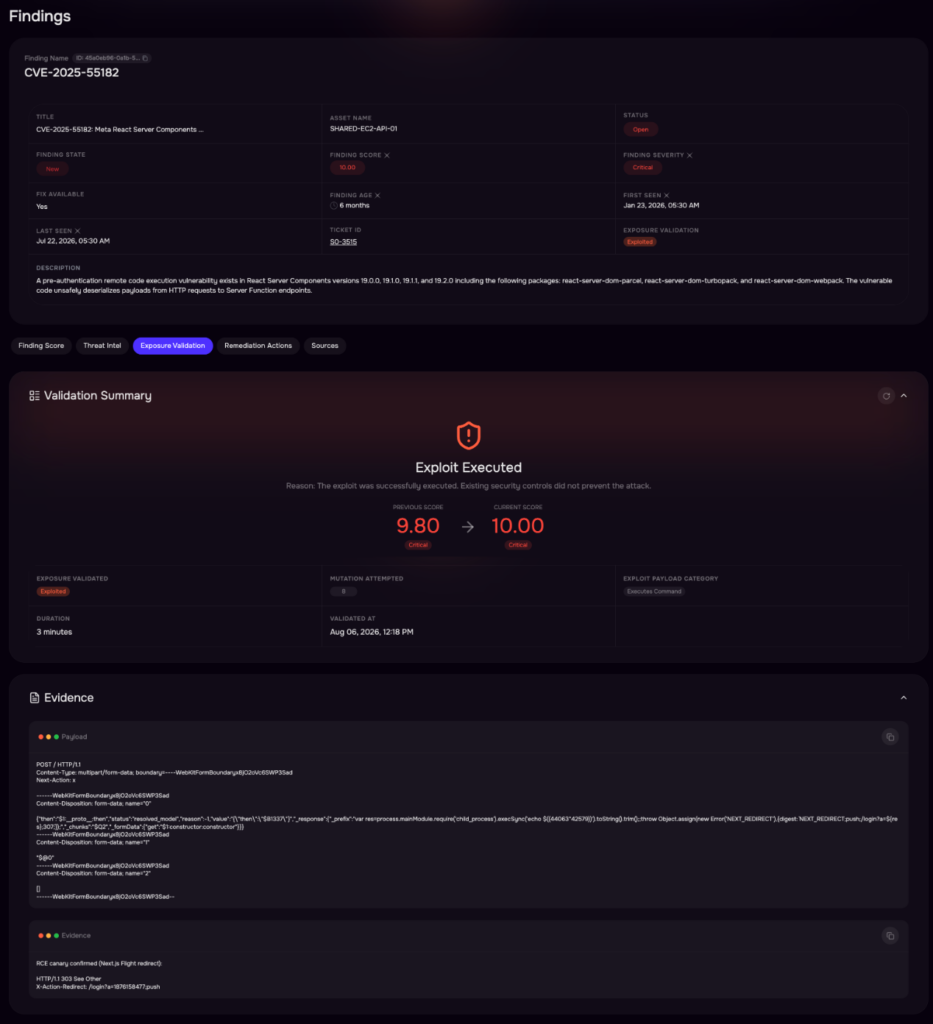
SAFE CTEM Exposure Validation Carvana Got 200% ROI in Less Than 9 Months- 25% lower insurance premiums
- 2x insurance coverage
Phase 5: Mobilization – Get It Fixed, Fast
Practitioner Expectation: Mobilizing the right stakeholders and processes to remediate validated exposures effectively.
The practitioner problem:
- Findings are prioritized and validated, but remediation still stalls on manual coordination between security, IT, and business owners.
- Without the ability to mobilize well, either nothing gets done, or remediation takes lots of painful, manual effort – chasing ticket owners, coordinating patch windows, confirming fixes landed.
- Every additional manual hand-off adds delay, and the underlying exposure stays live the whole time it sits in someone’s queue.
How SAFE CTEM solves it: 1000+ Agentic Workflow Templates. 100+ Agents to Ingest, Reason, and Act
- Mobilization is more than just opening a ticket. It ensures the right owner acts, governs exceptions, escalates overdue work, and independently verifies that exposures are fully closed.
- Fully customizable agentic workflows drive autonomous remediation, minimizing manual hand-offs.
- Governed, context-rich tickets are automatically routed to the correct owners in ServiceNow or Jira, leveraging the criticality and ownership data established during scoping and discovery.
- Integrated remediation management includes bidirectional sync, SLA tracking, automated escalation, policy-governed exceptions, and independent verification.
- Workflows seamlessly plug into existing processes, providing remediation owners with fully justified tickets—including asset details, validated exploitability, and business impact—so they can act immediately without needing to research the finding.
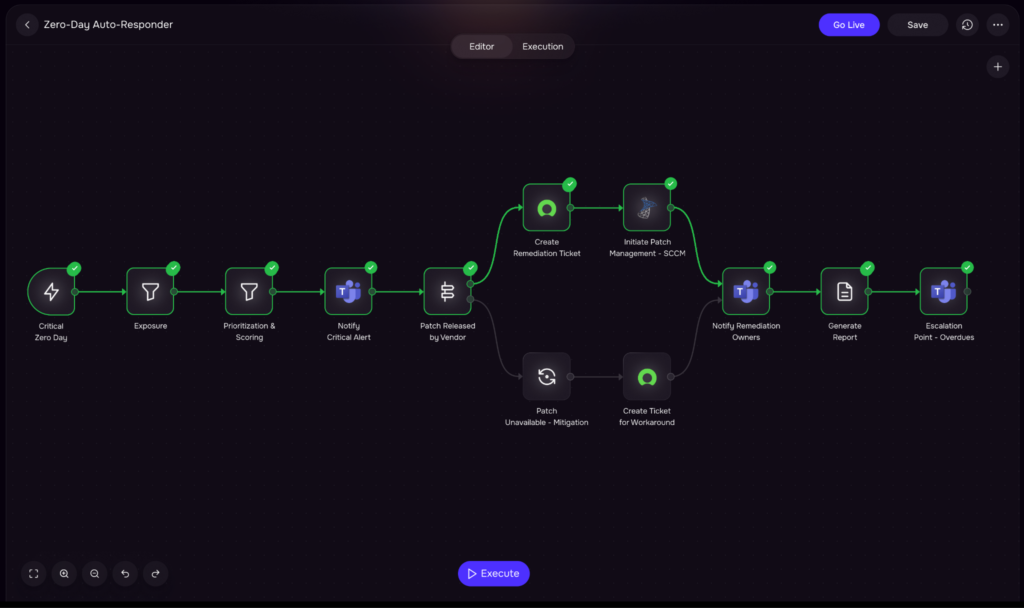
SAFE CTEM Agentic Workflow
Tying It Together: SAFE One
The SAFE CTEM AI Co-Worker ties all five phases together: an autonomous system orchestrating a swarm of 100+ AI agents that runs Scoping through Mobilization as one continuous loop, unifying data across 150+ tools with a Zero Data Loss Guarantee. Customers see a 70% reduction in critical exposures and 40% faster MTTR, and Gartner named SAFE a 2025 Visionary in Exposure Assessment Platforms.
CTEM answers the first-party question – what’s exposed, exploitable, and getting fixed. Two questions still sit outside it: what about third-party risk, and what does this mean in dollars? SAFE One closes both by integrating SAFE CTEM with CRQ (Cyber Risk Quantification) and SAFE TPRM (Third-Party Risk Management):
- SAFE TPRM AI Co-Worker extends the same continuous discipline to vendors – agentic workflows automate assessment, monitoring, and remediation, instead of a point-in-time questionnaire that goes stale the day it’s submitted
- SAFE CTEM AI Co-Worker, fully integrated with SAFE CRQ, forms a single First-Party Risk Management layer that turns findings into business risk: risk scenarios model specific ways the business could be harmed, likelihood and loss magnitude combine into Annualized Loss Expectancy (ALE), and risk treatment shows what each fix buys back in ALE – dollar terms a board can act on
SAFE CTEM is the only exposure management platform with a native SAFE CRQ built in, rather than exporting findings to a separate GRC tool to price later. That’s borne out externally too: SAFE was named a Leader in The Forrester Wave™: Cyber Risk Quantification Solutions, Q2 2025, with the highest score in 21 criteria, #1 in Strategy, and called out as the most comprehensive CRQ-native solution in the market.
That’s the full loop: CTEM, integrated with CRQ, proves what’s exploitable in dollar terms, and TPRM extends that same rigor to every vendor – turning 25 years of unusable vulnerability data into a short list of what matters, validated, moving toward fixed, and priced in terms the business already understands.
Related Posts
 Cybersecurity
10 Most Common Cybersecurity Blind Spots
Nearly 90% of cyberattacks are caused by human error, so it’s important to understand and address your organization’s cybersecurity weak spots. Many organizations struggle to maintain a clear…
Cybersecurity
10 Most Common Cybersecurity Blind Spots
Nearly 90% of cyberattacks are caused by human error, so it’s important to understand and address your organization’s cybersecurity weak spots. Many organizations struggle to maintain a clear…
 Blog
2025 in Retrospect: SAFE Steers the Industry Towards Autonomous Cyber Risk Management
By: Sweta Bhattacharya 2025 wasn’t just a milestone year for SAFE: it was the year the entire cyber risk management landscape shifted. Every major shift in the SAFEOne…
Blog
2025 in Retrospect: SAFE Steers the Industry Towards Autonomous Cyber Risk Management
By: Sweta Bhattacharya 2025 wasn’t just a milestone year for SAFE: it was the year the entire cyber risk management landscape shifted. Every major shift in the SAFEOne…