RiskLens is now part of SAFE - Safe Security
RiskLens, a SAFE company

RiskLens is now part of SAFE

The FAIR-based cyber risk quantification you know from RiskLens, now built into the SAFE platform. Quantify cyber risk in dollars, automatically and continuously.

  • FAIR-based quantification, built by the team behind the standard
  • Loss exceedance and dollar-based risk, automated
  • Now built into our CTEM and TPRM AI Co-Workers
  • From data to board-ready reporting

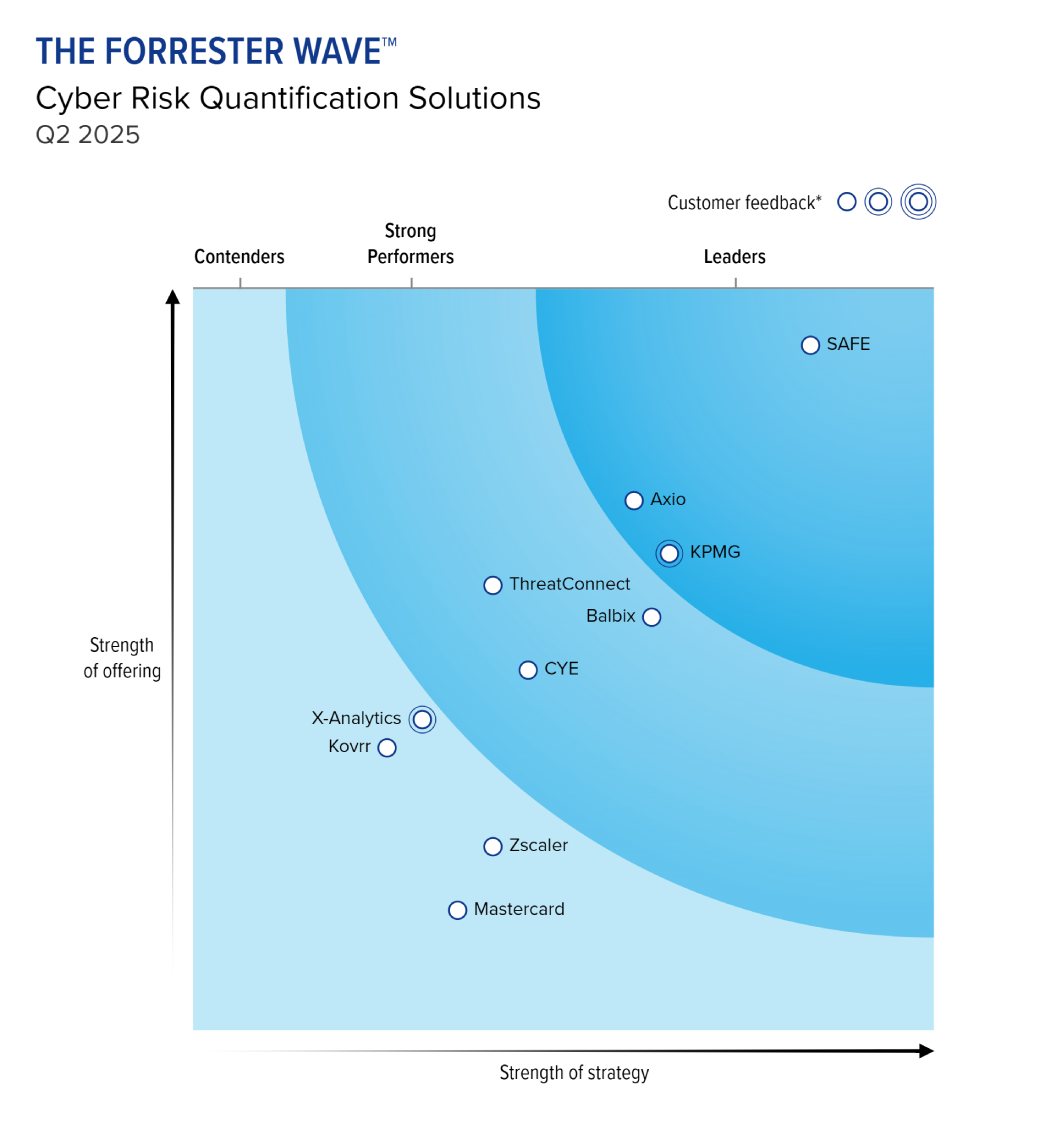
Trusted by 10% of the Fortune 500 Leader, The Forrester Wave: Cyber Risk Quantification 2023

Book your SAFE demo

Tell us where to reach you, then pick a time on the next screen.

The news

RiskLens is part of SAFE.

RiskLens, the pioneer of the FAIR cyber risk quantification standard, is now part of SAFE. The methodology has not changed. What changed is that it now runs automatically inside the CTEM and TPRM AI Co-Workers you already use to manage exposure and third-party risk.

If you are a RiskLens user

FAIR continues, and so does the team behind it. The same decision science you built your program on now runs on a platform that automates the analysis instead of asking you to assemble each one by hand.

If you are evaluating CRQ

Quantification runs inside our CTEM and TPRM AI Co-Workers, so the dollar figure is produced by the same system that finds the exposure and drives the fix, rather than by a separate modelling exercise alongside it.

Why it moved into the products

Point-in-time assessments with subjective manual inputs cannot keep pace when zero-day attacks do not wait for an annual risk review. Automating FAIR was the step practitioners had been asking for: the rigor and defensibility of the model, at the speed and scale of the data.

What that gives you

Risk is quantified continuously from the signals already flowing through the platform, rather than re-modelled each quarter. The number on the board slide is the same number the platform used to prioritize the work.

The standard

One model,
four applications.

FAIR expresses cyber events as a probable frequency and magnitude of loss, in dollars. Its extensions cover controls, materiality and third parties, and we automate all of them.

  1. 01 FAIR Cyber events priced in business terms
  2. 02 FAIR-CAM The effect of controls on risk
  3. 03 FAIR-MAM Materiality, before and after an incident
  4. 04 FAIR-TAM Third-party cyber risk

We automate all four. FAIR-CAM measures how much a control actually reduces loss, FAIR-MAM assesses materiality before, during and after an incident, and FAIR-TAM prices third parties by the financial impact and likelihood of an attack. Book a meeting above to see them run on your data.

How it works

Quantification,
running inside the products.

Four things change when FAIR stops being a separate exercise and starts running on the platform that already holds your exposure and vendor data.

01 The model

FAIR-based modelling, not a proprietary score

What it means

FAIR decomposes risk into how often a loss event is likely and how much it would cost, then expresses it in dollars. It is accredited as an industry standard by The Open Group, so the logic behind a number is inspectable and defensible rather than a vendor black box.

How we do it

We built SAFE One on the FAIR model and automate the extensions with it: FAIR-CAM for control efficacy, FAIR-MAM for materiality, FAIR-TAM for third-party risk.

FAIR the standard RiskLens pioneered, now automated on the platform

02 The output

Risk expressed in dollars

What it means

Quantification expresses risk through likelihood, loss magnitude and annualized loss exposure, so exposures and vendors can be ranked against each other in the same units the business already plans in.

How we do it

A Financial Quantification Agent produces the figures continuously, and an Enterprise Aggregation Agent rolls them up and down by scenario, business unit, application and geography.

$ is the unit, so security work can be compared to any other investment

03 The cadence

Continuous, not point-in-time

What it means

Point-in-time assessments with subjective manual inputs go stale between reviews. Zero-day attacks do not wait for an annual risk cycle, so the analysis has to refresh as the underlying data does.

How we do it

Risk updates from the signals already flowing through the platform rather than from a re-modelling exercise, so the number is current when someone asks for it.

5,000+ out-of-the-box risk scenarios behind the modelling

04 The delivery

Built into CTEM and TPRM

What it means

The same model runs inside both AI Co-Workers, pricing an exposure on your own asset and a vendor in your supply chain in the same dollars.

How we do it

In our CTEM AI Co-Worker it drives a quantification-based scoping engine and ties findings to business impact. In our TPRM AI Co-Worker it prices each vendor as a loss scenario, so the portfolio ranks by dollars at stake.

2 AI Co-Workers, one quantification engine, one dollar scale

See both in your demo
The outcomes

What a defensible number
is actually for.

Board-ready reporting

Quantified risk becomes decision-ready reporting for every stakeholder, including defensible regulatory reports for the SEC, NYDFS and others. Prompt-built dashboards cover CISOs, CFOs, boards and business leaders without a manual rebuild each quarter.

Spend prioritized by dollar risk

Treatment plans can be compared by cost, risk reduction and ROI, and what-if analysis models how each initiative changes loss likelihood and financial impact. Budget justification stops being an argument about severity counts.

Numbers you can defend

Because the model is an accredited open standard rather than a proprietary rating, every figure traces back to its inputs. FAIR-CAM ties control investments to measurable risk reduction instead of guesstimates.

Trusted By 10% of Fortune 500

  • T-Mobile
  • Fannie Mae
  • Verizon
  • Honeywell
  • S&P Global
  • HP
  • AAA
  • ADP
  • Chipotle
  • Snap Inc.
See It

See it run in CTEM,
from ingestion to a quantified fix.

Quantification is built into our CTEM AI Co-Worker, so watch it in place: ten minutes, fifteen chapters, real data. One email for the full walkthrough.

Chapter 01

Introduction

0:00 / 0:00

Chapters

No form fatigue, one email, full video walkthrough.

FAQ

Questions we get
about RiskLens and SAFE.

RiskLens is now part of SAFE, and the FAIR-based quantification it pioneered lives on inside the SAFE platform rather than as a separate tool. If you are a RiskLens customer or evaluating what replaced it, the answer is SAFE: the same model, automated, and delivered inside our CTEM and TPRM AI Co-Workers. Book a meeting above and we will map your current RiskLens usage onto the platform.

RiskLens, the pioneer of the FAIR cyber risk quantification standard, is now part of SAFE, and the FAIR decision science methodology is embedded into the SAFE platform. The intent was to automate FAIR: keep the rigor and defensibility of the model, and remove the manual assembly that made each analysis a project.

Yes. We built SAFE One on the FAIR model, which is accredited as an industry standard by The Open Group and stewarded by the FAIR Institute. We automate the FAIR family alongside it: FAIR-CAM for the effect of controls on risk, FAIR-MAM for materiality before, during and after an incident, and FAIR-TAM for third-party cyber risk.

The same quantification engine runs inside both AI Co-Workers. It drives the scoping and business-impact analysis in our CTEM AI Co-Worker and prices each vendor as a loss scenario in our TPRM AI Co-Worker. Because it is the same engine in both, an exposure on your own asset and a risk from a third party are expressed in the same units and can be ranked against each other.

Endorsed by Leading Analysts

Book a meeting

The FAIR model you already trust.
Automated, continuous, and priced in dollars.

Book a Meeting