Able2Shell: Public Exploit Chains Put N-central Management Infrastructure at Risk

Overview
On November 9, 2026, N-able took its hosted N-central environments offline following the public disclosure of 33 reported vulnerabilities, collectively named Able2Shell. The disclosure included proof-of-concept (PoC) exploits describing multiple attack paths, including unauthenticated access, remote code execution (RCE), and privilege escalation.
N-able responded with an emergency security update, N-central 2026.4 Hotfix 2 (HF2), on November 10, addressing seven CVEs with CVSS 4.0 scores ranging from 8.3 to 9.3.
N-central is a Remote Monitoring and Management (RMM) platform used by IT teams and Managed Service Providers (MSPs) to manage endpoints, execute scripts, and deploy software across customer environments. A compromised N-central server could allow attackers to abuse these management capabilities and gain access to downstream systems, potentially affecting multiple organizations.
As of November 12, N-able has acknowledged scanning activity associated with the published PoC but reports no indications of compromise within its hosted infrastructure. The vendor states that HF2 addresses all identified vulnerabilities exploitable without authentication, with further fixes planned for the remaining findings.
Vulnerability at a Glance
| Attribute | Details |
| Name | Able2Shell |
| Affected product | N-able N-central |
| Initial public disclosure | November 9, 2026 |
| Reported vulnerabilities | 33, according to the researcher |
| CVEs addressed in HF2 | 7 |
| CVSS 4.0 | 8.3 – 9.3 (High – Critical) |
| Vulnerability classes | XXE, SSRF, OGNL injection, path traversal, stored XSS, privilege escalation |
| Potential impact | Credential exposure, administrative compromise, RCE, root-level access |
| Fixed build for the first seven CVEs | 2026.4.1.26 |
| Exploitation status | Public PoC available; scanning activity observed. No confirmed successful compromise reported as of November 12, 2026. |
| Remediation | Apply HF2, upgrade Agents and Probes, and monitor for further hotfixes |
Technical Analysis: What Makes Able2Shell Dangerous?
Able2Shell comprises multiple vulnerabilities affecting N-central’s authentication mechanisms, XML processing, file handling, application services, and privileged system utilities. The weaknesses include unauthenticated access to internal resources, remote code execution (RCE), and local privilege escalation.
N-able addressed seven CVEs in N-central 2026.4 Hotfix 2 (HF2). These vulnerabilities affect different components and have distinct prerequisites for exploitation. Public research also describes exploit chains that combine multiple weaknesses to achieve higher levels of access.
Seven CVEs Addressed by N-central HF2
| CVE | Vulnerability | CVSS 4.0 | Potential impact |
|---|---|---|---|
| CVE-2026-125883 | XML External Entity (XXE) injection | 9.3 | Unauthorized XML processing and access to internal resources |
| CVE-2026-125881 | Server-Side Request Forgery (SSRF) | 9.3 | Server-side requests to unintended destinations |
| CVE-2026-125878 | OGNL injection | 8.7 | Remote code execution |
| CVE-2026-125879 | Insecure syslog-ng configuration | 8.6 | Local privilege escalation to root |
| CVE-2026-125882 | File repository path traversal | 8.6 | Remote code execution |
| CVE-2026-91000 | Insecure IPC channels | 8.4 | Local privilege escalation |
| CVE-2026-125880 | Stored cross-site scripting (XSS) | 8.3 | Script execution in an administrator’s browser context |
Source: N-able HF2 Release Notes
1. XXE and SSRF: Unauthorised Access to Internal Resources
CVE-2026-125883 and CVE-2026-125881 | Critical | CVSS 9.3
Both vulnerabilities affect the processing of untrusted XML content within N-central’s service-import functionality.
- XXE (CVE-2026-125883): Improperly restricted XML external entities can allow attacker-controlled XML to reference local files or internal services. The disclosed research describes an unauthenticated XXE path that can retrieve a trusted internal session and form part of a chain leading to command execution as the nable service account.
- SSRF (CVE-2026-125881): The service-import schema validation process accepts schema references that can influence outbound requests made by the N-central server. An unauthenticated attacker may be able to induce requests to internal or external destinations that would otherwise be inaccessible directly.
The two vulnerabilities demonstrate how externally supplied XML content can cross application trust boundaries. While SSRF enables unintended server-side requests, the researcher’s XXE exploit chain describes additional steps involving session access and account manipulation to reach RCE.
2. OGNL Injection: Server-Side Code Execution
CVE-2026-125878 | High | CVSS 8.7
Object-Graph Navigation Language (OGNL) is an expression language used in Java applications to access objects and evaluate expressions.
An OGNL injection vulnerability occurs when untrusted input is interpreted as an expression rather than ordinary application data. Depending on the evaluation context, this can allow an attacker to invoke application methods or execute commands.
N-able identifies multiple OGNL injection vulnerabilities in N-central. The public research describes how OGNL injection can be incorporated into an exploit chain involving stored XSS and an authenticated administrator’s session.
Successful exploitation can result in command execution within the application’s security context. The privileges obtained depend on the affected process and any additional vulnerabilities used in the chain.
3. Path Traversal: File Upload to Remote Code Execution
CVE-2026-125882 | High | CVSS 8.6
This vulnerability affects N-central’s file repository upload functionality.
Path traversal occurs when an application does not adequately restrict user-controlled file paths, allowing files to be written outside their intended directories.
N-able identifies this issue as an RCE vulnerability. Under the required authenticated and privileged conditions, an attacker could potentially manipulate file placement to reach executable locations or other sensitive resources.
The impact depends on the attacker’s existing permissions, the destination directory, and whether the affected server executes the uploaded content.
4. Stored XSS: Abuse of Administrator Sessions
CVE-2026-125880 | High | CVSS 8.3
The stored cross-site scripting vulnerability affects patch metadata processed by N-central’s MMS3 component.
An attacker with the necessary access can place malicious script content in affected metadata. When an administrator subsequently views that content, the script may execute in the administrator’s authenticated browser context. Public research describes chaining stored XSS with other application weaknesses to perform privileged operations, including reported paths to command execution.
Administrator interaction is an important prerequisite. Stored XSS alone does not provide direct operating-system command execution; the broader impact depends on the application functionality and additional weaknesses accessible through the compromised browser session.
5. Local Privilege Escalation: From Service Access to Root
CVE-2026-125879 and CVE-2026-91000 | High | CVSS 8.6 and 8.4
Two vulnerabilities addressed by HF2 allow existing lower-privileged access to be escalated.
- Insecure syslog-ng configuration (CVE-2026-125879): N-central permits the nable service account to modify configuration data consumed by a privileged syslog-ng component. An attacker with the required access can potentially exploit this trust boundary to execute commands with root privileges.
- Insecure IPC channels (CVE-2026-91000): Insufficient authentication or authorization of local Inter-Process Communication (IPC) operations can allow a lower-privileged process to access functionality intended for more privileged components, resulting in local privilege escalation.
Both vulnerabilities require an existing level of access. They are relevant to chained exploitation because an initial vulnerability that provides execution as nable may create the conditions needed for subsequent escalation to root. Root access would provide control over the N-central server’s operating system, but does not by itself demonstrate compromise of the endpoints managed by that server.
Enterprise Impact: From RMM Compromise to Downstream Risk
N-central provides centralized administrative capabilities across managed endpoints. Depending on the permissions and configuration of the compromised environment, an attacker with sufficient access could potentially abuse legitimate management features.
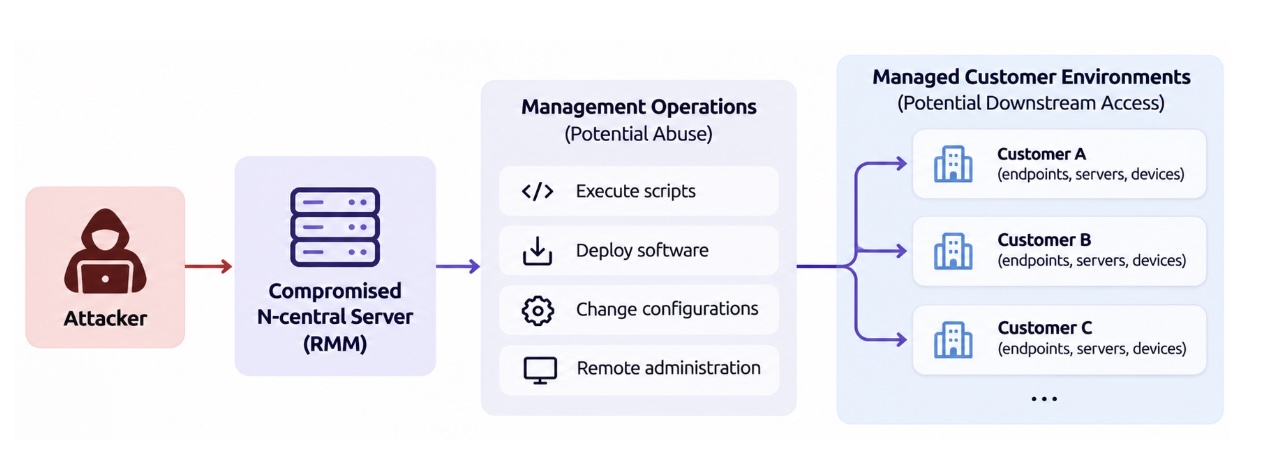
This creates three areas of risk:
- Management-server compromise: Vulnerabilities may provide unauthorized access to configuration, credentials, application functionality, or operating-system execution.
- Abuse of RMM capabilities: Administrative control could allow unauthorized script execution, software deployment, or other management operations against enrolled endpoints.
- Cross-customer exposure: MSPs often use centralized management platforms to administer multiple customer environments. A compromise of this infrastructure could create exposure across customer boundaries, depending on tenant permissions, management access, and endpoint connectivity.
Remediation and Detection
N-able released N-central 2026.4 HF2 (build 2026.4.1.26) to address the seven assigned CVEs, including all identified vulnerabilities exploitable without authentication. Additional fixes are planned for the remaining findings.
Organizations should prioritize the following actions:
- Patch N-central and Restrict Exposure
- Upgrade on-premises servers to 2026.4.1.26 or a newer vendor-approved build.
- Keep unpatched servers offline in accordance with N-able’s guidance.
- Restrict management-console access to trusted networks, VPNs, or approved administrative IP addresses.
- Track subsequent hotfixes for the remaining vulnerabilities.
- Update Agents and Probes
- Upgrade Agents first, followed by Probes, as instructed by N-able.
- Verify version compatibility and communication after upgrading.
- Check patch-management functionality, including the offline patch cache, for disruption.
- Hunt for Suspicious Activity
Review N-central server logs and managed-endpoint activity, particularly for systems exposed before patching.
| Area | What to investigate |
| Authentication | Unknown administrator accounts, password resets, or privilege changes |
| Script execution | Unrecognized scripts, scheduled jobs, or software deployments |
| File activity | Unexpected uploads, executable files, or repository changes |
| Configuration | Unauthorized syslog or privileged-service changes |
| Remote access | Unusual remote-control sessions or administrative activity |
| Managed endpoints | Unexpected processes or deployments originating from N-central |
- Assess Downstream and MSP Exposure
- Identify all endpoints, customer environments, and credentials accessible through N-central.
- Investigate unauthorized management activity on downstream systems if compromise is suspected.
- For MSP-managed environments, confirm the provider’s patch status, management-console exposure, and investigation findings.
Priority: Patch and isolate exposed infrastructure, verify Agent/Probe compatibility, and investigate suspicious management activity. A server hotfix addresses known vulnerabilities but does not remove unauthorized access an attacker may already have established.