Java4Shell (CVE-2026-114938): A Critical Java Runtime Flaw Exposes Enterprise Applications to RCE

From authentication services to CI/CD infrastructure, a memory corruption vulnerability in OpenJDK’s Base64 decoder creates potential remote code execution paths across enterprise Java applications. With patches now available, understanding the conditions that make these workloads exploitable is critical to prioritizing remediation.
Overview
On November 17, 2026, Oracle and the OpenJDK project released security updates addressing CVE-2026-114938, commonly known as Java4Shell, a memory corruption vulnerability in Java’s hardware-accelerated Base64 decoder. The vulnerability can allow unauthenticated remote code execution (RCE) when specially crafted input reaches the affected decoding implementation.
Unlike vulnerabilities confined to a particular application or third-party library, Java4Shell affects functionality within the Java runtime itself. Base64 decoding is routinely used in enterprise applications to process authentication headers, encoded tokens, API requests, and other application data. This creates a potentially broad attack surface. Applications running affected Java versions may expose vulnerable decoding operations through existing network-facing functionality, including endpoints accessible before authentication.
The vulnerability has been assigned a CVSS v3.1 score of 8.1 (High) by Oracle, reflecting significant potential impact but high attack complexity. Researchers have demonstrated remote code execution against multiple enterprise Java applications, including Jenkins, Jira, Confluence, Keycloak, JFrog Artifactory, and PingFederate under affected configurations.
However, Java4Shell is not universally exploitable across all Java environments. Exploitation requires compatible processor hardware, an affected JVM configuration, and an application path that processes attacker-controlled Base64 input.
For enterprises, these dependencies make exposure assessment particularly important. Identifying an affected Java version is the starting point; determining whether the vulnerable execution path is reachable is what establishes the actual risk.
Java4Shell: Vulnerability at a Glance
The distinction between the high severity score and the potential for unauthenticated RCE is important. CVSS reflects the vulnerability’s overall exploitation conditions, including attack complexity, rather than indicating that exploitation is trivial across every affected Java application.
Technical Analysis: How Java4Shell Exploits the Base64 Decoder
The Vulnerable Code Path
Java applications commonly use the standard java.util.Base64.Decoder class to convert Base64-encoded input into its original binary representation.
To accelerate decoding, the HotSpot JVM can replace parts of the standard implementation with CPU-specific optimized routines, known as intrinsics. On compatible x86-64 processors, Java uses AVX-512 vector instructions to process Base64 input efficiently.
Java4Shell affects this accelerated decoding path.
The vulnerability arises from incorrect handling of malformed Base64 input, particularly when padding characters are encountered near a decoding boundary. An integer underflow during output-length handling can cause the decoder to write beyond the allocated destination buffer.
Because this operation occurs within the JVM’s native optimized code, the resulting memory corruption bypasses the normal memory-safety guarantees expected from Java application code.
Understanding the Memory Corruption
Published research identifies a malformed Base64 input pattern that can trigger the vulnerability under the appropriate runtime conditions.
At a high level, the vulnerable operation proceeds as follows:
- An application receives attacker-controlled Base64-encoded data and passes it to Java’s standard decoder.
- The JVM invokes the hardware-accelerated decoding implementation when the supported CPU instructions and runtime configuration are available.
- A malformed padding boundary causes the decoder’s length-handling logic to calculate an incorrect value.
- The optimized routine performs an out-of-bounds write, corrupting adjacent heap memory.
- Depending on the affected memory objects and application execution context, the corruption can cause a JVM crash, information disclosure, or potentially arbitrary code execution.
Technical research describes an overwrite extending approximately 62 bytes beyond the intended destination buffer in affected cases.
The 65-byte malformed input described in the original vulnerability research is a useful illustration of the boundary condition, but it is not a universal trigger for every affected Java version. Different optimized decoding implementations and input-length thresholds can affect reproduction.
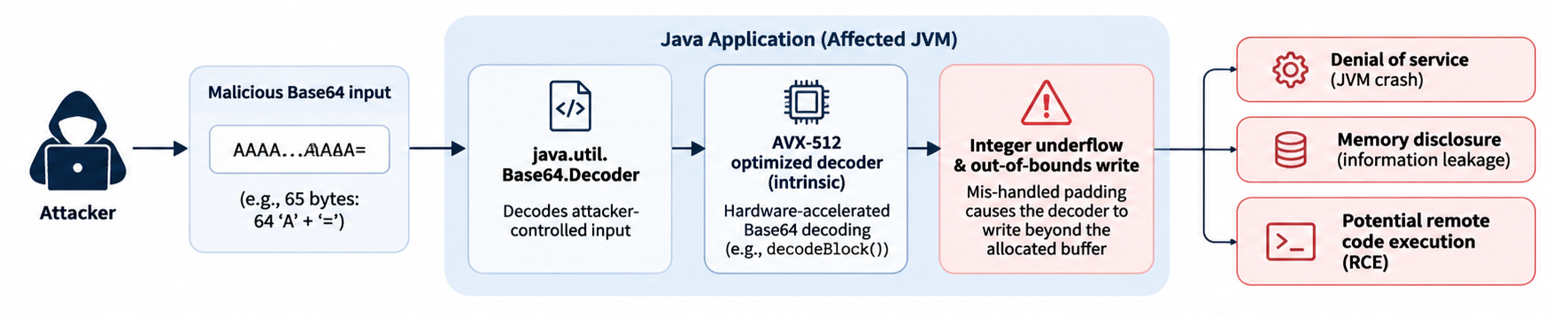
Figure 1: Java4Shell: From Malformed Base64 Input to JVM Memory Corruption
Why a Base64 Decoder Can Become a Remote Attack Surface
Base64 is an encoding mechanism, not a security control. Applications frequently decode untrusted data during routine request processing, sometimes before user authentication is complete.
Examples include HTTP Basic authentication credentials, SAML messages, encoded application tokens, and structured API payloads. An application does not need to expose a dedicated Base64 decoding endpoint to be affected. It may invoke the vulnerable decoder indirectly through authentication middleware, an application framework, or an underlying dependency.
This is what makes Java4Shell significant: a memory corruption vulnerability in a foundational runtime function can become remotely reachable through otherwise legitimate application behavior.
However, the presence of Base64-encoded input does not automatically establish vulnerability. The application must invoke the affected Java decoder with attacker-controlled data under the necessary runtime conditions.
Exploitability: Which Java Environments Are Actually Vulnerable?
Java4Shell’s potential enterprise impact is substantial, but its exploitation depends on several technical prerequisites being met simultaneously.
The processor dependency is particularly important. The vulnerable optimized implementation is automatically selected on supported systems, making modern Intel Xeon and AMD EPYC processors relevant for enterprise exposure assessment.
By contrast, ARM64 systems and older x86-64 processors without AVX-512 VBMI are not known to be affected by this specific implementation flaw.
The required instruction set must also be available to the running JVM. In virtualized environments, the capabilities exposed to a guest operating system may differ from those supported by the underlying physical processor.
These conditions create meaningful differences in exploitability between workloads running identical Java versions. A server may contain an affected runtime but lack the hardware required to execute the vulnerable intrinsic. Another server running the same Java build may expose the affected decoder through an unauthenticated application endpoint.
Enterprise Impact: One Runtime Vulnerability, Multiple Application Attack Paths
Java remains deeply embedded across enterprise infrastructure, including identity and access management, CI/CD systems, artifact repositories, application servers, and business-critical services.
Because Java4Shell affects the runtime rather than a specific application, different products may inherit the vulnerability when deployed on affected JVM configurations.
A few of the identified application-level attack paths:
These findings describe attack paths demonstrated or reported by the original vulnerability researchers on affected configurations. They should not be interpreted as evidence that every installation of these products is vulnerable, or that the listed downstream business impacts have occurred in real-world attacks.
The broader concern is the compromised application’s privilege and connectivity.
For example, a successful compromise of a CI/CD server may expose deployment credentials or access to build infrastructure. Similarly, compromise of an identity-management platform may create opportunities to access connected applications and services.
The potential blast radius therefore depends not only on the vulnerable runtime but also on the application’s privileges, network connectivity, managed assets, and access to sensitive systems.
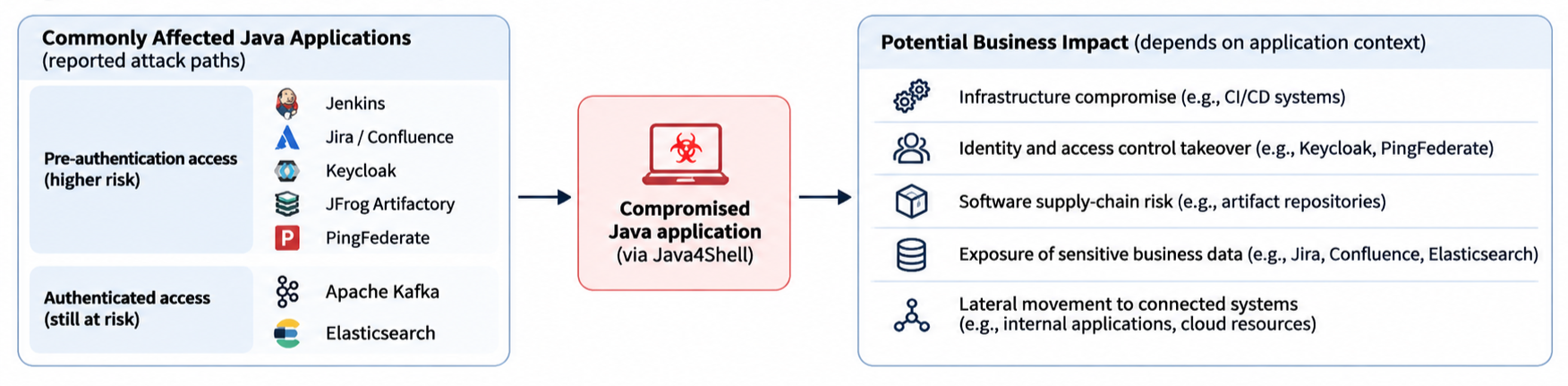
Figure 2: Potential Enterprise Impact of a Java4Shell Compromise
Remediation and Detection
Oracle’s November 17, 2026 security release provides fixes for CVE-2026-114938. Organizations should prioritize patching affected Java runtimes, particularly those supporting internet-facing applications, identity infrastructure, CI/CD platforms, and other business-critical services.
Because Java4Shell affects a specific hardware-accelerated decoding path, identifying a vulnerable Java version alone is insufficient to establish that a given version is exploitable. Exposure assessment should also consider processor capabilities, JVM configuration, and whether attacker-controlled input can reach the affected decoder.
1. Identify Affected JVMs and Hardware
Start by identifying the Java runtimes used by running applications, including those bundled with enterprise software and container images.
Check the Java version and distribution:
java -version
For running JVM processes, inspect the active runtime and startup configuration:
jcmd  VM.version

jcmd  VM.command_line
The Java executable available through the system PATH may differ from the runtime used by an application. On Linux, the executable associated with a running process can also be identified using:
readlink -f /proc//exe
Verify processor capabilities
The affected AVX-512 accelerated Base64 decoding path requires an x86-64 CPU exposing the following instruction sets:
avx512f

avx512bw

avx512vbmi

bmi2
On Linux, inspect the available CPU flags:
grep -m1 '^flags' /proc/cpuinfo | tr ' ' '\n' | \

grep -E '^(avx512f|avx512bw|avx512vbmi|bmi2)$'
All four flags must be present for this hardware prerequisite to be satisfied. The command displays matching capabilities but does not independently verify that all four are available.
In virtualized environments, inspect the instruction sets exposed to the guest operating system, as these may differ from those supported by the physical host.
Inspect the JVM’s effective Base64 intrinsic configuration
For a running JVM, use:
jcmd  VM.flags -all | \

grep -iE 'UseBASE64Intrinsics|UseAVX'
The relevant settings are:
For a separate JVM invocation, the effective startup defaults can be inspected using:
java -XX:+PrintFlagsFinal -version | \

grep -iE 'UseBASE64Intrinsics|UseAVX'
This reports the configuration of the newly launched JVM, not an existing application process.
These checks establish runtime and hardware prerequisites but do not prove that the vulnerable intrinsic is executed. Actual exploitability also depends on whether attacker-controlled Base64 input can reach the affected decoding path.
Organizations should therefore correlate version and configuration findings with application-level exposure, particularly authentication workflows, encoded tokens, API payloads, and other decoding operations accessible before authentication.
2. Upgrade to Fixed Java Releases
Updating to a vendor-patched Java runtime is the recommended permanent remediation. Oracle’s November 17 security release includes the following fixed versions:
Standard OpenJDK 8 and 11 are not affected by this particular implementation flaw. Oracle Java 8 Enterprise Performance Pack requires separate consideration.
For Eclipse Temurin, Amazon Corretto, Microsoft Build of OpenJDK, Azul Zulu, Red Hat OpenJDK, Oracle GraalVM, and other distributions, verify the applicable fixed release against the corresponding vendor security advisory.
Applications that bundle Java internally may require product-specific updates rather than system-level Java package upgrades. Containerized applications should be rebuilt using patched runtime images and redeployed.
After upgrading, restart affected JVM processes and verify their active runtime versions. Updating an installed Java package without restarting a long-running application does not ensure that the patched runtime is in use.
3. Apply Compensating Controls Where Patching Is Delayed
Where immediate patching is not feasible, organizations can disable the affected hardware-accelerated Base64 decoding path through JVM startup options.
Preferred mitigation – disable Base64 intrinsics:
-XX:+UnlockDiagnosticVMOptions -XX:-UseBASE64Intrinsics
This disables the optimized Base64 implementation while preserving other hardware acceleration capabilities.
Alternative mitigation – disable AVX-512:
-XX:UseAVX=2
This restricts the JVM to AVX2 or lower, preventing selection of the affected AVX-512 decoding implementation on supported x86-64 JVMs. This option is architecture-specific and should not be applied indiscriminately to ARM64 workloads.
Both mitigations require restarting the affected JVM. Organizations should verify the effective runtime settings after deployment:
jcmd  VM.flags -all | \

grep -iE 'UseBASE64Intrinsics|UseAVX'
These changes should be evaluated for compatibility with existing applications and the impact on performance before production deployment.
Additional compensating measures include restricting unnecessary network exposure, limiting access to sensitive application interfaces, and applying vendor-supported WAF protections where available.
However, network-layer filtering cannot guarantee protection across every application-specific Base64 decoding workflow. These measures should supplement, rather than replace, runtime patching.
4. Monitor for Potential Exploitation
Java4Shell exploitation can result in JVM memory corruption, process crashes, and potentially arbitrary code execution. Security teams should monitor both vulnerability-triggering activity and suspicious behavior following a possible compromise.
A malformed Base64 request alone does not establish an exploitation attempt, and a JVM crash does not necessarily indicate Java4Shell. Security teams should correlate application request logs, JVM diagnostic artifacts, endpoint telemetry, and the underlying runtime configuration before attributing suspicious activity to this vulnerability.
Detection should also account for the difference between denial-of-service and code-execution outcomes. Memory corruption may terminate the JVM without producing observable post-exploitation activity, while successful code execution may manifest through unexpected process creation, credential access, or network communication.
Because the vulnerable decoder can be reached through different application workflows, a single generic network signature should not be treated as comprehensive Java4Shell detection. Monitoring should combine application-layer visibility with JVM crash diagnostics and endpoint-level behavioral detection.
5. Verify Remediation Effectiveness
Remediation should not be considered complete solely because a Java package has been updated or a JVM mitigation flag has been configured.
Organizations should verify that:
- The patched runtime is loaded by the running application, including embedded Java installations and containerized workloads.
- The required JVM mitigation flags are active wherever patching remains pending.
- Previously identified application exposure paths have been reassessed following remediation.
- Critical services remain operational and perform as expected after runtime upgrades or configuration changes.
- Vulnerability findings are updated based on the effective runtime, hardware capabilities, and remediation status.
For workloads where exploit validation is feasible, controlled testing can provide additional assurance that the vulnerable execution path is no longer exploitable. Such testing should be performed in isolated environments to avoid destabilizing production JVM processes.
From Vulnerability Detection to Actual Exposure
Java4Shell highlights an important challenge in enterprise vulnerability management: identifying a vulnerable software version does not necessarily mean an application is exploitable.
The vulnerability affects a specific hardware-accelerated decoding path in the JVM. Consequently, two applications running the same affected Java version can have very different exposure levels. One may operate on hardware that cannot execute the vulnerable AVX-512 instructions, while another may expose the affected decoder through an unauthenticated application endpoint.
This distinction matters when organizations have hundreds or thousands of Java workloads requiring assessment. Prioritizing every affected runtime equally can divert remediation efforts from applications with reachable attack paths and significant business impact.
For Java4Shell, effective exposure assessment requires correlating the affected runtime with CPU capabilities, JVM configuration, application-level reachability, and the underlying service’s privileges. Where feasible, exploit validation can provide additional evidence that the vulnerable execution path is actually reachable.
This is the value of a Continuous Threat Exposure Management (CTEM) approach: moving beyond version-based vulnerability findings to identify, prioritize, and validate exposures that present meaningful risk to the organization.
As new vulnerabilities emerge, the ability to make this distinction becomes critical to directing remediation efforts toward the systems where exploitation could have the greatest impact.
References
- Oracle – November 2026 Critical Security Patch Update
- OpenJDK – November 17, 2026 Security Advisory
- Red Hat – RHSB-2026-018: Java4Shell
- Calif – Java4Shell Technical Disclosure
- CERT-EU – Advisory 2026-021: High Severity Vulnerability in Java SE and OpenJDK