Exposure Management
for Financial Services
Defend the business, and prove it to the board and regulators.

Business challenges
-
Regulators and boards expect exposure answers in hours, especially when a zero-day drops.
-
Sprawling estates across legacy core systems, cloud, APIs, and acquired entities breed inconsistent data and blind spots.
-
Security teams must justify spend and prioritization in financial terms.
-
Third-party and fourth-party concentration risk extends exposure beyond your perimeter.
-
Audit-ready evidence takes weeks of manual collection.
Make exposure management measurable and defensible
The SAFE CTEM AI Co-Worker connects every exposure to business impact and dollars, with evidence behind every decision.
Scoping: Start with critical business services
Scoping that starts with the business, not the scanner.
Identify what matters: The Asset Criticality Agent flags assets tied to critical services, sensitive data, and exposure.
Group the way you’re governed: Business groups by line of business, application, geography, or environment.
Quantify from the start: Scope informed by risk quantification, not just scanner inventory.
Map the ecosystem: Connect first-party assets and third parties within common business groups.
Discovery: A single, defensible source of truth
One prioritized view you can rely on.
150+ integrations, one knowledge graph: Layer on top of existing scanners without replacing them.
Zero-drop ingestion: Normalized, deduplicated data with no loss, so reporting stands up to audit.
Data quality you can show: Connector health and data quality scores reveal feed reliability.
Faster zero-day response: Determine exposure across the estate and report upward without a fire drill.
Prioritization: Risk in dollars, not severity scores
CVSS tells you how severe. SAFE tells you what it costs.
Rank by financial impact: Combine 25+ parameters, including business impact and compensating controls, with quantified loss.
See the risk reduction: Show which fixes buy down the most risk, in dollars.
Adjust for reality: Validated controls reduce priority and viable attack paths increase it.
Explain every score: Rankings trace to evidence for risk committees, auditors, and regulators.
Validation: Evidence over assumption
Before you disrupt the business to deploy the patch, your Co-Worker confirms it’s worth disrupting for.
Test your controls: Assess EDR, WAF, segmentation, hardening, and identity restrictions for relevance and evidence.
Confirm exploitability: Replace theoretical severity with proof of reachability and exploitability.
Adversarial Exposure Validation: Safely test whether exposures are exploitable, giving auditors and boards validated evidence.
Close the right findings: Show which “criticals” were already neutralized, and why.
Mobilization: Governed, measurable closure
From backlog to risk reduction, and proof of it.
Right owner, first time: The Ownership Resolution Agent identifies accountable teams.
Context-rich tickets: The Remediation Ticketing Agent initiates fixes with evidence attached.
Track patches and exceptions: Patch Intelligence and Exception Agents coordinate closure, with time-bound, auditable risk acceptance.
Report outcomes: SLA compliance, MTTR, and risk reduction for leadership and audit.
Built for everyone who owns exposure
CISO
Report exposure and risk reduction to the board in dollars, with evidence.
Head of Risk / Exposure Management
One defensible operating model for security and risk.
Security Analyst
Move from manual consolidation to investigating what the agents escalate.
Financial services teams running on SAFE

Trusted By 10% of Fortune 500











Related Resources
 Podcasts
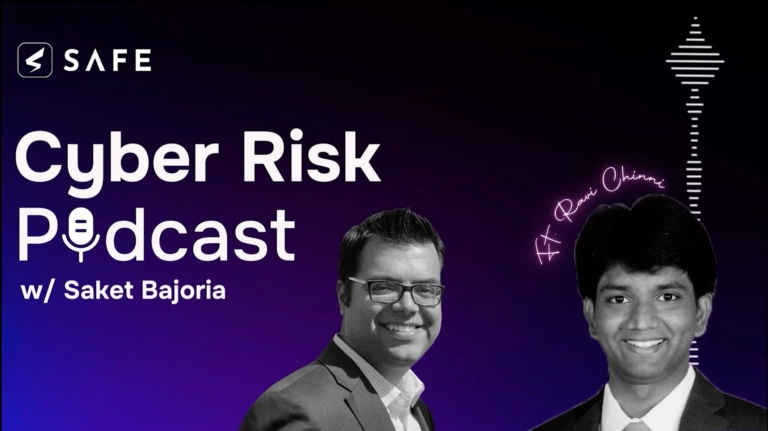
The Cyber Risk Podcast with Ravi Chinni, S&P Global, on Scaling Cyber Risk Bottom-Up
How to ensure teams take the right actions and executives stay informed on cyber risk burndown. In Episode Six of The SAFE Cyber Risk Podcast, host Saket Bajoria,…


 CTEM
Shift Two: Centralizing Exposure Data Is Not the Same as Understanding It
Part 3 of a four-part series on what the defender’s window requires at enterprise scale. Risk-based prioritization only works when the underlying exposure data can be reconciled, contextualized,…

 CTEM
Shift One: Why CTEM Has to Prioritize Business Risk, Not Severity
Part 2 of a four-part series on what the defender’s window requires at enterprise scale. In the first article in this series, we argued that the defender’s window…
 CTEM
The Defender’s Window Is Open. Here Is What Enterprise Security Has to Change.
Part 1 of a four-part series on what the defender’s window requires at enterprise scale. This week, OpenAI and more than 100 organizations, including Google, Microsoft, CrowdStrike, and…
 Exposure Management
Continuous Exposure Management Program
Gartner Defined CTEM in 2022. Most Teams Are Still Running 2015 Processes. Gartner introduced the Continuous Threat Exposure Management framework in 2022 to describe a structured approach to…

 CTEM
A Blueprint for Cyber Resilience in Global Manufacturing
SAFE partnered with an industrial giant to meet the challenge of too much data, not enough clarity. In the world of global manufacturing, downtime isn’t just an IT…


 Exposure Management
The Comprehensive Exposure Management Guide
Exposure management in cybersecurity is the process of identifying, assessing, and mitigating potential vulnerabilities and threats to minimize the risk of cyberattacks on an organization’s assets. Unlike traditional…