CVE-2026-114656 Traefik mTLS Bypass Through A Negated Host Matcher

Traefik versions before 2.11.58 and 3.7.13 can drop client-certificate enforcement when a router rule uses a negated Host matcher. An unauthenticated client can reach a backend that was configured to require mutual TLS. The vendor fixed the domain-deduction logic in 2.11.58 and 3.7.13.
Traefik is a reverse proxy that selects routes from rules such as Host and PathPrefix. It also resolves TLS options from the routers that claim a host on an entrypoint. That resolution step is where this defect sits.
The advisory says a negated Host matcher is still counted as a domain served by the router. When another router serves the same host with non-default TLS options, Traefik reports a conflict and applies the default TLS options to both routers. The default options request no client certificate.
In the authors’ local run, a client with no certificate completed the TLS handshake and received HTTP 200 from a backend protected by RequireAndVerifyClientCert. The same router rules on 3.7.13 rejected the anonymous handshake. No credentials or user interaction were needed in that run.
The CVE record and vendor advisory assign CVSS 4.0 6.9, Medium. NVD also lists a primary CVSS 3.1 score of 9.3 while the CNA-derived CVSS 3.1 score is 7.5. The scores come from different sources and are reported here as published.
If a router says it does not serve a host, why does Traefik still count that host when it chooses TLS options?
Vulnerability at a Glance
| Field | Detail |
|---|---|
| CVE | CVE-2026-114656 |
| Component | Traefik dynamic router rule domain deduction and TLS options resolution |
| CWE | CWE-436, Interpretation Conflict |
| Severity | Medium in the vendor advisory and CVE record |
| CVSS status | CVSS 4.0 6.9 from the CNA and VulnCheck. CVSS 3.1 differs: 7.5 CNA-derived, 9.3 NVD primary. |
| Privileges | None. The client is unauthenticated. |
| Interaction | None. |
| Vector | CVSS:4.0/AV:N/AC:L/AT:P/PR:N/UI:N/VC:N/VI:N/VA:N/SC:H/SI:L/SA:N |
| Trigger | A router rule with a negated Host matcher plus another router that serves the same host with non-default TLS options. |
| Impact | Anonymous TLS handshake succeeds and the protected backend becomes reachable. |
| Affected | v2 before 2.11.58 and v3 3.0.0 through 3.7.12 per the CVE record and advisory. |
| Fixed | v2.11.58 and v3.7.13. |
| Fix commit | 153c8f4d79ff9ac83b6b33f3be550e2b35e62598, Ignore negated matchers when parsing rule domains. |
| Workaround | The advisory says core.strictTLSOptions=true disables the fallback. |
| Credit | No finder name is stated in the vendor advisory consulted for this lab. |
What Actually Breaks
Defect 1 – negated matchers were treated as served domains
Domain deduction walked every matcher of the selected type. Before the fix, a negated leaf still returned its value, so a rule such as PathPrefix(/) && !Host(secure.example.com) reported secure.example.com as a served domain. The fix adds ParsePositiveMatchers and skips negated leaves.
pkg/rules/parser.go

-func (tree *Tree) ParseMatchers(matchers []string) []string {

+func (tree *Tree) ParsePositiveMatchers(matchers []string) []string {

switch tree.Matcher {

case and, or:

-        return append(tree.RuleLeft.ParseMatchers(matchers), tree.RuleRight.ParseMatchers(matchers)...)

+        return append(tree.RuleLeft.ParsePositiveMatchers(matchers), tree.RuleRight.ParsePositiveMatchers(matchers)...)

default:

+        if tree.Not {

+            return nil

+        }

if slices.Contains(matchers, tree.Matcher) {

return lower(tree.Value)
Defect 2 – the conflict fell back to default TLS options
Both HTTP and TCP domain parsers called the old matcher walker. The fix switches them to the positive-only walker, so a host excluded by a negated matcher no longer participates in TLS options conflict detection.
pkg/muxer/http/mux.go - ParseDomains

-return buildTree().ParseMatchers([]string{"Host"}), nil

+return buildTree().ParsePositiveMatchers([]string{"Host"}), nil
pkg/muxer/tcp/mux.go – ParseHostSNI
-return buildTree().ParseMatchers([]string{“HostSNI”}), nil
+return buildTree().ParsePositiveMatchers([]string{“HostSNI”}), nil
Defect 3 – default options request no client certificate
The lab used a router with RequireAndVerifyClientCert and a catch-all router with a negated Host matcher and default TLS options. When Traefik counted both routers as serving the protected host, it logged the conflict and applied the default options. The client certificate check disappeared from the effective TLS policy.
tls.yml

options:

default: {}

strict:

clientAuth:

clientAuthType: RequireAndVerifyClientCert

caFiles: [certs/client-ca.pem]
routers-vuln.yml
secure-mtls: Host(`mtls.local`) -> tls.options: strict@file
shadow-negated: PathPrefix(`/`) && !Host(`mtls.local`) -> tls: {}
The config above is the lab trigger shape. It is shown to explain the code path, not as a deployment recipe.
Impact
Proven primitive
In the authors’ arm64 run, a TLS client with no client certificate reached the whoami backend through Traefik 3.7.12 and received HTTP 200. A signed client certificate also reached the backend. Traefik logged that Host mtls.local was served by multiple routers with different TLS options and that default TLSOptions would be applied.
Consequence
The effective TLS policy no longer matched the operator’s intent. Any network client able to reach the entrypoint could complete the handshake without a certificate and be forwarded to the protected backend. The CVSS vector records high scope change and low integrity impact, with no direct confidentiality or availability loss at the proxy layer.
Scope of impact
The advisory covers the v2 and v3 lines. This lab ran only the v3 line on arm64 with one protected host and one negated router. Other configurations, providers, and platform results were not tested here and are analysis only.
Lab Reproduction
The lab used the public environment at fixedbyreboot/CVE-2026-114656-POC, pinned to commit b145b1a96858d8e72703ae98a7f0f966932cc5cc. Its router rules and TLS options were kept. The lab baked them into images and added side-by-side vulnerable, fixed, config-control, and mitigation variants. All runs were local on arm64 with Docker 29.9.3 and Compose v5.7.0.
| Build | Version | Lab port | Result | Observation |
|---|---|---|---|---|
| Vulnerable | v3.7.12 | 18443 | BYPASS | Anonymous client reached backend, HTTP 200. Conflict log present. |
| Fixed | v3.7.13 | 18444 | PROTECTED | Anonymous handshake rejected. Signed certificate reached backend, HTTP 200. |
| Config control | v3.7.12 | 18445 | PROTECTED | Plain Host(other.local) shadow router. Anonymous handshake rejected. |
| Mitigation | v3.7.12 | 18446 | FAIL-CLOSED | With strictTLSOptions=true, conflicting routers were disabled. No client reached backend, HTTP 404. |
The probe connected with SNI mtls.local twice, with no client certificate and with the lab’s signed throwaway certificate. Ports are local to this lab and are not part of the vulnerability. Results can vary between runs and platforms. The values below are from one authors’ run.
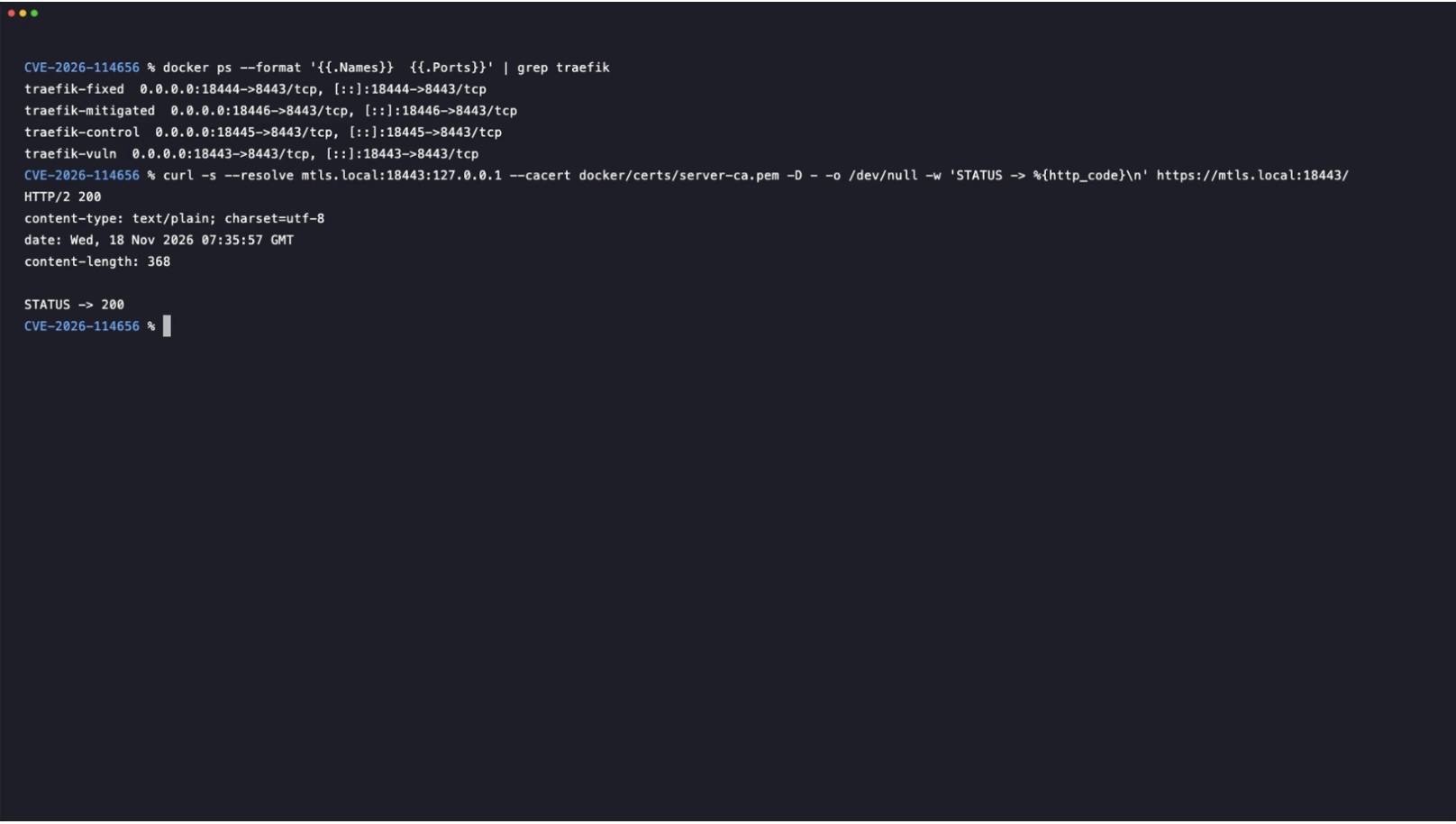
Figure 1. Authors’ arm64 run. The vulnerable build returned STATUS 200 to a request with no client certificate option. The frame is from the local video capture.
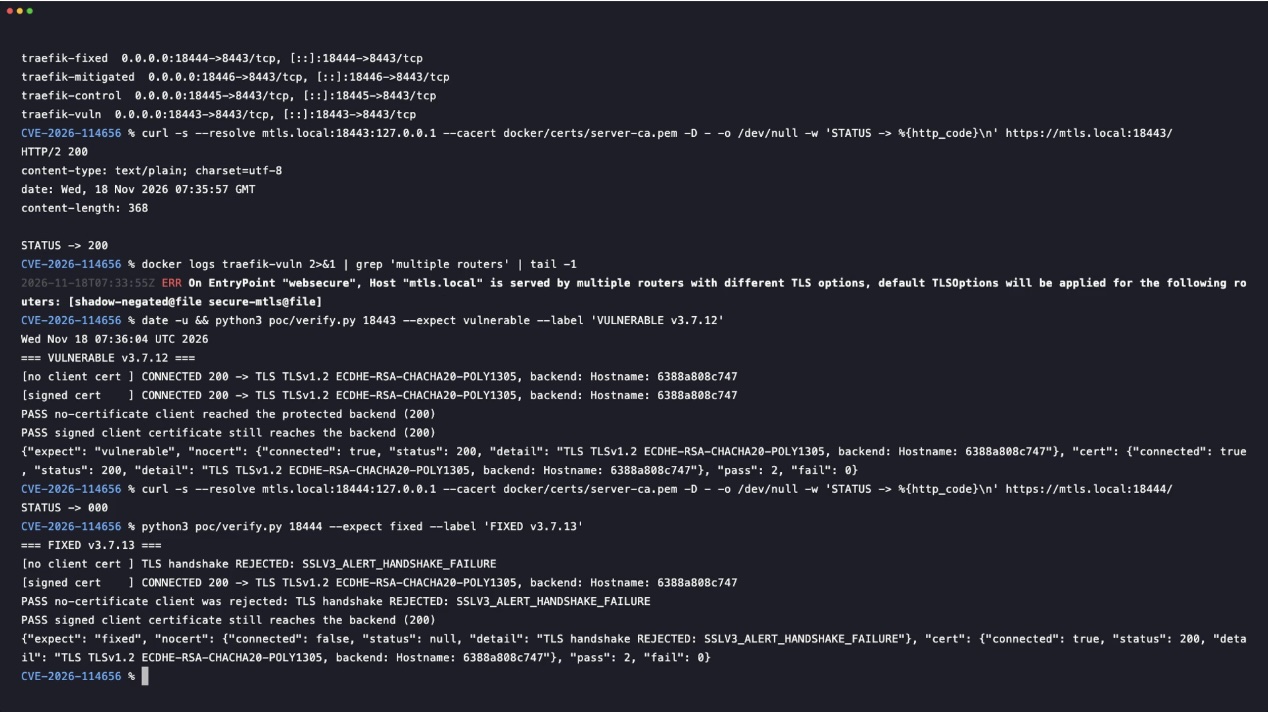
Figure 2. Same authors’ run. The fixed build rejected the anonymous handshake while accepting the signed certificate. The frame is from the same video capture.
Raw probe output is in evidence/30-proof.txt. Conflict logs are in evidence/35-tls-conflict.txt and evidence/36-strict-conflict-log.txt. The version matrix is in evidence/50-version-matrix.txt.
Attack Scenarios
Scenario 1 – exposed entrypoint with a negated catch-all router
An operator protects a host with RequireAndVerifyClientCert and adds a catch-all router that excludes that host with !Host(). The exclusion makes both routers appear to serve the host during TLS options resolution. An anonymous client then reaches the protected backend.
Scenario 1 – authors’ lab run
Unauthenticated client

|

| TLS ClientHello for protected host, no certificate

v

Traefik entrypoint

|

| domains from !Host() rule plus strict TLS router -> conflict -> default TLS options

v

Protected backend returns HTTP 200
Scenario 2 – configuration drift across routers
A strict router and a plain router are managed by different teams or files. A negated matcher in one file changes the domain set seen by TLS options resolution. The resulting fallback is logged at ERROR level, but forwarding continues with weaker TLS settings. This scenario follows from the advisory and the authors’ log evidence.
Scenario 2 – advisory and lab evidence
Strict router file

|

| Host(protected) with clientAuth

v

Domain resolver

^

| negated Host in another router still counted

|

Other router file

|

v

ERROR log and default TLS options
Scenario 3 – v2 deployments
The advisory says v2 before 2.11.58 is affected by the same defect. This lab did not containerize the v2 line, so the flow is analysis based on the advisory and fix commit, not an independent lab result.
Affected Products and Fixed Versions
| Product line | Affected versions | Fixed version | Lab status |
|---|---|---|---|
| Traefik v2 | 0 up to 2.11.57 | 2.11.58 | Not containerized here |
| Traefik v3 | 3.0.0 up to 3.7.12 | 3.7.13 | Tested: 3.7.12 bypass, 3.7.13 protected |
The advisory says v3 releases below 3.7 are end of life and unpatched. The vendor fix commit was authored on 2026-09-04. GitHub release data consulted for this lab lists v3.7.12 published on 2026-08-26 and v3.7.13 on 2026-09-04.
How Enterprises Should Respond
- Patch the proxy.
Upgrade to a fixed release in your active line.
- Use the vendor builds. Move to 2.11.58 or later on v2, or 3.7.13 or later on v3.
- Replace end of life v3. The advisory says older v3 lines will not receive their own patch.
- Rebuild derived images. Include embedded proxies in appliances and internal base images.
- Audit router rules for negated host matchers.
Look for rules that combine a protected host with !Host() in another router on the same entrypoint.
- Search dynamic config. Include files, Kubernetes CRDs, and generated rules.
- Compare TLS options. Two routers claiming one host must not disagree about client authentication.
- Prefer explicit routes. A plain Host matcher for an unrelated domain did not trigger the fallback in the authors’ control run.
- Use strict TLS options while patching.
The advisory says core.strictTLSOptions=true disables the fallback to default TLS options.
- Expect fail-closed behavior. In the authors’ run, strict mode disabled both conflicting routers and returned HTTP 404.
- Fix the config too. Disabled routes need correction before traffic returns.
- Keep it after upgrade. Strict options prevent the same class of silent downgrade.
- Hunt for the conflict signature.
The downgrade is logged by Traefik at ERROR level.
- Search proxy logs. Look for multiple routers with different TLS options and default TLSOptions will be applied.
- Alert on conflict lines. Treat them as a TLS policy change, not a routine warning.
- Verify after changes. Probe protected hosts with and without a client certificate from a trusted host.
Closing
The failure is a domain-deduction error that changes the effective TLS policy. Fix the parser, patch the proxy, and alert when two routers disagree about TLS options.
negated Host matcher

+ second router with distinct TLS options

+ fallback to default options

= anonymous access to an mTLS-protected route