CVE-2026-123270 Unauthenticated Remote Code Execution In Redpanda Connect Streams Mode


Redpanda Connect 4.39.0 through 4.110.0 expose the streams-mode management API on 0.0.0.0:4195 without authentication, and a pipeline definition submitted over that API can run commands on the host. Redpanda fixed the default in 4.111.0 by making the stream CRUD endpoints opt-in. The same execution path returns when an operator enables them with –bind-http.
Redpanda Connect, the commercial distribution of Benthos, is a stream-processing runtime. In streams mode it runs multiple pipelines inside one process and exposes a management HTTP API for creating, updating, and removing them. The API listens on port 4195 so operators and automation can manage pipelines remotely.
The default configuration exposes more than management. The API has no authentication unless the operator configures it, and a pipeline definition may include processors that execute operating system commands. Redpanda Connect treats a config written locally and a config received over HTTP the same way, so an open listener becomes an execution endpoint.
CVE-2026-123270 covers that combination. The advisory says every release from 4.39.0 through 4.110.0 is vulnerable in its default streams-mode configuration. A client with network access to TCP/4195 can create a stream with one request, and starting the stream runs the command. Command output can also return in the HTTP response body, so the attacker does not need a second channel.
Redpanda changed the default in 4.111.0: the stream CRUD endpoints are registered only when the new –bind-http flag is set. The routes still exist and still have no authentication gate of their own. The advisory and our lab both show that the same execution path returns when an operator enables the flag. This post covers the defect, the fix, and the evidence from an arm64 container run.
Who can reach TCP/4195 on your Connect instances, and what stops them from defining the next pipeline?
Vulnerability at a Glance
| Field | Detail |
|---|---|
| CVE | CVE-2026-123270, assigned by CERT/CC and published on 2026-11-09 |
| Component | Redpanda Connect streams-mode management HTTP API (embedded Benthos core) |
| CWE | CWE-306 Missing Authentication for Critical Function |
| Severity | Critical |
| CVSS | 9.8, CVSS:3.1/AV:N/AC:L/PR:N/UI:N/S:U/C:H/I:H/A:H (CISA-ADP). NVD status was Awaiting Analysis on 2026-11-13. |
| Privileges | None |
| Interaction | None |
| Vector | Network, TCP/4195 |
| Trigger | POST /streams/{id} with a pipeline definition that contains a code-executing processor |
| Impact | Arbitrary command execution as the Connect service account; output can return in band |
| Affected | 4.39.0 through 4.110.0 in the default streams-mode configuration |
| Fixed | 4.111.0 (2026-09-25) registers the stream CRUD endpoints only with –bind-http |
| Fix commit | benthos c2a2dcffc9, pull request #506; first shipped in Benthos v4.81.0 and Connect 4.111.0 |
| Workaround | On 4.110.0 and earlier run streams with –no-api; bind http.address to 127.0.0.1; enable http.basic_auth; restrict TCP/4195 |
| Credit | Adrian Pastor (GitHub @pagvac), as credited in the advisory |
What Actually Breaks
Two defaults create the exposure. The management API is enabled unless the operator turns it off, and it accepts pipeline configuration over the network. Each default is reasonable inside a trusted operator network. Together they turn a remote configuration interface into a remote shell.
Defect 1 – The streams API is opt-out
Redpanda Connect v4.109.0 and v4.110.0 pin Benthos v4.80.0. In that core, the streams command has one flag that controls the management API: –no-api. Its value defaults to false, so the API is on. The service bootstrap inverts the flag and passes the result into streams mode.
// benthos v4.80.0, internal/cli/streams.go

&cli.BoolFlag{

Name:  "no-api",

Value: false,

Usage: "Disable the HTTP API for streams mode",

},
// benthos v4.80.0, internal/cli/common/service.go:98
enableStreamsAPI := !c.Bool(“no-api”)
The advisory names this inversion as the source of the default exposure. The operator has to know about a flag and set it to remove a network service that most deployments do not need.
Defect 2 – No authentication gate on the CRUD routes
The stream routes are registered on the service-wide HTTP server. Registration adds handlers for /streams and /streams/{id} and attaches no authorization check. Basic auth is a service-wide setting, and its default struct sets Enabled to false.
// benthos v4.80.0, internal/stream/manager/api.go:51-57

m.manager.RegisterEndpoint(

"/streams/{id}",

"Perform CRUD operations on streams, supporting POST (Create),"+

" GET (Read), PUT (Update), PATCH (Patch update)"+

" and DELETE (Delete).",

m.HandleStreamCRUD,

)
// benthos v4.80.0, internal/httpserver/basic_auth.go:48-57
func NewBasicAuthConfig() BasicAuthConfig {
return BasicAuthConfig{
Enabled: false,
…
}
}
The HTTP address default is 0.0.0.0:4195, set in internal/api/config.go:36. An out-of-the-box streams process therefore listens on every interface, and the CRUD routes answer requests that carry no credentials.
Defect 3 – A pipeline config can execute code
A pipeline config is executable content. The command and subprocess processors start OS processes, ffi loads native libraries, and sql_raw with unsafe_dynamic_query can build SQL from message data. The advisory names these processors as the execution primitives. The management API lints a submitted config for schema errors. It does not treat a remote config as untrusted, so any config that passes lint can reach an execution primitive. The attacker supplies the whole pipeline, which means the attacker supplies the code.
The fix – Register the routes only on request
Benthos pull request #506, merged on 2026-09-18, changes the default. The bootstrap enables the streams API only when –bind-http is set, and –no-api becomes a hidden, deprecated flag that prints a warning. The new flag’s help text states the reason: the endpoints accept pipeline configuration over HTTP. Redpanda Connect 4.111.0, released on 2026-09-25, moved from Benthos v4.80.0 to v4.81.0 and picked up the change.
// benthos v4.81.0, internal/cli/common/service.go

if c.Bool("no-api") {

logger.Warn("The --no-api flag is deprecated and no longer has any effect: ...")

}

enableStreamsAPI := c.Bool("bind-http")
// benthos v4.81.0, internal/cli/streams.go
&cli.BoolFlag{
Name: “bind-http”,
Value: false,
Usage: “Register the streams-mode HTTP API endpoints …”,
},
The same pull request makes the dynamic input and output HTTP endpoints opt-in with a bind_http field that defaults to false. Both changes remove HTTP surface from a default process.
The fix is a default-off change. It does not remove the routes and does not add authentication. Any operator who sets –bind-http gets the old behavior, including the missing auth gate.
Impact
Proven primitive
Our run created a stream over an unauthenticated POST and executed id and uname inside the target container. The command output came back in the HTTP response body on the same port. The process ran as uid 1000(demo) in the project’s container and as root in a plain python:3.12-slim container. The account was the only difference.
Consequence
Command execution under the service account gives access to the Connect process, its configuration, environment variables, mounted secrets, and any credentials that pipelines use. The host view depends on deployment. A container limits the filesystem and network reach. A bare-metal or VM install gives the account its full access. The advisory rates confidentiality, integrity, and availability impact as high.
Scope of impact (analysis)
The advisory says a passive Shodan sweep on 2026-09-14 found no internet-exposed instances in the reporter’s scope. The NVD record was marked Awaiting Analysis on 2026-11-13, and CISA’s SSVC data lists exploitation as none, automatable as yes, and technical impact as total. That combination reads as latent risk. The default is dangerous, the exposed population is not known to be large, and the exploit is a single request. Our assessment is that internal management networks and CI or lab deployments are the most likely exposure.
Lab Reproduction
The Docker builder VM in this environment could not reach release-assets.githubusercontent.com, so the image was changed to copy a host-fetched tarball. The in-image sha256 check stayed in place and passed. These are single-run results, and timings and request counts vary between runs.
| Run | Version and mode | Result | Observation |
|---|---|---|---|
| Repo PoC | 4.109.0, default streams | RCE confirmed | GET /streams returned 200. Blind marker showed uid=1000(demo). The in-band path returned the id output in the response body. |
| Host to container | 4.109.0, default streams, published port | RCE confirmed | curl from macOS with no credentials. The marker file was written and the new stream appeared in GET /streams. |
| Boundary below the fix | 4.110.0, default streams | RCE confirmed | GET /streams returned 200, POST returned 200, and the marker showed uid=0(root) in a plain image. |
| Fixed default | 4.111.0, default streams | Not exposed | GET /streams returned 404 while /ping returned 200. |
| Fixed default | 4.118.0, default streams | Not exposed | GET /streams returned 404. |
| Fix plus flag | 4.111.0, –bind-http | RCE confirmed | GET /streams returned 200, POST returned 200, and the marker showed uid=0(root). |
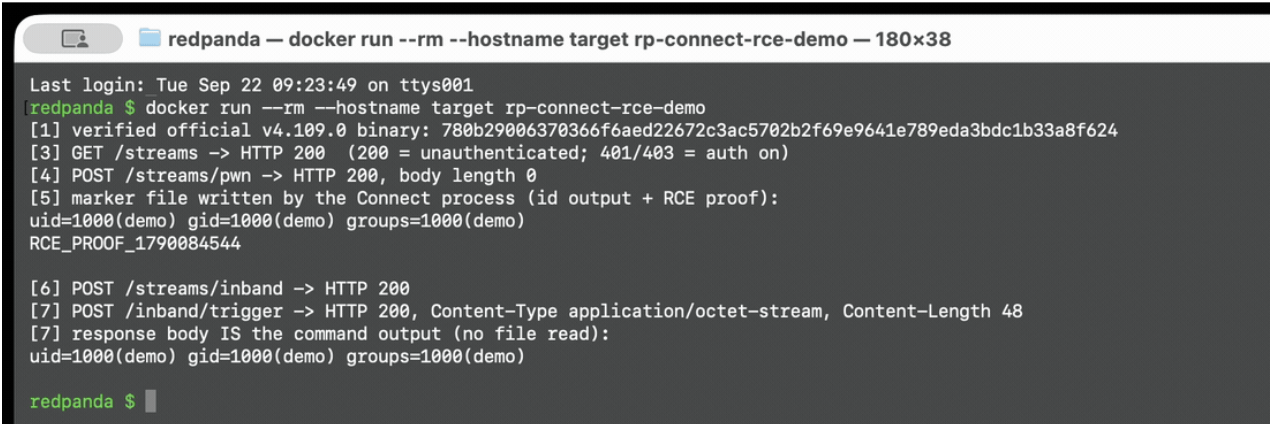
Figure 1. The authors’ demo recording shows the full flow on v4.109.0: the unauthenticated GET, the blind marker with uid=1000(demo), and the in-band response that returns the id output. Captured from assets/rp_connect_unauth_rce_demo.gif in the lab repository (authors’ run).
We repeated the network test from the host against a published port, with no credentials and no helper script:
$ curl -s -o /dev/null -w '%{http_code}\n' http://127.0.0.1:49195/streams

200

$ curl -s -o /dev/null -w '%{http_code}\n' -X POST \

-H 'Content-Type: application/x-yaml' \

--data-binary @pipeline.yaml \

http://127.0.0.1:49195/streams/manual

200

$ docker exec rp-target cat /tmp/manual_rce_proof.txt

uid=1000(demo) gid=1000(demo) groups=1000(demo)

target

MANUAL_PROOF_1794554346
$ curl -s -o /dev/null -w ‘%{http_code}\n’ http://127.0.0.1:49196/streams
404 # v4.111.0 default
The pipeline body used in the lab is not reproduced here. It contained a command processor, the same class of primitive that the advisory names. The test checks the missing authentication gate.
Attack Scenarios
Scenario 1 – Exposed streams instance (analysis)
An instance runs the documented default and a firewall or cloud security group allows TCP/4195 from an untrusted network. The attacker needs one HTTP request and no credentials. The stream starts as part of the create call.
Scenario 1 – Attack flow
Attacker

|

| POST /streams/{id} over TCP/4195, no credentials

v

Connect management API

|

| pipeline registered and started

v

command processor

|

v

Host shell as the service account
Scenario 2 – Operator enables –bind-http after upgrading (verified)
An operator upgrades past 4.111.0 and restores the old behavior because automation depends on the CRUD API. The flag brings the routes back with no authentication of their own. The advisory reports this path on 4.116.1 and 4.117.0, and our lab reproduced it on 4.111.0.
Scenario 2 – Attack flow
Operator sets --bind-http

|

v

Stream CRUD routes registered

|

| no auth gate by default

v

Attacker with TCP/4195 access

|

v

Same unauthenticated execution path
Scenario 3 – Internal lateral movement (analysis)
An attacker who already controls a workload in the same network segment scans for port 4195. The management API has no credentials to steal and no session to forge. A single request creates the stream, and the response can carry the command output back to the compromised workload.
Scenario 3 – Attack flow
Compromised workload

|

| internal scan finds TCP/4195

v

Connect management API

|

| pipeline upload

v

Command runs under the service account

|

v

Output returns to the attacker
Affected Products and Fixed Versions
| Product | Affected | Fixed | Notes |
|---|---|---|---|
| Redpanda Connect | 4.39.0 to 4.110.0, default streams mode | 4.111.0 | CRUD endpoints are opt-in. –bind-http re-enables them. |
| Benthos core (embedded) | Through v4.80.0 | v4.81.0 | Pull request #506 is the source of the gate. Connect 4.111.0 bumped the dependency from 4.80.0 to 4.81.0. |
| Connect 4.111.0 and later with –bind-http | When the flag is set | No behavior change | The flag re-enables the same endpoints. Require auth and bind to a trusted interface, or keep the flag off. |
Published dates: CVE record 2026-11-09, fix pull request merged 2026-09-18, Benthos v4.81.0 on 2026-09-18, Connect 4.111.0 on 2026-09-25. Redpanda’s statement through CERT/CC says the issue is fixed in 4.111 by making the endpoint opt-in and credits Adrian Pastor. The advisory notes that the pull request does not mention the CVE or the reporter.
How Enterprises Should Respond
- Patch first.
Move to Redpanda Connect 4.111.0 or later so a default streams process no longer registers the CRUD endpoints.
- Verify the behavior. After upgrading, GET /streams should return 404 while /ping still returns 200.
- Inventory every copy. Check container images, appliances, and vendored builds. The vulnerable code sits in the embedded Benthos core.
- Remove network exposure.
Treat port 4195 as a management plane, not an application endpoint.
- Bind to loopback. Set http.address to 127.0.0.1:4195 where remote management is not required.
- Restrict the port. Firewall TCP/4195 to operator ranges and remove public port mappings from containers.
- Authenticate the API if it must be enabled.
The fix changes the default registration, not the authentication model. An enabled API is still unauthenticated unless credentials are configured.
- Turn on basic auth. Configure http.basic_auth with a strong password hash before setting –bind-http.
- Treat the flag as privileged. Review why automation needs the CRUD API and prefer local config files.
- Hunt for abuse.
Look for stream creation that did not come from your deployment pipeline.
- Review access logs. Search for POST /streams, unexpected stream IDs, and requests to http_server paths that return octet-stream bodies.
- Inspect running streams. Check configs for command, subprocess, ffi, and sql_raw processors, and review child processes started by the Connect account.
- Re-test the fix.
Run the lab or an internal check after the upgrade to confirm the default and the opt-in mode behave as expected.
- Confirm the 404. A default 4.111.0 or later instance should not serve /streams.
- Confirm the dependency. The Connect build should include Benthos v4.81.0 or later.
Closing
CVE-2026-123270 is a default configuration problem with a code-execution consequence. The management API listened on every interface, accepted pipeline definitions without credentials, and passed those definitions to processors that run commands. Redpanda removed the default exposure in 4.111.0 by leaving the stream CRUD routes unregistered unless the operator asks for them.
The fix is narrow by design. It does not add authentication, and it does not remove the routes. An instance that runs with –bind-http keeps the old behavior. That makes the upgrade necessary but not sufficient: the flag has to be treated as a privileged switch, with http.basic_auth enabled and http.address bound to a trusted interface.
The verification is simple enough to keep in a deployment check. A fixed default instance returns 404 on /streams and 200 on /ping. A vulnerable default instance returns 200 on /streams and accepts a stream creation. An instance with the flag enabled returns 200 on /streams by design, so pair that result with an auth challenge and a bind-address check.
NVD still listed the record as Awaiting Analysis on 2026-11-13, and CISA’s SSVC data listed exploitation as none. The absence of observed exploitation is not evidence of safety. The exposed population was not measured, the default was on across the tested range, and the request is trivial to automate. Inventory and network controls matter as much as the version number.
default API + unauthenticated pipeline upload + code-executing processor = remote code execution
streams mode + default API + pipeline upload = unauthenticated RCE