Third Party Breach Detection and Notifications with SAFE TPRM

Your vendor passed its assessment. The questionnaire is complete, the security report is on file, and the next review is months away. Then someone forwards a breach headline and asks: are we affected?
The assessment record cannot answer that question on its own.
For a third-party risk management analyst, this is where a different kind of work begins. You need to identify the right company, find the service your business uses, understand what happened, contact the vendor, and explain the possible impact. Leadership needs an answer, even as the facts keep changing.
It gets harder when the breached company is your vendor’s supplier. Its name may never appear in your procurement list. Even a well-maintained register of direct vendors may not tell you enough about the dependency behind a fourth-party breach.
I believe a useful TPRM program has to help teams make decisions between assessments. When a breach is reported, analysts need evidence, relationship context, and a clear next step. This guide explains what that work involves and where SAFE TPRM’s Breach Events feature fits in.
What third party breach detection means for TPRM
Third-party breach detection in TPRM means identifying reported security incidents connected to suppliers, checking their relevance to your organization, and starting the appropriate response. Fourth-party breach monitoring extends that work to the providers your suppliers depend on. A notification brings an event to your attention; investigation establishes whether your business is affected.
A vulnerability is a weakness. A suspicious claim is a lead. A vendor’s acknowledgment is evidence of an incident. None of these, on its own, tells you exactly which of your records, accounts, or services were affected.
In SAFE, Breach Events provides a shared view of third- and fourth-party incidents, with a route into investigation and issue creation. Its table is populated through SAFE’s External Risk Signals pipeline.
Why manual assessments leave a breach response gap
The assessment and the incident answer different questions
An assessment helps you understand a supplier’s controls and the risk of working with it. A breach investigation asks what happened, whether your relationship falls within the affected scope, and what needs to change now.
Suppose a supplier completes a review in January and experiences an incident in June. The January evidence is still useful: it may identify the security contact, relevant systems, and expected controls. But it cannot establish the facts of the June incident. The analyst needs a way to bring that new evidence into the relationship record.
This is where an assessment-led workflow falls short without an effective monitoring and response layer. More questionnaires will not help a team learn about a new event and act on it.
A company name is not enough to establish exposure
A headline may refer to a parent company, acquired business, regional subsidiary, or product line. Your contract may use another name. Even if the company match is correct, the affected service could be different from the one you use.
Before making a confident impact statement, an analyst needs to establish three things: the exact organization involved, the service or environment affected, and the connection to the business. Miss one, and you risk unnecessary escalation or misplaced confidence.
Fourth parties make the investigation less direct
Consider a hypothetical example: your organization buys a customer support service that uses another provider to store attachments. If that storage provider experiences a breach, you need to know whether the support vendor placed your information in the affected environment.
You may have no contract or direct contact with the storage provider. Your direct vendor is your route to answers. Fourth-party risk management therefore needs more than a list of technology names. Analysts need to validate the relationship, then investigate the relevant data or service path.
What the best TPRM platforms should help you do
When evaluating the best TPRM platforms for breach detection and notifications, I would start with a live investigation. Give the team a reported event and ask them to explain their exposure and next action. Look for support across the following areas.
| Capability to evaluate | Evidence to request in a demonstration |
| Relevant event discovery | A reported incident connected to a monitored supplier, with a traceable source |
| Third- and fourth-party context | A clear distinction between a direct vendor and an indirect dependency |
| Evidence quality | Report date, source, acknowledgment status, and a way to investigate uncertainty |
| Analyst notification | A working delivery path, appropriate recipients, and understandable timing |
| Response ownership | A follow-up record with an owner, priority, and due date |
| Business relevance | A way to combine the event with your service, data, access, and criticality information |
Pay particular attention to business relevance. A breach headline cannot tell you how your organization uses the supplier. Payroll, a public marketing website, and a privileged administration service can each require a very different response. That context needs to inform the decision.
Ask vendors to separate discovery time from notification time, too. How long after a source becomes available does the event enter the system? What happens next? Are messages batched? Which relationships are covered? Those answers tell you more than an undefined promise of “real time.”
These are evaluation criteria; products may implement them differently. The demonstration should show how the evidence and handoffs work together.
How to use SAFE Breach Events
Start at Third-Party Inventory > Breach Events. The page combines insights with an event table. The documented reporting windows are one week, one month, three months, and one year.
Start with the portfolio view
The overview separates total events, third-party events, and fourth-party events. Use it to orient your review, then move to the individual records. The event table provides the breach name, affected organization, relationship, reported date, official disclosure status, reference, and Create Issue action.
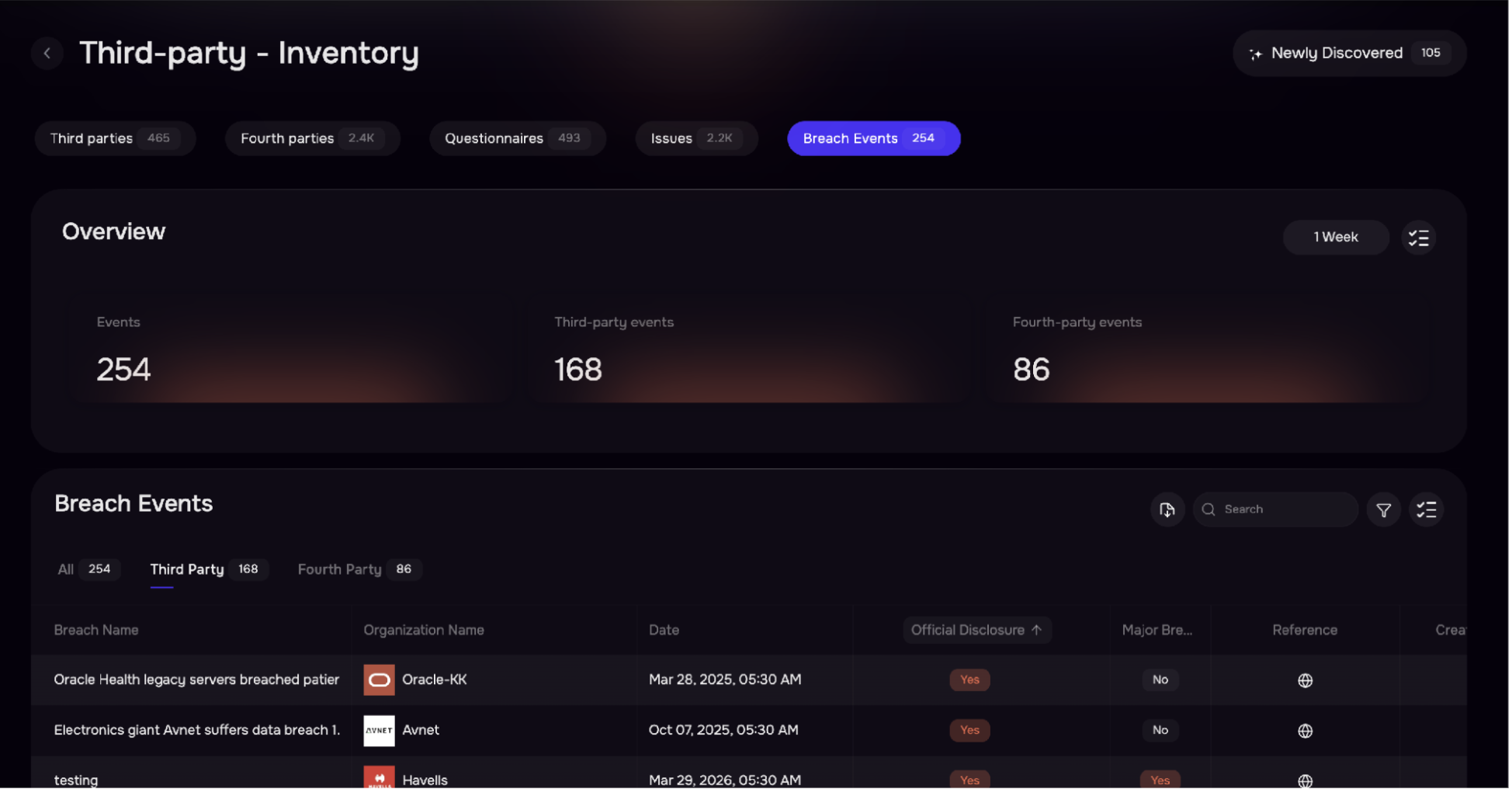
Which events deserve attention first? I would begin with known critical services and sensitive access, then investigate uncertain relationships that could carry significant impact. This is an analyst decision; the event count alone cannot make it.
A larger count may reflect more reported activity, a different reporting window, or a broader set of monitored relationships. Before presenting a trend to leadership, establish what is being counted. A higher number does not automatically mean your organization has suffered more breaches.
Read the event as evidence
SAFE TPRM’s Breach Events page combines third- and fourth-party events with organization and relationship information, disclosure status, reference links, and issue creation. These elements help you move from a portfolio-level question to a specific investigation.
Start by establishing the organization. Open the underlying source, check the reported scope, and identify what still needs confirmation. Keep the source’s publication date separate from the incident date and the time your team learned about it.
A report published today may describe an older compromise. An updated article may add information about an existing event. Mixing those dates can give leadership a misleading timeline.
Open the details and investigate the relationship
Selecting an event opens Breach Details, showing breach information and impacted organizations.
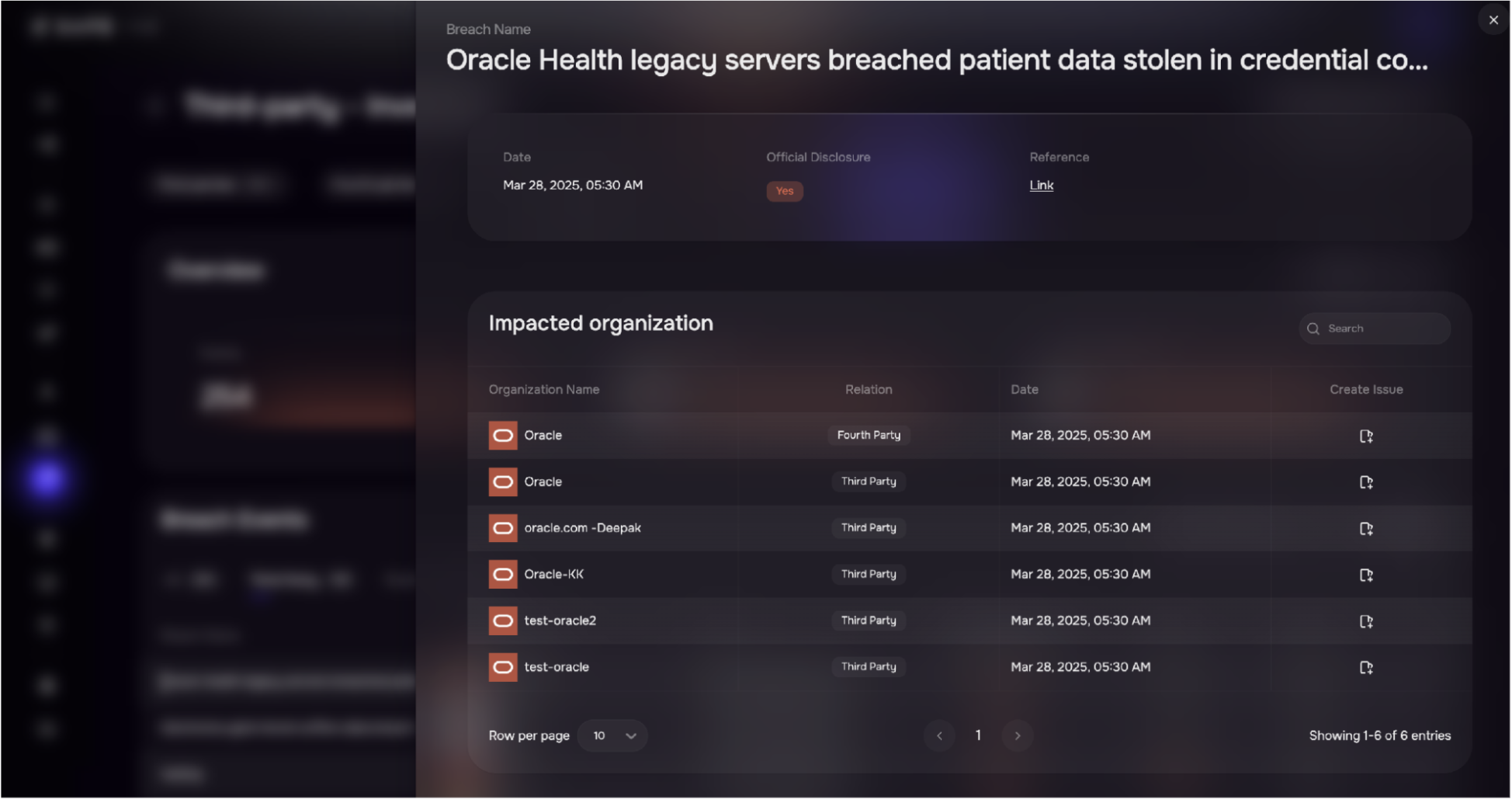
For each listed relationship, ask how it connects to your organization. A direct vendor and an indirect dependency may require different evidence requests and different people to follow up.
The organization list is the starting point for scoping. Is the relevant product, region, tenant, or data set involved? A group-level incident does not establish customer-specific impact. Keep that distinction clear throughout the investigation.
How to investigate fourth party breach exposure
SAFE’s Fourth Parties view adds dependency context: linked third-party counts, breach indicators, and discovery evidence. It uses passive technical signals including DNS, website technology, and infrastructure information. The confidence label Confirmed means multiple independent discovery signals; Unconfirmed means one signal.
This context helps an analyst ask better questions. It does not prove that the provider holds your sensitive information. A technology visible on a vendor’s public website, for example, may support that website rather than the service you buy.
Keep relationship confidence and incident confidence separate. You can be confident that two organizations are connected while remaining uncertain about the reported breach. Equally, strong incident evidence may still leave you needing to validate the connection to your supplier.
For a potentially important indirect event, ask your direct vendor:
- Do you use the affected provider for the service you deliver to us?
- Which product, environment, region, and data flows are involved?
- Was our information present during the affected period?
- Could the incident interrupt our service or affect access to our environment?
- What evidence supports your current conclusion, and when will you update us?
If several direct vendors depend on the same provider, examine them together. They may not share the same impact, but the dependency gives you a useful investigation group. One vendor may use an affected service while another uses an unrelated product from that provider.
How SAFE breach notifications reach analysts
SAFE documents a consolidated email covering third- and fourth-party breach events, with links to further details. This gives teams a route from their inbox into the relevant investigation.
What happens after the email arrives matters just as much. Assign someone to review it, arrange backup coverage, and agree which conditions require escalation. A consolidated notification helps reduce scattered intake when someone owns the next step.
SAFE also provides a broader configurable notifications framework. Administrators manage Default Notifications; users can create My Notifications. The framework offers web and email channels, filters, and real-time or scheduled delivery depending on the trigger. SAFE describes a 10–15 minute aggregation window for real-time notifications.
A practical breach triage workflow for TPRM analysts
The following workflow is a recommended operating practice. It combines event evidence with information your organization and vendors must supply.
- Validate the report and the organization
Read the source before repeating the headline. Check the legal entity, domain, product, and any relevant subsidiary. Record whether you are dealing with an allegation, an acknowledged incident, or customer-specific evidence.
Be precise while the facts develop. “A breach has been reported at a supplier” and “our data has been breached” are different statements. Careful wording makes the escalation more credible and leaves room for new evidence.
- Trace the route to your business
For a direct vendor, identify the internal service owner and the services in use. For an indirect provider, identify which direct vendors may depend on it and validate those connections.
Then examine the possible exposure routes: stored information, shared credentials, system access, software dependencies, or service availability. An event can matter even without evidence of data theft. An unavailable service may still interrupt an important business process.
- Prioritize the decision
Consider incident credibility alongside business criticality, sensitive data, privileged access, substitutability, and the number of potentially affected relationships. These factors help determine the urgency of the next action; they are not a universal risk formula.
| Investigation situation | Suggested response posture |
| Credible event involving a critical service or privileged access | Prompt joint review with the service owner and security team |
| Reported event with an uncertain but potentially serious indirect connection | Urgent relationship validation and targeted vendor outreach |
| Credible incident affecting a service you do not appear to use | Verify the scope before lowering priority |
| Weak or ambiguous reporting with no established connection | Preserve the source, validate attribution, and monitor for changes |
Use your organization’s response targets for timing. This table is a starting point for judgment, not a SAFE severity model or a substitute for your incident response process.
- Create a follow-up that someone can finish
SAFE supports creating an issue from Breach Events. Its wider issue workflow includes priority, assignee, labels, and due date, while the issue list provides status and ownership visibility.
Write the task around the unanswered question. “Investigate breach” gives the assignee very little to work with. A more useful task is: confirm whether the affected file-transfer environment processed our employee records during the reported exposure period, obtain supporting evidence, and identify any required protective action.
Now the assignee knows what completion means. Include the source, the relationship being investigated, known facts, unanswered questions, and the next review time. Make assumptions visible so another analyst can take over without reconstructing the conversation.
- Ask for evidence that changes the decision
A generic reassurance from a vendor may leave the central question unanswered. Ask for the affected service boundary, relevant dates, customer scope, containment status, and the basis for any statement that you are unaffected.
The evidence will vary. It might be a customer-specific response, an incident notice with a clear product scope, a verified service mapping, or a relevant technical finding reviewed with your security team. Request what you need to make the decision. Sending the full annual questionnaire again may not get you those answers.
- Communicate what is known and what happens next
A leadership update can be short. Explain what happened, how the organization may be connected, what is confirmed, what remains uncertain, who owns the response, and when the next update will arrive.
For example:
“A reported incident concerns an indirect provider used by our support vendor. We are validating whether our attachment storage is in scope. The vendor relationship owner is obtaining a written response, and the security team is reviewing relevant access. Customer impact is not yet established.”
This illustrative update does not describe a real customer incident. It keeps evidence, uncertainty, and action clear without overstating what the team knows.
- Close with a reason and keep the learning
Close the investigation when the evidence supports a decision, not when the news cycle moves on. Record why the event was relevant or irrelevant, what action was taken, and any unresolved risk accepted by an authorized owner.
If the investigation exposed missing contacts or an undocumented dependency, update the inventory. If the vendor could not explain customer impact, carry that finding into the next assessment. Each investigation should make the next response easier.
What TPRM leaders should measure
I would measure how quickly the team reaches a useful decision and how well that decision is supported. An increasing alert count tells you little on its own. A shorter time to establish ownership or resolve uncertainty tells you more about how the team is working.
The following are recommended program measures, calculated from your available event and issue records. They are not a list of built-in Breach Events dashboards.
| Measure | Practical definition |
| Time to triage | Time from team receipt of an event to a recorded initial relevance decision |
| Time to ownership | Time from team receipt to assignment of an accountable lead |
| Time to vendor response | Time from the evidence request to the first substantive response |
| Scope resolution rate | Share of investigated events with a documented impact or no-impact conclusion |
| Overdue follow-up rate | Share of open follow-up tasks past their agreed due date |
| Validated dependency coverage | Share of critical direct vendors whose important indirect dependencies have been reviewed |
Define the denominator and time window before reporting percentages. A fast response that says nothing about scope should not count as a substantive vendor response. A closed issue without supporting rationale should not count as resolved exposure, either.
Review a sample of completed investigations with the team. Look for inaccurate company matching, delayed ownership, weak evidence requests, and unsupported closure. These reviews often reveal more than a dashboard of totals.
Questions about third and fourth party breach monitoring
Can a vendor pass an assessment and still suffer a breach?
Yes. An assessment evaluates available evidence about controls and risk at a point in time or over a defined period. A later incident needs fresh investigation. Use assessment records to speed up scoping and find the right contacts, then collect evidence about the event itself.
Does a fourth party breach mean my organization is affected?
No. A breach at an indirect provider is a reason to investigate. You still need to validate the dependency, the affected service, and the connection to your data or operations. An accurate supplier relationship alone does not establish customer-specific impact.
Does an official disclosure establish the full impact?
No. Acknowledgment strengthens the evidence that an incident occurred, but the affected scope may still evolve. An unacknowledged report is not automatically false, either. Investigate credibility and relevance while making uncertainty clear.
How is a breach alert different from a security rating change?
A breach alert concerns a reported incident. A rating change reflects a change in the factors behind a security assessment or score. Either may warrant investigation, but they answer different questions. An unchanged score does not mean there has been no incident.
Can SAFE help teams act after a breach is reported?
Yes. The documented Breach Events workflow includes issue creation, allowing analysts to initiate follow-up from an event. Define the evidence required, identify an accountable owner, and agree when the team will review the answer.
How should analysts handle a vendor that does not respond?
Escalate through the relationship owner using your agreed process. Record the unanswered questions and assess whether the uncertainty itself requires protective action or a business decision. Keep the missing response visible; do not assume silence means there is no impact.
Can a TPRM breach feed replace a security operations team?
No. Supplier breach intelligence helps identify and investigate external events. Security teams still assess relevant activity in your environment and decide on technical response. TPRM adds relationship knowledge, vendor coordination, and follow-through across the business.
Put breach intelligence to work in SAFE TPRM AI Co-Worker
When a supplier breach is reported, I want the team to be able to explain the relationship, show the evidence, name the owner, and describe the next decision. That is how I would judge a breach monitoring program’s usefulness.
SAFE Breach Events brings the investigation into the TPRM workflow. It gives teams a way to connect incoming intelligence to vendor follow-up, including when the dependency sits one level beyond their direct relationship.
Start with one relevant event in Breach Events. Validate the source, establish the business connection, and define the follow-up. Then check how the notification reached the analyst and whether the investigation would keep moving if that person were unavailable.
Related Posts
 Cybersecurity
10 Most Common Cybersecurity Blind Spots
Nearly 90% of cyberattacks are caused by human error, so it’s important to understand and address your organization’s cybersecurity weak spots. Many organizations struggle to maintain a clear…
Cybersecurity
10 Most Common Cybersecurity Blind Spots
Nearly 90% of cyberattacks are caused by human error, so it’s important to understand and address your organization’s cybersecurity weak spots. Many organizations struggle to maintain a clear…

 Blog
2025 in Retrospect: SAFE Steers the Industry Towards Autonomous Cyber Risk Management
By: Sweta Bhattacharya 2025 wasn’t just a milestone year for SAFE: it was the year the entire cyber risk management landscape shifted. Every major shift in the SAFEOne…
Blog
2025 in Retrospect: SAFE Steers the Industry Towards Autonomous Cyber Risk Management
By: Sweta Bhattacharya 2025 wasn’t just a milestone year for SAFE: it was the year the entire cyber risk management landscape shifted. Every major shift in the SAFEOne…