CCPA Third-Party Risk: Managing Service Providers, Contractors, and Third Parties Under the CCPA and CPRA

Who is a service provider, a contractor, or a third party under the CCPA, and why does the label matter so much?
Your privacy team asks procurement for the contract with the ad tech vendor that receives hashed emails from your site. Procurement sends a click-through order form. Legal asks whether that vendor is a “service provider” or a “third party.” Nobody knows, because nobody decided. And under the California Consumer Privacy Act, as amended by the CPRA, that undecided label changes almost everything: whether the disclosure is a “sale” or “sharing,” whether consumers can opt out of it, and whether you have a defense if the vendor misuses the data.
This is not hypothetical. In March 2025, the California Privacy Protection Agency ordered American Honda Motor Co. to pay $632,500 and change its practices. One of the cited problems was that Honda shared consumers’ personal information with advertising technology companies without producing contracts containing the terms the law requires. The order also required Honda to fix its contracting process so those terms are in place going forward.
Here is what that case tells a third-party risk team. Under the CCPA, the contract is not paperwork that follows the relationship. The contract defines the relationship. If the right terms are missing, the vendor you thought was a service provider is, for legal purposes, a third party. Every program that manages vendor risk through questionnaires alone, without tying the answers to the classification and the contract, is exposed to the same gap.
Why do CCPA vendor programs break down?
Most privacy and TPRM teams know the definitions. The breakdowns happen in the handoffs between privacy, procurement, security, and the business owner. These are the four we see most.
Nobody classifies the vendor at intake
Civil Code section 1798.140 defines three categories. A service provider processes personal information on behalf of a business and receives it for a business purpose under a written contract with specific prohibitions. A contractor is a person to whom the business makes personal information available for a business purpose under a written contract with the same prohibitions, plus a certification that the contractor understands and will comply with them. A third party is anyone who is not the business, a service provider, or a contractor. If intake does not ask what data the vendor will receive and why, the classification gets made by default, usually by whoever signs the order form.
The contract is missing the statutory terms
Section 1798.100(d) requires a business that sells or shares personal information with a third party, or discloses it to a service provider or contractor for a business purpose, to enter into an agreement that specifies limited and specified purposes, obligates the recipient to comply with the CCPA and provide the same level of privacy protection, gives the business rights to take reasonable and appropriate steps to help ensure compliant use, requires the recipient to notify the business if it can no longer meet its obligations, and gives the business the right, upon notice, to stop and remediate unauthorized use. Vendor paper rarely includes all five. Standard SaaS terms almost never describe the business purpose with the specificity the CPPA regulations expect.
The questionnaire and the contract disagree
The vendor’s privacy questionnaire says it never combines your data with other customers’ data. Its data processing addendum reserves the right to use “aggregated service data” to improve its products. Its trust center lists a subprocessor you have never heard of. Each document gets reviewed by a different person, and nobody compares them. This is exactly the conflict that matters under the CCPA, because combining personal information outside the business purpose is one of the prohibitions that makes a vendor a service provider in the first place.
Due diligence happens once and is never enforced
The CPPA regulations say directly that whether a business conducts due diligence of its service providers and contractors factors into whether it has reason to believe they are misusing personal information. The regulations give an example: a business that never enforces the contract terms or exercises its rights to audit or test the vendor’s systems might not be able to rely on the defense that it had no reason to believe the vendor intended to violate the law. That matters because Civil Code section 1798.145(i) protects a business from liability for a service provider’s or contractor’s violations when, at the time of disclosure, the business had no actual knowledge or reason to believe the vendor intended to commit one. One-time onboarding reviews do not build that record. Continuous oversight does, which is how SAFE TPRM is designed to work.
What is a practical framework for CCPA vendor oversight?
The framework below follows the lifecycle of a vendor relationship and maps each step to what the statute and regulations ask for. The point is to make classification, contract terms, and evidence travel together instead of living in three separate systems.
Step 1: Classify at intake, before the contract is signed
Capture what personal information the vendor will receive, which categories (including sensitive personal information), the business purpose, and whether the vendor will use the data for its own purposes. That last question is often the deciding one. A vendor processing data purely on your behalf for a specified business purpose can be a service provider. A vendor using the data for cross-context behavioral advertising, or for its own products outside your relationship, is likely a third party, and the disclosure may be a sale or sharing. In SAFE TPRM, these answers live in intake business context and feed tiering, so a vendor receiving sensitive personal information is routed to deeper review by rule rather than by memory. Record the classification decision and who made it.
Step 2: Match contract terms to the classification
For service providers and contractors, the contract has to carry the prohibitions in section 1798.140: no selling or sharing, no retaining or using the data for purposes outside the specified business purposes, no use outside the direct business relationship, and no combining with data from other sources except as the law and regulations permit. Contractors also need the certification. The CPPA regulations at Cal. Code Regs. tit. 11, section 7051, add that business purposes must be described specifically, not by referring to the entire contract generally. For third parties, the section 1798.100(d) terms apply, and the regulations add separate contract requirements. Tie the executed agreement to the vendor record so the classification and the terms can be checked together. SAFE’s contract analysis can extract relevant contractual language and surface obligations for an analyst to review against the classification.
Step 3: Collect evidence that the vendor can meet the terms
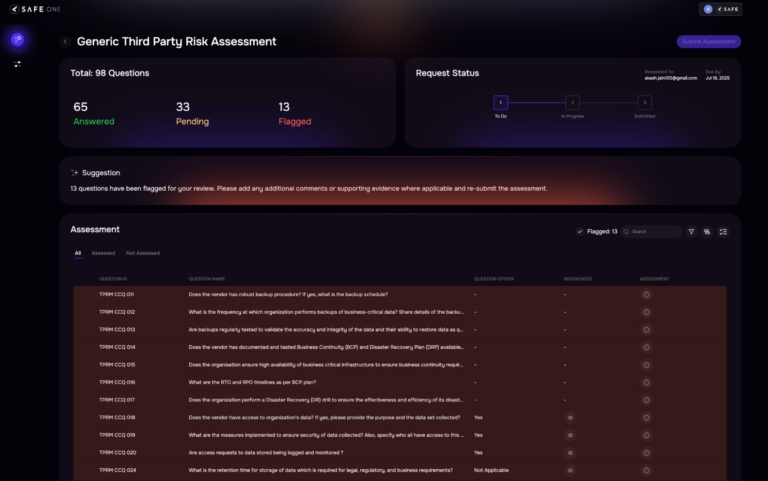
Contract terms promise behavior. Evidence shows capability. Ask about data segregation, retention and deletion, subprocessors, consumer request handling, and security controls appropriate to the data. Section 1798.100(e) requires businesses to implement reasonable security procedures and practices, and the CPPA’s contract regulations give, as an example, requiring service providers and contractors to do the same. Our free data privacy and GDPR vendor questionnaire covers most of these areas and works for CCPA reviews with minor additions. If you also process EU personal data, the processor due diligence in our guide to GDPR third-party risk overlaps heavily. SAFE’s AI-assisted assessment reads the vendor’s uploaded evidence, suggests answers with citations back to the source document, and flags discrepancies between questionnaire answers and supporting documents, such as a “no data combining” answer that conflicts with a DPA clause. An analyst reviews each flag and decides.
Step 4: Track subcontractors
Both the service provider and contractor definitions require the vendor to notify you when it engages another person to help process personal information for your business purpose, and to bind that person by written contract to the same requirements. The regulations repeat the flow-down for subcontractors. Keep a list of known subprocessors on the vendor record, and treat a new one as a reassessment trigger, not an FYI email. For the broader view, see our guide to fourth-party risk management.
Step 5: Exercise your oversight rights, and keep the record
The statute allows the contract to permit the business to monitor compliance through measures including ongoing manual reviews and automated scans and regular assessments, audits, or other technical and operational testing at least once every 12 months. That 12-month figure is the most concrete benchmark the law gives you. Set reassessment cadence by tier, with at least annual review for vendors that handle sensitive personal information, and pair it with continuous outside-in monitoring for breach signals and exposure changes between reviews. Every exercise of oversight, and every follow-up, goes on the record. That record is what supports your position if a vendor misuses data later.
Step 6: Close the relationship cleanly
When the contract ends, confirm return or deletion of personal information, close open issues, and keep the history. The CPPA regulations give an example of a business requiring documentation that verifies a vendor no longer retains or uses the personal information of consumers who made valid deletion requests. The same discipline applies at exit. See our guide to vendor offboarding for the exit checklist.
What breaks when CCPA vendor oversight scales?
At 200 vendors, a privacy analyst can personally classify every vendor that touches personal information and read every DPA. The classification lives in a spreadsheet column. It is manual, but it is consistent, because one person made every call.
At 1,000 vendors, marketing, product, HR, and customer support each run their own tooling. Pixels and SDKs arrive through tag managers, not procurement. The spreadsheet column is now filled in by several people with different interpretations of “business purpose.” A vendor reviewed as a service provider in 2024 quietly adds an AI feature in 2026 that uses customer data for model improvement, and nobody reopens the classification.
At 5,000-plus vendors, the program is effectively a records problem. You need to answer, on demand, which vendors receive sensitive personal information, which are classified as third parties, which contracts lack the required terms, and when each vendor was last reviewed. If that answer takes three weeks of emails, you cannot use it to respond to a regulator, a consumer request audit, or your own board.
SAFE TPRM keeps classification, contract, evidence, and decision history on one persistent vendor record and rolls it up into portfolio views. Questionnaire profiles keep privacy question sets on the vendors that need them. Reassessments pre-fill from prior responses and reuse previously submitted documents, so annual review is a check for change rather than a full redo. Agentic workflows send reminders and escalate overdue evidence. San Francisco Health Plan uses SAFE to speed up third-party risk assessments by 90%, which is the kind of capacity a privacy program needs when the vendor count keeps climbing.
What trade-offs do privacy and TPRM teams face under the CCPA?
The first trade-off is legal precision versus operational speed. Privacy counsel wants every vendor classified with care and every contract reviewed line by line. The business wants the tool live this week. Teams end up either blocking everything or waving everything through.
The second is one questionnaire versus many. A single privacy questionnaire for every vendor is easy to run and produces noise. A tailored set per data category is accurate and hard to maintain.
The third is point-in-time versus ongoing oversight. Annual reviews are defensible on paper, but the regulations make clear that a business that never exercises its rights may lose its defense. Ongoing oversight is better evidence and more work.
SAFE TPRM narrows each of these. Tiering routes the vendors with sensitive personal information to full review and lets low-risk vendors move faster on a lighter profile. AI-assisted review does the first pass on evidence and contract language, with citations, so counsel and analysts spend their time on the flagged conflicts rather than reading every page. Continuous monitoring and scheduled reassessment create an oversight record without a new questionnaire every quarter. The judgment calls, including the classification itself, stay with your people.
Why SAFE TPRM for CCPA vendor oversight?
We built SAFE TPRM because vendor risk decisions keep getting made on partial information: a questionnaire here, a contract there, a trust center link in an email. The CCPA punishes that fragmentation more directly than most laws, because the legal status of the relationship depends on the documents agreeing with each other.
What the platform does today:
- Intake that captures data categories, business purpose, and context, feeding tiering and an Intake Score for inherent risk.
- AI-assisted review of vendor evidence, with suggested answers cited to source documents and flagged discrepancies between answers, documents, and contract language for analyst decision.
- Contract analysis that extracts relevant language and surfaces obligations for review against the vendor’s classification.
- Continuous outside-in monitoring and an evidence-based Exposure Score for residual risk, so oversight continues between reviews.
- Findings, issues, and remediation tracking with owners, deadlines, and exceptions, plus a persistent decision history on each vendor.
- Portfolio dashboards and one-click reports that show which vendors handle sensitive data, how they are classified, and when they were last reviewed.
SAFE supports the evidence, assessment, monitoring, and reporting work behind CCPA vendor oversight. It does not classify vendors for you as a legal matter and it does not replace counsel. It gives counsel and your TPRM team one record to work from. See SAFE TPRM in action or schedule a demo.
Frequently Asked Questions
Both receive personal information for a business purpose under a written contract that carries the same core prohibitions: no selling or sharing, no use outside the specified business purposes or the direct business relationship, and limits on combining data. A service provider processes personal information on behalf of the business. A contractor is a person to whom the business makes personal information available, and its contract must also include the contractor's certification that it understands and will comply with the restrictions. In practice, the oversight work is nearly identical for both.
The vendor may not qualify as a service provider or contractor, because the definitions in Civil Code section 1798.140 depend on the contract containing specific prohibitions. That can turn a disclosure into a sale or sharing, with opt-out and notice consequences. The CPPA's March 2025 order against American Honda cited sharing personal information with ad tech companies without producing contracts containing the necessary terms, and required Honda to fix its contracting process. SAFE TPRM helps by tying the executed contract to the vendor's classification and evidence so missing terms surface during review, not during an investigation.
The statute does not set a mandatory frequency, but it describes contracts that permit monitoring through ongoing manual reviews and automated scans and regular assessments, audits, or other technical and operational testing at least once every 12 months. Many teams use that as the benchmark for vendors that handle sensitive personal information and review lower-risk vendors less often. What matters most is that you actually exercise the rights: the CPPA regulations note that a business that never enforces its contract or audits its vendors may lose the defense that it had no reason to believe they were misusing data.
Yes. Under section 1798.140, a service provider or contractor that engages another person to help process personal information for your business purpose must notify you and bind that person by written contract to the same requirements. Keep the subprocessor list on the vendor record and treat new subprocessors as a trigger for review. In SAFE, that review runs through the same assessment and issue workflow as the original vendor, so the decision and evidence stay linked.
Updated CPPA regulations took effect on January 1, 2026, adding rules on cybersecurity audits, risk assessments, and automated decisionmaking technology alongside revisions to existing rules. Compliance dates are phased: per the CPPA, the first cybersecurity audit certifications are due April 1, 2028 for businesses with more than $100 million in revenue, and risk assessment attestations and summaries are due by April 1, 2028. If your business is in scope, expect your vendor oversight records to be part of the evidence you rely on. Check the current regulation text and your counsel's reading for your specific obligations.
No. CCPA compliance depends on your notices, consumer request handling, contracts, security practices, and decisions that require legal judgment. A TPRM platform supports the vendor side: classification at intake, evidence review, contract and questionnaire comparison, monitoring, remediation, and reporting. SAFE TPRM is built for that work. This page is general information, not legal advice; confirm your obligations with counsel.