NIST Software Supply Chain Guidance: SSDF, SP 800-161, and Vendor Attestation in 2026

The attestation mandate is gone. Now what do you ask your software vendors?
For two years, a lot of software risk reviews leaned on one artifact: the CISA Secure Software Development Attestation Form. If a vendor had signed it for federal customers, many TPRM teams treated that as a strong signal and moved on.
Then the ground shifted. On January 23, 2026, OMB Memorandum M-26-05 rescinded M-22-18 and its companion M-23-16, the memos that had required federal agencies to collect those attestations. Agencies must still keep a complete inventory of software and hardware and build assurance processes that match their own risk determinations. They may still use the Common Form. They may also require a current software bill of materials (SBOM) on request. But the single, government-wide checkbox is no longer mandatory.
Look, the attestation was never the assessment. It was a CEO signature on four practice areas. The underlying NIST guidance it pointed to (the Secure Software Development Framework, and the broader supply chain risk management practices in SP 800-161) is still there, still current, and still the best shared vocabulary you have for asking software vendors hard questions. The real question for your program is how to use that guidance without a mandate doing the work for you.
Which NIST and federal documents actually matter here?
Here is the short map, as of October 2026:
- Executive Order 14028 (May 2021), Section 4(e), directed NIST to publish guidance on practices that enhance software supply chain security. It is the origin of most of what follows.
- NIST SP 800-218, Secure Software Development Framework (SSDF) Version 1.1, final since February 2022. It organizes practices into four groups: Prepare the Organization (PO), Protect the Software (PS), Produce Well-Secured Software (PW), and Respond to Vulnerabilities (RV). Appendix A maps EO 14028 Section 4(e) clauses to SSDF practices and tasks.
- NIST SP 800-218 Rev. 1 (SSDF Version 1.2), published as an initial public draft on December 17, 2025, following Executive Order 14306 (June 2025). Its comment period closed January 30, 2026. As of NIST’s October 2026 project page, it is still listed as a draft, so version 1.1 remains the final reference.
- NIST SP 800-218A, an SSDF Community Profile for generative AI and dual-use foundation models, final since July 2024.
- NIST SP 800-161 Rev. 1, Cybersecurity Supply Chain Risk Management Practices for Systems and Organizations, published May 2022 with updates as of November 1, 2024. NIST added a fillable version of its SCRM Assessment Scoping Questionnaire (Table 26) in December 2025.
- The CISA Secure Software Development Attestation Form, released March 11, 2024. Optional for agencies since M-26-05, but still published.
Why do software supply chain reviews fail in most TPRM programs?
The guidance is good. The way it gets used is often not. Software is one slice of the broader supply chain cyber risk problem, and it is the slice where a single compromised update can reach thousands of customers at once. Four patterns show up again and again.
The attestation became the assessment
The Common Form covers four areas: secure build environments, a good-faith effort to maintain trusted source code supply chains, provenance for internal code and third-party components, and automated tools or comparable processes that check for vulnerabilities, plus a vulnerability disclosure program. That is a solid floor. But it is a self-attestation that applies to code the producer develops, and the form itself excludes third-party open source and proprietary components incorporated into the end product. Programs that stopped at “signed form received” never asked how those components were governed.
SBOMs collected, never read
Teams asked for SBOMs because it felt rigorous. Then the files sat in a shared drive. An SBOM you do not compare against known vulnerabilities, or check again when a new critical CVE drops, is a compliance artifact, not a risk control. The software supply chain and SBOM questionnaire is a better starting point because it asks how the vendor uses its own SBOM, not just whether one exists.
One questionnaire for every kind of software
A SaaS HR tool, an on-premises OT historian, and a code library your engineers pull from a package registry carry very different supply chain risks. Running the same 150-question review on all three wastes vendor goodwill on the low-risk ones and under-tests the high-risk one.
No path from “vulnerability disclosed” to “vendor reassessed”
The SSDF’s RV group is about responding to vulnerabilities. Your program needs the mirror image: when a widely exploited flaw lands in a component your vendor uses, something should reopen that vendor’s review. Most programs wait for the annual cycle.
How should you turn NIST guidance into a vendor assessment framework?
Use each document for what it is good at. SP 800-161 Rev. 1 tells you how to run the program. The SSDF tells you what to ask software producers. Attestations and SBOMs are evidence inside that structure, not substitutes for it. SAFE TPRM follows the same pattern: tier the vendor, assess against your chosen controls, review the evidence, track gaps to closure, and keep monitoring.
Step 1: Set the program level with SP 800-161 Rev. 1
SP 800-161 Rev. 1 takes a multilevel approach, integrating C-SCRM into enterprise strategy, mission and business processes, and operational systems. In practice that means three decisions before you send a single questionnaire: which software suppliers are critical to which business services, what level of assurance each tier requires, and who owns the risk decision. A clear vendor risk tiering model is the bridge between the NIST language and your vendor inventory.
Step 2: Ask SSDF-aligned questions, scaled by tier
Build your software producer questions around the four SSDF groups, and make the depth depend on tier.
- PO: Does the vendor define security requirements for its software, train developers, and secure its development environments (PO.5, added in version 1.1)?
- PS: How does the vendor protect code from tampering, verify release integrity, and collect provenance data for all components of a release (PS.3.2)?
- PW: How are third-party components selected and kept current, and what testing (code review, SAST, DAST, fuzzing) runs before release?
- RV: Is there a vulnerability disclosure program, what are the response timelines, and how does the vendor do root cause analysis?
A Tier 1 software supplier answers all four groups in depth, with evidence. A Tier 3 SaaS utility might answer a short subset. For cloud-hosted software, pair this with the SaaS vendor security questionnaire.
If the vendor builds or fine-tunes AI models, add the SP 800-218A profile. It augments the SSDF by adding practices, tasks, recommendations, considerations, and informative references specific to AI model development throughout the software development lifecycle. Treat it as an extension of the same four groups rather than a separate review, and see our guide to AI vendor risk assessment for the rest of that picture.
Step 3: Weigh the evidence, not just the answer
Rank evidence by strength. A third-party assessment against NIST guidance beats a self-attestation. A self-attestation signed by an officer beats a questionnaire answer. A current SBOM the vendor can regenerate on request beats a stale one. When you receive the CISA Common Form, record whether it is company-wide or product-specific, and which versions it covers. Note too that, per the form, an attestation stays binding for future versions until the producer tells the agency its practices no longer conform. In SAFE TPRM, AI review compares a vendor’s questionnaire answers against the documents it uploaded and flags answers that are vague, unsupported, or contradicted, so the analyst spends time on the discrepancies instead of reading every page.
Step 4: Connect vulnerabilities back to vendors
Define what reopens a software vendor’s review: a critical vulnerability in a component they use, a breach disclosure, an acquisition, a major version change. The form’s own scope rules treat major version changes as a trigger for new attestation, which is a useful model even outside federal work.
What breaks when you apply this to hundreds of software vendors?
Most enterprises have far more software suppliers than they think. Count SaaS subscriptions, on-premises products, embedded software in devices, and managed services that run their own tooling, and the list runs long.
- At 200 software vendors, an analyst can still read each response. Expect roughly 30 to 50 Tier 1 vendors needing SSDF-depth reviews.
- At 1,000, the evidence pile becomes the bottleneck. If each Tier 1 review involves a SOC 2 report, a pen test summary, an attestation, and an SBOM, that is thousands of pages a year.
- At 5,000-plus, nobody can answer “which of our vendors ship software containing this vulnerable component?” by searching email. The question arrives on the morning a critical CVE is announced, and the board wants an answer by the afternoon. A program that cannot produce a scoped list of affected vendors in hours is not managing software supply chain risk, it is waiting for it.
This is where SAFE TPRM helps most. Document intelligence extracts and maps content from vendor evidence such as SOC 2 and ISO 27001 reports to your assessment questions. Questionnaire responses can be suggested from uploaded documents with citations, then reviewed and approved by your analyst. Reassessments pre-fill from prior responses and reuse documents the vendor already submitted, so the annual cycle is a delta, not a restart.
What trade-offs come with software supply chain assurance?
Self-attestation versus independent assessment
Self-attestation is cheap and fast, and a false federal attestation carries real legal exposure for the signer, which gives it some teeth. Independent assessments are stronger evidence but slower and more expensive for the vendor. A reasonable rule: accept self-attestation plus targeted follow-up for Tier 2 and 3, and push for third-party evidence on Tier 1 software that touches sensitive data or critical operations.
SBOM depth versus usability
A complete SBOM for a large product can list thousands of components. That is great for automated matching and useless for a human reviewer. Ask whether the vendor can provide one, how often it is refreshed, and how the vendor itself uses it to respond to new vulnerabilities. M-26-05 points agencies toward requesting an SBOM on request and, for cloud platforms, an SBOM of the runtime production environment. That is a sensible pattern for private-sector contracts too.
Standard forms versus your own questions
The CISA form is standardized, which makes it easy to collect at scale. Custom SSDF-aligned questions fit your risk better but mean more vendor effort. SAFE TPRM resolves this by letting you accept an existing artifact as evidence, reuse that document to suggest answers to your own questions, and focus follow-ups on what it does not cover.
Why SAFE TPRM for software supply chain risk?
We built SAFE TPRM so that the people reviewing software vendors could spend their time on judgment, not on transcription. Here is what that looks like for a program built on NIST guidance:
- Risk-based routing at intake and onboarding, with an Intake Score for inherent risk captured when the software is requested, separate from the evidence-based Exposure Score that tracks residual risk over time.
- Custom questionnaires aligned to SSDF practice groups, assigned by tier through risk assessment workflows.
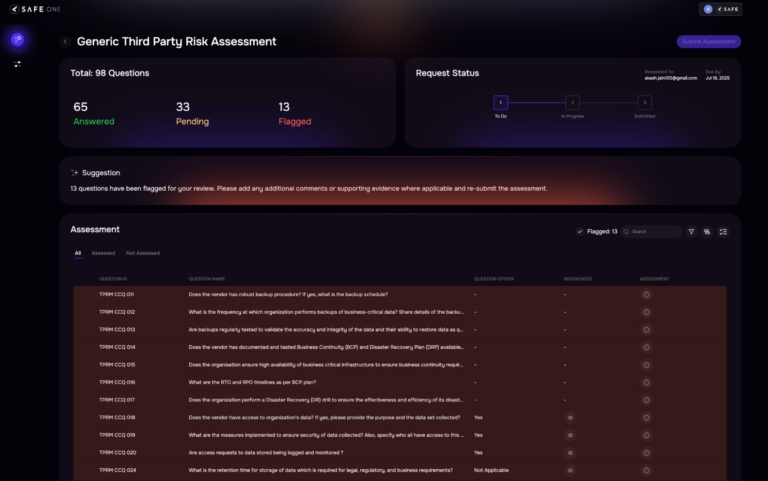
- AI-assisted evidence review: extraction from vendor documents, suggested answers with source citations, and flags on unsupported or contradictory responses, with your analyst making the call.
- Continuous monitoring of each vendor’s external footprint, breach signals, and vulnerabilities, with a clear view of what changed, so a material change can trigger reassessment.
- Issues and remediation tracking with owners, action plans, and exceptions, so SSDF gaps do not disappear after the review closes.
Teams see the difference in cycle time. Kyriba streamlined the assessment of 300+ vendors in one week, and San Francisco Health Plan speeds up third-party risk assessments by 90%. For related federal context, see our guides to FISMA third-party risk and CMMC subcontractor flow-down. Then see SAFE TPRM in action or schedule a demo.
Frequently Asked Questions
Not government-wide. OMB M-26-05 (January 23, 2026) rescinded M-22-18 and M-23-16, which had required agencies to obtain attestations before using covered software. Agencies may still choose to use the Common Form, and individual agencies or contracts can still require it, or require an SBOM on request. If you sell to federal agencies, check each contract. If you buy software, the form remains useful evidence, just not a mandate. This is general information, not legal advice; confirm obligations with counsel.
SSDF version 1.1 (NIST SP 800-218, February 2022) is the current final version. NIST released SSDF version 1.2 (SP 800-218 Rev. 1) as an initial public draft on December 17, 2025, in response to Executive Order 14306, and the comment period closed January 30, 2026. As of October 2026, NIST still lists Rev. 1 as a draft. Build your questions on 1.1 and watch for the final 1.2.
The SSDF (SP 800-218) describes secure development practices for software producers. SP 800-161 Rev. 1 describes how an acquiring organization manages cybersecurity supply chain risk across its enterprise, including strategy, policy, plans, and risk assessments for products and services. In TPRM terms, 800-161 shapes your program and the SSDF shapes the questions you ask software vendors. SAFE TPRM lets you build questionnaires around SSDF practice groups and route them by vendor tier, so both layers live in one workflow.
The SSDF is voluntary guidance. It was written so that any software producer can integrate its practices into its development lifecycle, and so that software acquirers can use it as a common vocabulary with suppliers. Federal contracts may impose it; outside that, it is a best-practice reference. Many private-sector buyers use it to structure software vendor due diligence because it is specific, public, and familiar to vendors.
Ask for evidence proportional to risk. For critical software: SSDF-aligned questionnaire responses, any existing attestation or third-party assessment, an SBOM on request and how often it is refreshed, a vulnerability disclosure policy with response timelines, and recent independent testing. For lower tiers, a shorter subset is enough. SAFE TPRM can reuse documents vendors have already submitted to answer new questions, which cuts repeat requests during reassessment.
There is no single government-wide SBOM mandate under M-26-05. The memo says agencies may adopt contract terms requiring a current SBOM on request, and that cloud platform terms should cover the runtime production environment. It also points agencies to CISA's 2025 Minimum Elements for an SBOM, published in draft in August 2025. Requirements therefore vary by agency and contract.
NIST SP 800-218A, finalized in July 2024, is an SSDF Community Profile for generative AI and dual-use foundation models. It adds practices, tasks, and considerations specific to AI model development across the lifecycle. If a vendor trains or fine-tunes models that process your data, ask SSDF questions plus the 800-218A additions. SAFE TPRM lets you add those questions to the vendor's tier-based questionnaire so AI suppliers are assessed in the same workflow as every other software vendor.