Singapore PDPA Third-Party Risk: Managing Data Intermediaries Under the Personal Data Protection Act

Who is accountable when your vendor mishandles personal data in Singapore?
You are. That is the short version of Section 4(3) of Singapore’s Personal Data Protection Act 2012 (PDPA): an organisation “has the same obligation under this Act in respect of personal data processed on its behalf and for its purposes by a data intermediary as if the personal data were processed by the organisation itself.”
A data intermediary is an organisation that processes personal data on behalf of another organisation. Think payroll processors, cloud hosts, IT vendors, contact centres, mailing houses, and the agency running your loyalty programme. Under Section 4(2), when a data intermediary processes personal data on your behalf under a contract evidenced or made in writing, it is directly bound by only a narrow set of obligations: protection (Section 24), retention limitation (Section 25), and notifying you of a data breach without undue delay (Section 26C(3)(a), or Section 26E where it acts for a public agency). Everything else, from consent and purpose to access, accuracy, overseas transfer, and breach assessment and notification to the Personal Data Protection Commission (PDPC), stays with you.
The stakes are real. Since 1 October 2022, the PDPC can impose financial penalties of up to 10% of an organisation’s annual turnover in Singapore where that turnover exceeds S$10 million, and up to S$1 million in other cases. Many of the PDPC’s published enforcement decisions involve a vendor somewhere in the chain. The PDPC’s own Guide to Managing Data Intermediaries (2020) draws its examples directly from those cases.
So the question for a privacy or TPRM lead is not whether your vendors are PDPA compliant. It is whether you can show the PDPC that you managed them as if the data never left your hands.
Why do data intermediary programs fail under the PDPA?
Four failure modes recur in the PDPC’s guidance and the decisions it cites.
The obligations were never written down
Section 4(2) only narrows a data intermediary’s direct obligations when processing happens under a contract evidenced or made in writing. The PDPC Guide is blunt: “It is a breach of the PDPA if there is no contractual agreement or document setting out the key obligations and responsibilities of the DI.” It also notes that an organisation can be a data intermediary even when the contract does not label it one. If your IT support vendor touches customer data and the agreement says nothing about protection or retention, you have a gap regardless of what you call them.
The contract exists, but the requirements were never communicated
The PDPC expects organisations to “articulate their business requirements, work with their vendors on a set of agreed technical measures, and to follow through with proper testing based on risk scenarios derived from the business requirements.” A generic data protection clause does not tell a web developer how to handle personal data in a new customer portal. The data controller is “ultimately responsible for determining the scope of responsibilities and security requirements,” according to the Guide.
The vendor fixed the breach and never told you
One of the PDPC’s own examples: an IT vendor managing a customer portal accidentally exposed one customer’s data to others, fixed the error, and did not notify the organisation. The organisation found out from customer complaints. Since 1 February 2021, a data intermediary that has reason to believe a breach has occurred must notify you without undue delay. Your clock then starts. You must assess whether the breach is notifiable in a reasonable and expeditious manner, and if it is, notify the PDPC no later than three calendar days after you make that assessment. If your vendor does not report promptly, you cannot meet that timeline.
The contract ended, the data did not
The Retention Limitation Obligation binds the data intermediary directly, but exit is where it usually fails. Data sits in a former vendor’s backup, a test environment, or a subcontractor’s system long after the purpose ended. The PDPC’s Guide treats exit management as a full stage of the lifecycle, with clear timeframes for ceasing retention and exit audits to confirm it happened.
What framework should you use to manage data intermediaries?
The PDPC gives you one. Its Guide describes a four-stage Data Intermediary Management Lifecycle: Governance and Risk Assessment, Policies and Practices, Service Management, and Exit Management. Run each stage with a named owner, a defined evidence set, and an output you could hand to the PDPC. This is also how SAFE TPRM organises the vendor lifecycle, from intake through offboarding, so the regulator’s model and the platform’s workflow line up.
First, decide how much rigour each vendor gets. The PDPC’s Annex A recommends additional measures for “complex data processing activities,” meaning a significant scale of personal data, sensitive types of personal data, or both. Use that as your tiering line. A vendor processing NRIC numbers, financial details, or health data for 50,000 customers is Tier 1. A photographer covering your conference is not.
Stage A: Governance and risk assessment
Owner: senior management, with the DPO and business owner. The PDPC says the decision to outsource and its scope “should be determined by the senior management” of the organisation. The output is a documented rationale covering business objectives, the scale and sensitivity of the data, high-level risks, and the requirements that will go into the contract. For evaluation and selection, check that the intermediary has a data protection framework, staff training, and security arrangements suited to the data. The Guide suggests considering external validation such as the Data Protection Trustmark (DPTM) or APEC certifications for complex processing. Our data privacy vendor questionnaire covers the core questions.
Stage B: Policies, practices, and the contract
The contract is the PDPC’s “primary means” of ensuring protection and retention. Annex B of the Guide lists clauses to consider, including:
- Prohibition on use or disclosure for unauthorised purposes.
- Specific protection measures, such as database encryption or not storing full NRIC numbers.
- Prohibition on sub-contracting without your approval, and flow-down of the same obligations to any sub-contractor.
- Reporting signs of abnormalities and data incidents without undue delay.
- Overseas transfer conditions, so data only goes where a comparable standard of protection applies, consistent with Section 26.
- Your rights to request audits and conduct on-site inspections.
- Timely return, destruction, deletion, or anonymisation of the data when no longer required.
Then agree standard operating procedures for operations, regular management reports, and ad hoc incident reports, including the escalation path. For more on clause design, see our guide to vendor contract risk management.
Do not stop at the first tier of the chain. Your intermediary’s own sub-contractors process the same data, and the PDPC’s suggested clauses require the same obligations to flow down to them. Ask every Tier 1 intermediary for a current list of sub-contractors that touch your data, the countries where processing happens, and how they oversee those parties. Refresh that list at each review, because cloud and support arrangements change more often than contracts do. The fourth-party cyber exposure questionnaire is a practical way to collect it, and our guide to fourth-party risk management covers what to do with the answers.
Stage C: Service management
This is ongoing oversight. The PDPC describes onboarding and training for the intermediary’s staff, regular management meetings, proactive monitoring by the intermediary (database and access logs), periodic audits or independent audit reports, on-site inspections, and table-top exercises to test incident reporting. The frequency should follow the risk profile. For Tier 1, an annual review plus a breach-notification drill is a sensible floor. Add external evidence too. Continuous monitoring of the vendor’s internet-facing infrastructure surfaces exposures and breach signals between reviews.
Stage D: Exit management
Set exit plans before you need them. The Guide recommends clear timeframes for the intermediary to cease retaining personal data, full handover of documentation, exit audits and checks, and secure migration if the data moves to a new provider. Capture a written confirmation of destruction or return. The vendor exit security attestation questionnaire gives you the structure.
Breach readiness across all four stages
Run the three-day PDPC timeline backwards. If you need, say, 24 hours to assess and prepare a notification once you have the facts, your vendor must report within hours of having reason to believe a breach occurred, not at the end of their own investigation. A breach is notifiable if it results, or is likely to result, in significant harm to an affected individual, or is of significant scale. The prescribed scale threshold is 500 affected individuals. Write the reporting expectation, the contact path, and the minimum facts into the contract and the SOP, then test it.
What breaks when you manage 200, 1,000, or 5,000 data intermediaries?
At 200 vendors, perhaps 40 process personal data on your behalf. A DPO and one analyst can hold the contracts, SOPs, and annual reviews in their heads and a shared drive.
At 1,000 vendors, 200 or more are intermediaries. Contract terms vary by vintage, sub-contractor lists are out of date, and nobody is certain which vendors hold data overseas. The breach-notification path you designed exists for your top 20 vendors and is assumed for the rest.
At 5,000 vendors, common for a regional bank, insurer, or telco, the lifecycle stops being a lifecycle. Onboarding still happens because procurement forces it. Service management and exit management quietly stop, and those are precisely the stages the PDPC’s enforcement examples come from.
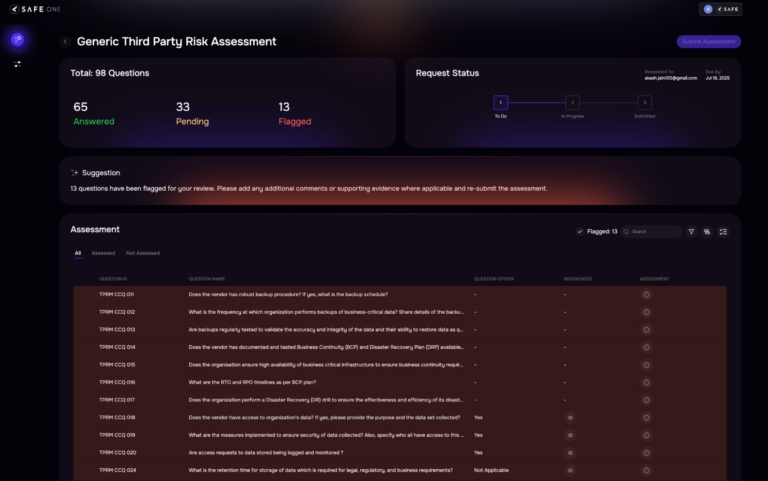
SAFE TPRM keeps all four stages running at that volume. Intake captures data types and processing context so complex processing is flagged from the start. Document Analyzer reads the vendor’s policies, certifications, and audit reports and maps them to your questions. Outside-In monitoring covers every vendor continuously. Remediation and offboarding are tracked as workflow states, not calendar reminders.
What trade-offs do privacy and TPRM teams face with data intermediaries?
Audit rights versus practicality. The PDPC suggests audit and inspection rights, and you should have them for Tier 1. But you cannot audit 200 intermediaries a year. Most teams rely on independent reports for the majority and reserve inspections for the highest-risk handful.
Standard contracts versus negotiated terms. Large cloud providers will not accept your data processing addendum. You accept their terms and compensate with configuration controls and monitoring. Smaller vendors will sign your terms but may lack the capability to meet them.
Privacy team versus security team. Privacy owns the PDPA relationship. Security owns the controls review. Without a shared record, each assumes the other covered the gap.
SAFE TPRM resolves the last trade-off most directly: one vendor record with intake context, assessment evidence, contract analysis, monitoring findings, and remediation history that both teams work from. For the first two, AI-assisted review of the evidence a vendor already has, and continuous external monitoring, give you more assurance per vendor without adding audit days.
Why SAFE TPRM for PDPA data intermediary oversight?
We built SAFE TPRM because the PDPA puts accountability on you while the data sits with someone else. SAFE supports the evidence, assessment, monitoring, and reporting work that demonstrates that accountability. It does not make you PDPA compliant, and it does not replace your DPO’s judgment.
- Structured intake. Record what personal data a vendor processes, whether it is sensitive, the scale, and where it is processed. The Intake Score captures inherent risk at intake; the Exposure Score tracks residual risk as evidence and monitoring data arrive.
- Evidence and contract intelligence. Document Analyzer extracts relevant information from security and privacy evidence. Contract Analyzer helps surface contractual language relevant to your review. AI review flags discrepancies between vendor answers and supporting documents, with citations.
- Continuous Outside-In monitoring. Watch each intermediary’s external posture, including vulnerabilities, email security, breach signals, and credential exposure, and see what changed.
- Issues, exceptions, and reassessment. Convert gaps into tracked issues with owners and deadlines, and trigger reassessment on material events.
- Onboarding and offboarding as governed stages. Offboarding tracks open issues, outstanding evidence, and the audit history for the vendor.
- Portfolio reporting for the DPO, risk committee, and board.
If you also operate under GDPR, compare our pages on GDPR processor due diligence and India’s DPDP Act and data processors. To see the platform on your own vendor list, watch SAFE TPRM in action or schedule a demo.
Frequently Asked Questions
A data intermediary is an organisation that processes personal data on behalf of another organisation. Processing includes recording, holding, organising, adapting, retrieving, combining, transmitting, and erasing or destroying data. When it processes under a contract evidenced or made in writing, Section 4(2) limits its direct obligations to protection, retention limitation, and notifying the engaging organisation of a breach. The PDPC notes an organisation can be a data intermediary even if the contract does not label it one, so classify vendors by what they actually do with personal data.
The organisation that engaged the intermediary. Under Section 26C, the intermediary must notify that organisation without undue delay once it has reason to believe a breach occurred. The organisation must then assess whether the breach is notifiable, and if it is, notify the PDPC no later than three calendar days after making that assessment under Section 26D, and notify affected individuals where required. Because the intermediary's speed drives your timeline, SAFE TPRM lets you capture each vendor's incident notification commitments during assessment and track gaps as issues.
For contraventions on or after 1 October 2022, the PDPC can impose a financial penalty of up to 10% of an organisation's annual turnover in Singapore if that turnover exceeds S$10 million, and up to S$1 million otherwise. The organisation remains accountable for data processed by its intermediaries under Section 4(3), and an intermediary can also be penalised for breaching its own Protection or Retention obligations. The PDPC weighs factors including the nature and duration of the non-compliance and whether adequate measures were in place.
Yes. Financial institutions regulated by the Monetary Authority of Singapore face MAS expectations on outsourcing and technology risk on top of the PDPA. For banks, MAS Notice 658 on Management of Outsourced Relevant Services and the Guidelines on Outsourcing (Banks) took effect on 11 December 2024. These sit alongside the PDPA rather than replacing it. Our guide to TPRM in financial services covers the wider regulatory picture.
Certification helps, but it does not replace your accountability. The PDPC Guide suggests considering whether an intermediary's practices are externally validated, for example through the Data Protection Trustmark or APEC certifications, as part of due diligence. You still need a written contract, clear requirements, and ongoing oversight proportionate to the data. SAFE TPRM can analyse certifications and audit reports a vendor provides, map them to your questions, and highlight what they do not cover.
No. This page summarises the PDPA and PDPC guidance as general information for privacy, security, and TPRM practitioners. The official text on Singapore Statutes Online and the PDPC's current advisory guidelines prevail. Work with your DPO and legal counsel on how the PDPA applies to your organisation and your vendor arrangements.