The TPRM Mind Map 2027: Who Really Owns Third-Party Risk Now

Nine roles, seven shared enablers and one simple idea: third-party risk is no longer one team’s job. Here is the first complete map of who owns what, and how to put it to work on Monday.
01 · WHY THIS MAP
The question I hear more than any other
Every week, someone asks me a version of the same question: “Who actually owns third-party risk in our company?”
Sometimes it is a new TPRM manager who has inherited a spreadsheet of 3,000 vendors. Sometimes it is a CISO who has just been asked by the board why a supplier’s breach became their headline. Sometimes it is a procurement leader who is tired of being called “the bottleneck.”
The honest answer has always been uncomfortable: everyone, and therefore no one. Security assumes procurement checked. Procurement assumes legal covered it in the contract. Legal assumes the business owner knows what the vendor does. And the business owner assumes “risk” approved it, so it must be fine.
That gap used to be survivable. It is not anymore.
| ~48%
of breaches now involve a third party, up 60% year on year VERIZON DBIR 2026 |
45%
of organizations had third-party business interruptions in two years GARTNER, 2023 |
6%
of organizations are effective across all three TPRM outcomes GARTNER, 2023 |
Put those three numbers side by side and the story writes itself. Third parties are now involved in close to half of all breaches. Almost half of organizations have already felt a third-party disruption. And only a sliver say their TPRM program is actually working.
I do not think that is because TPRM teams are not working hard. In my experience, they are some of the hardest-working people in the building. It is because we have been asking one team to carry a responsibility that is spread across nine.
02 · THE MISSING PICTURE
Why the industry needs a TPRM mind map
We have no shortage of TPRM frameworks. There are lifecycle models, questionnaire standards such as SIG and CAIQ, control catalogs, maturity models and regulatory guidance from DORA to the OCC. What we have never had is a simple, shared picture of who does what across the organization.
To my knowledge, there is no widely adopted TPRM roles and responsibilities map that people can put on a slide, pin to a wall, or use to start a hard conversation with a peer. RACI charts exist, but they live inside individual policies and rarely travel. So every program reinvents the same picture from scratch, usually after an incident.
The TPRM Roles & Responsibilities Mind Map 2027 is my attempt to fix that. It is built from what we see across the programs SAFE works with, the TPRM playbooks we have published this year, and the shift we are watching in regulation and technology. It is not meant to be the last word. It is meant to be a shared starting point, something any TPRM leader can take, adapt and make their own.
You can outsource the work to a vendor. You cannot outsource the accountability.
03 · THE FOUNDATION
First, what a TPRM program actually is in 2027
Strip away the jargon and third-party risk management answers three questions about every outside relationship that matters: What could go wrong? How bad could it be? And what are we doing about it? Every framework, checklist and questionnaire is just a structured way of answering those three questions, vendor by vendor.
What has changed is the shape of the answer. For most of the last decade, TPRM meant one questionnaire a year, a spreadsheet and a folder of SOC 2 reports. In 2027, a credible program is a continuous loop that follows a relationship from the first request to the final exit. At SAFE, we describe it as six core stages, with two activities running across all of them.
| STAGE | WHAT HAPPENS | WHAT IT PRODUCES |
|---|---|---|
| 1. Intake and tiering | Record the service, the owner, the data and access involved, and the impact of failure. Set an inherent risk tier. | A vendor record, an accountable owner, a tier |
| 2. Due diligence | Collect evidence proportionate to the tier and check it covers the service you will actually use. | An assessment with findings and a recommendation |
| 3. Contracting and onboarding | Turn findings into contract conditions, record the decision and any accepted risk, and scope access. | A documented decision and agreed obligations |
| 4. Continuous monitoring | Watch for incidents, new exposures, expired evidence and changes in how the vendor is used. | A current risk view and triggered reviews |
| 5. Remediation and incidents | Give every material finding an owner, a deadline and proof of closure; coordinate vendor incidents. | Verified fixes or a documented response |
| 6. Offboarding and exit | Revoke access, close integrations, confirm data return or disposal, and protect continuity. | A completed, auditable exit record |
| Across all stages | Inventory and discovery underneath; reporting and governance on top. | One source of truth and a board-ready view |
Here is the part most programs miss. Each of those stages has a different natural owner. Procurement controls the front door. Legal controls the contract. The CIO controls continuity. The business owner knows what the vendor actually does. A lifecycle is only as strong as the people holding each link, which brings us to the map.
04 · ORIENTATION
How to read the mind map
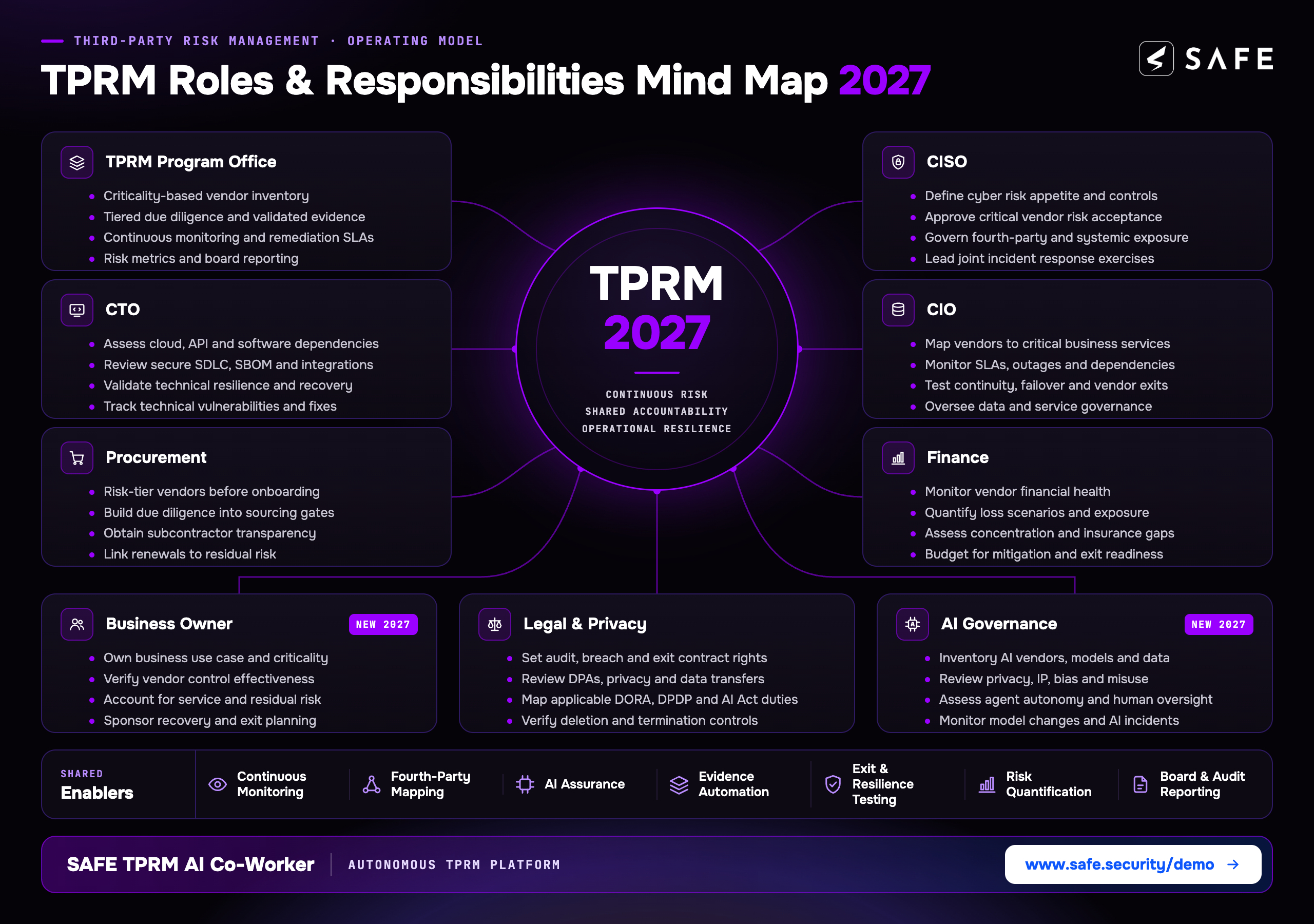
The map has three layers, and each one carries a message.
- The hub: TPRM 2027. Around it sit three words that define the modern program: continuous risk (not annual), shared accountability (not one team) and operational resilience (not just security).
- The nine roles. The TPRM Program Office, CISO, CTO and Procurement on one side; the CIO, Finance and Legal & Privacy on the other; and two roles marked New 2027: the Business Owner and AI Governance. Each has four responsibilities, deliberately kept short enough to fit on one line.
- The shared enablers. Seven capabilities along the bottom that every role depends on: continuous monitoring, fourth-party mapping, AI assurance, evidence automation, exit and resilience testing, risk quantification, and board and audit reporting. No single role owns them, and every role is weaker without them.
Below, I walk through each role: what it owns, why it matters right now, the one question it should be able to answer, and the SAFE templates I would hand that person on day one.
05 · ROLES & RESPONSIBILITIES
The nine roles, one by one
ROLE 01 · THE CONDUCTOR
TPRM Program Office
The program office is the hub that keeps every other box on the map in sync. It is not the team that “does TPRM” for everyone else. Think of it as the conductor of an orchestra: it does not play every instrument, but without it you get nine people playing nine different songs.
WHAT THIS ROLE OWNS ON THE MAP
- Criticality-based vendor inventory. One source of truth for every third party, ranked by what it touches, not by contract value. In SAFE’s experience, most organizations miss 20 to 40 percent of their third parties through shadow IT, card purchases and subcontractors.
- Tiered due diligence and validated evidence. Depth of review matched to risk, and evidence that is checked rather than just collected.
- Continuous monitoring and remediation SLAs. Clear timelines for fixing what is found, with escalation when deadlines slip.
- Risk metrics and board reporting. Outcomes, not activity. “We completed 150 assessments” tells a board nothing. “We found 12 critical risks and here is what we are doing about each” tells it everything.
WHY IT MATTERS IN 2027
Gartner’s own research is blunt about the state of most programs. Its December 2023 survey of 376 senior executives found that only 6 percent of organizations were effective across all three TPRM outcomes it measured, and its analyst described traditional TPRM as “resource-intensive, overly process-oriented and has little to show for in terms of results“. That is not a technology problem first. It is a coordination problem, and coordination is exactly what the program office exists to solve.
The math also matters. SAFE’s own working estimate is roughly 40 hours for a manual critical-vendor assessment, which means 80 critical and high-risk vendors equals about 1.6 full-time people doing nothing but assessments. When the math does not close, coverage quietly drops. The program office is the role that has to notice that and say it out loud.
| THE QUESTION THIS ROLE MUST BE ABLE TO ANSWER Do we know every third party we depend on, which ones matter most, and what we are doing about the risks in the critical few? |
FROM THE SAFE TPRM PLAYBOOK
- Third-Party Cyber Risk Management Program Checklist: the structure for standing up the whole program.
- Vendor Risk Assessment Checklist: 147 questions across six stages, onboarding to renewal.
- Shadow SaaS and AI Vendor Discovery Checklist: for the vendors nobody told you about.
- Guides: how to tier vendors, TPRM metrics and KPIs and the vendor risk program maturity guide.
ROLE 02 · THE RISK APPETITE OWNER
CISO
The CISO’s job on this map is not to review every questionnaire. It is to set the rules of the game: how much cyber risk the organization is willing to carry through its vendors, and who gets to say yes when a critical vendor falls short.
WHAT THIS ROLE OWNS ON THE MAP
- Define cyber risk appetite and controls. The minimum control expectations for each tier, written down before the first vendor shows up.
- Approve critical vendor risk acceptance. When a critical vendor cannot fix a gap in time, someone with authority has to accept it on the record. That is a CISO decision, not an analyst’s.
- Govern fourth-party and systemic exposure. The risk that sits in your vendors’ vendors, and in the handful of providers everyone depends on at once.
- Lead joint incident response exercises. Rehearse a vendor breach with your critical vendors before it is real.
WHY IT MATTERS IN 2027
The 2026 Verizon Data Breach Investigations Report found a third party involved in nearly half of all breaches, up 60 percent year on year. SAFE’s analysis of the report puts the figure at 48 percent. Third-party risk is no longer a subset of breach risk. It is close to half of it.
Fourth-party exposure is where this gets uncomfortable. In August 2025, attackers used stolen OAuth tokens from the Salesloft Drift integration to pull data from Salesforce instances at more than 700 organizations, including several well-known security vendors. Most of those companies never had a direct breach. They had a connected app. That is a systemic exposure question, and it belongs at the CISO’s level.
| THE QUESTION THIS ROLE MUST BE ABLE TO ANSWER If our most critical vendor, or the provider behind it, were breached tonight, who would we call first, what would we cut off, and what is our exposure? |
FROM THE SAFE TPRM PLAYBOOK
- Vendor Data Breach Response Checklist: First 48 Hours: run the first two days before you need to.
- Vendor Identity and Privileged Access Security Questionnaire: 28 checks on the logins you handed to vendors.
- Also in the library: the Fourth-Party Cyber Exposure Questionnaire and the Vendor Incident Exposure Readiness Questionnaire.
- Guides: fourth-party risk management best practices and vendor incident response.
ROLE 03 · THE DEPENDENCY MAPPER
CTO
Every modern product is stitched together from cloud services, APIs, open-source libraries and SaaS integrations. The CTO is the person who actually knows how those pieces connect, which makes the CTO the only person who can tell you what a vendor failure really breaks.
WHAT THIS ROLE OWNS ON THE MAP
- Assess cloud, API and software dependencies. Which vendors sit inside your product and data flows, not just on your invoice list.
- Review secure SDLC, SBOM and integrations. How vendors build what you run, what is inside it, and how it connects to your systems.
- Validate technical resilience and recovery. Whether the vendor can actually come back from an outage at the speed your product needs.
- Track technical vulnerabilities and fixes. Vendor-side exposures followed to closure, not just logged.
WHY IT MATTERS IN 2027
Vulnerability exploitation has now overtaken stolen credentials as the most common way attackers get in, according to the 2026 DBIR. The same report found only 26 percent of known exploited vulnerabilities were fully remediated, down from 38 percent, and the median time to a full patch grew from 32 to 43 days (Help Net Security summary of the DBIR). When those unpatched systems belong to a vendor with an API key into your environment, the CTO’s architecture is the attack surface.
| THE QUESTION THIS ROLE MUST BE ABLE TO ANSWER Which vendors run inside our product or data flows, and how fast could we isolate any one of them without taking ourselves down? |
FROM THE SAFE TPRM PLAYBOOK
- Vendor Vulnerability and Patch Management Questionnaire: 32 checks across eight control domains.
- SaaS Vendor Security Questionnaire: 40 questions across 12 domains.
- Also in the library: the Software Supply Chain and SBOM Security Questionnaire (48 checks) and the Fintech API and Integration Security Questionnaire.
- Guides: software bill of materials (SBOM) and cyber supply chain risk management.
ROLE 04 · THE RESILIENCE OWNER
CIO
If the CTO knows how the pieces fit, the CIO knows what the business cannot live without. On the map, the CIO turns a vendor list into a map of critical business services, and then asks the uncomfortable question: what happens on the day one of them stops?
WHAT THIS ROLE OWNS ON THE MAP
- Map vendors to critical business services. Payroll, claims, payments, customer support: which vendors keep each one running.
- Monitor SLAs, outages and dependencies. Performance and availability, not just security posture.
- Test continuity, failover and vendor exits. A tested exit plan for every critical vendor, not a paragraph in a policy.
- Oversee data and service governance. Where your data lives, who can reach it, and how it comes back.
WHY IT MATTERS IN 2027
The faulty CrowdStrike update on 19 July 2024 hit about 8.5 million devices, and the insurer Parametrix estimated roughly $5.4 billion in direct losses for the Fortune 500. Nobody was hacked. A trusted vendor made a mistake, and concentration did the rest.
Regulators have noticed. Under the EU’s Digital Operational Resilience Act (DORA), which has applied since January 2025, financial entities must keep a register of their ICT third-party arrangements, and in November 2025 the European Supervisory Authorities designated 19 critical ICT third-party providers for direct oversight, including Amazon Web Services, Google Cloud and Microsoft. Resilience is now a supervised obligation, not a best practice.
| THE QUESTION THIS ROLE MUST BE ABLE TO ANSWER For each critical business service, which vendors keep it running, and have we actually tested what happens if one of them disappears? |
FROM THE SAFE TPRM PLAYBOOK
- Vendor Offboarding and Exit Template: plan the full transition, including for critical services.
- Vendor Exit Security Attestation Questionnaire: confirm access, data and integrations are really gone.
- Also in the library: the Cloud Infrastructure Provider Security Questionnaire (48 checks) and the Vendor Cyber Recovery and Ransomware Resilience Questionnaire.
- Guide: continuous vendor monitoring.
ROLE 05 · THE FRONT DOOR
Procurement
Procurement is where most vendors first walk into the building. That makes it the cheapest place to catch risk and the most expensive place to miss it. Once a contract is signed and the integration is live, every fix costs more.
WHAT THIS ROLE OWNS ON THE MAP
- Risk-tier vendors before onboarding. No purchase order for a high-impact service without a tier.
- Build due diligence into sourcing gates. Risk review becomes a step in the buying process, not a parallel track that slows it down.
- Obtain subcontractor transparency. Ask who your vendor depends on before you depend on them.
- Link renewals to residual risk. A renewal is leverage. Use it to close open findings.
WHY IT MATTERS IN 2027
In a Gartner survey of 100 executive risk committee members, 84 percent said third-party risk misses had caused operational disruption. Many of those misses start at the moment a vendor is approved without anyone asking what it will touch.
The fix is not more paperwork. It is better sequencing. A tier at intake decides which questionnaire goes out, how deep the review goes and how often the vendor is checked again. Get that first step right and everything downstream gets lighter.
| THE QUESTION THIS ROLE MUST BE ABLE TO ANSWER Can any new vendor reach a signed contract without a risk tier, and do our renewals ever depend on whether findings were fixed? |
FROM THE SAFE TPRM PLAYBOOK
- Startup Vendor Security Questionnaire (no SOC 2 report): for early-stage vendors you still want to buy from.
- Vendor SOC 2 Report Review Checklist: read the report, not just its cover page.
- Also in the library: the Vendor Onboarding Security Questionnaire (37 questions across 11 domains) and the SIG-aligned Vendor Assessment Checklist.
- Guides: vendor due diligence and vendor contract risk management.
ROLE 06 · THE TRANSLATOR
Finance
Finance turns third-party risk into the language boards actually act on: money. “This vendor is high risk” starts a debate. “This vendor carries an estimated loss exposure larger than our insurance limit” starts a decision.
WHAT THIS ROLE OWNS ON THE MAP
- Monitor vendor financial health. A vendor that goes bankrupt is a continuity event, not just a commercial one.
- Quantify loss scenarios and exposure. What a realistic vendor failure would cost, in dollars, using a consistent method such as FAIR.
- Assess concentration and insurance gaps. Where several critical functions rely on one provider, and where your policy would not cover the loss.
- Budget for mitigation and exit readiness. Fund the fixes and exit plans that the numbers say are worth it.
WHY IT MATTERS IN 2027
IBM’s 2026 Cost of a Data Breach report put the global average breach at a record $4.99 million and the US average at $11.5 million (Baker Donelson summary). And insurance is not the safety net many assume: for the CrowdStrike outage, Parametrix estimated that cyber cover would pay no more than 10 to 20 percent of Fortune 500 losses.
The ripple effect can dwarf the original event. The Cyber Monitoring Centre estimated the 2025 Jaguar Land Rover attack cost the UK economy about £1.9 billion and affected more than 5,000 organizations, many of them suppliers who were never attacked themselves.
| THE QUESTION THIS ROLE MUST BE ABLE TO ANSWER Which five vendors carry our largest loss exposure in dollars, and how much of that is actually covered? |
FROM THE SAFE TPRM PLAYBOOK
- Vendor Cyber Loss Scenario Questionnaire: 28 checks across seven control domains, built for quantification.
- Vendor Cyber Insurance Evidence and Residual Risk Checklist: 30 checks on what the vendor’s cover really protects.
- Both are part of the SAFE TPRM template library. For the method, see the FAIR-based approach in TPRM automation.
ROLE 07 · THE ACCOUNTABLE OWNER
Business Owner NEW 2027
This is the first of the two roles that are new on the 2027 map, and it may be the most important change of all. For years, the business owner was treated as a requester: someone who wanted a tool and waited for “risk” to approve it. That model is broken. You can outsource the work. You cannot outsource the accountability.
WHAT THIS ROLE OWNS ON THE MAP
- Own the business use case and criticality. Only the business owner truly knows what the vendor will do, what data it needs and what breaks if it fails.
- Verify vendor control effectiveness. Not by reading a SOC 2 report, but by confirming the controls that matter for this use case are actually in place.
- Account for service and residual risk. Once a risk is accepted, the person who benefits from the vendor owns the leftover risk.
- Sponsor recovery and exit planning. If this vendor disappears, the business owner should already know the plan B.
WHY IT MATTERS IN 2027
Here is a pattern from our own playbook that we see again and again. A company onboards a customer-support platform. Months later, the vendor switches on a new AI feature that processes customer conversations. Security did not change anything. Procurement did not change anything. The business owner is the only person who notices, and only if they know it is their job to notice.
Intake is where this starts. The risk tier set in the first hour drives everything that follows, and the tier is only as good as what the business owner tells you about the relationship.
| THE QUESTION THIS ROLE MUST BE ABLE TO ANSWER For every vendor I sponsor, can I explain what it does for us, what data it touches, what would happen if it failed, and what we would do next? |
FROM THE SAFE TPRM PLAYBOOK
- Vendor Risk Assessment Questionnaire: a seven-step assessment business owners can follow.
- Vendor Offboarding and Exit Template: the exit plan the business owner sponsors.
- Also in the library: the Minimum Cybersecurity Checklist for Low-Risk Vendors (12 checks), so low-risk work stays light.
- Guide: the vendor risk assessment process.
ROLE 08 · THE OBLIGATIONS MAPPER
Legal & Privacy
Contracts are where your risk opinion becomes enforceable. Legal and privacy teams turn findings into rights: the right to audit, to be told about a breach, to get your data back, and to leave.
WHAT THIS ROLE OWNS ON THE MAP
- Set audit, breach and exit contract rights. Notification timelines, audit access, subcontractor terms and exit assistance, agreed before signature.
- Review DPAs, privacy and data transfers. Who processes what data, where, and under which safeguards.
- Map applicable DORA, DPDP and AI Act duties. Know which regulations apply to which vendor relationships.
- Verify deletion and termination controls. Confirm data is actually returned or destroyed at the end.
WHY IT MATTERS IN 2027
The regulatory calendar is crowded, and most of it lands on third parties. In India, the Digital Personal Data Protection Rules were notified on 14 November 2025 with an 18-month phase-in for core obligations, which points to around May 2027. They require security clauses in processor contracts, notification to the Data Protection Board within 72 hours of a breach, and penalties of up to ₹250 crore (India Briefing).
In Europe, DORA already applies to financial entities. And the EU’s AI Omnibus, in force since 27 July 2026, moved the deadline for stand-alone high-risk AI systems to 2 December 2027. Deferred is not cancelled. Contracts signed in 2027 will still be in force when those duties bite.
| THE QUESTION THIS ROLE MUST BE ABLE TO ANSWER For every critical vendor, can we prove we have the right to audit, the right to be told within our regulatory deadline, and the right to get our data back? |
FROM THE SAFE TPRM PLAYBOOK
- Vendor Exit Security Attestation Questionnaire: 24 checks to confirm deletion and termination.
- Also in the library: the Vendor Data Processing Security Schedule Review Checklist (32 checks) and the Data Privacy and GDPR Vendor Questionnaire.
- Guides: vendor contract risk management and GDPR and third-party risk.
ROLE 09 · THE NEWEST SEAT AT THE TABLE
AI Governance NEW 2027
Two years ago, this box would not have been on any TPRM chart. Today it is the fastest-growing source of third-party risk most organizations have. Every vendor is becoming an AI vendor, often without a new contract, a new review or even an announcement.
WHAT THIS ROLE OWNS ON THE MAP
- Inventory AI vendors, models and data. Which vendors use AI, which models they rely on, and what of your data goes into them.
- Review privacy, IP, bias and misuse. Training on your data, ownership of outputs, fairness and abuse.
- Assess agent autonomy and human oversight. What an AI agent is allowed to do on its own inside your systems, and who can stop it.
- Monitor model changes and AI incidents. A model update is a material change. Treat it like one.
WHY IT MATTERS IN 2027
IBM’s 2026 breach data makes the case on its own. Incidents involving employee use of shadow AI rose to 43 percent, from 20 percent a year earlier, and cost an average of $5.39 million. Among organizations with an AI-related incident, 92 percent lacked proper AI access controls and 68 percent had no AI governance policy (Baker Donelson summary). The 2026 DBIR similarly found shadow AI had become the third most common non-malicious insider action in its data-loss dataset.
AI governance does not replace the CISO or legal. It gives them a specialist who can ask the questions a standard security questionnaire never covered: what the model was trained on, how it is updated, and how far an agent is allowed to act without a human.
| THE QUESTION THIS ROLE MUST BE ABLE TO ANSWER Which of our vendors use AI on our data today, what are those systems allowed to do on their own, and how would we know if that changed? |
FROM THE SAFE TPRM PLAYBOOK
- LLM Vendor Risk Questionnaire: 46 questions across 12 domains, built for AI and model vendors.
- Shadow SaaS and AI Vendor Discovery Checklist: find the AI tools already in use.
- Guide: how to run an AI vendor risk assessment.
06 · THE FOUNDATION EVERY ROLE STANDS ON
The seven shared enablers
If the roles are the people, the enablers are the plumbing. They sit at the bottom of the map because everything above them leaks without them. Notice that none belongs to a single role. That is the point.
| ENABLER | WHAT IT MEANS IN PRACTICE | WHO LEANS ON IT MOST |
|---|---|---|
| Continuous monitoring | Outside-in signals, evidence expiry and usage changes watched every day, not once a year. A change only matters if it reaches someone who can act. | Program Office, CISO, CIO |
| Fourth-party mapping | Knowing which of your vendors share the same sub-processors, clouds and integrations, so one breach can be traced to every exposed relationship. | CISO, CIO, Finance |
| AI assurance | Evidence that a vendor’s AI does what it claims, within agreed limits, with a human able to intervene. | AI Governance, Legal & Privacy |
| Evidence automation | Collecting, reading and checking documents and answers by machine, so analysts spend time on judgment instead of chasing PDFs. | Program Office, Procurement |
| Exit and resilience testing | Exit plans and failover that have actually been exercised for critical vendors. | CIO, Business Owner |
| Risk quantification | Expressing vendor risk as estimated loss in dollars, using a consistent model such as FAIR. | Finance, CISO, Board |
| Board and audit reporting | A current, outcome-based view of third-party risk that leadership and auditors can act on. | Program Office, CISO |
07 · FROM MAP TO OPERATING MODEL
Putting it together: who leads each stage
A map is useful. An operating model is better. Here is how I would translate the mind map onto the six lifecycle stages as a starting point. Your organization will move some boxes around, and it should. What matters is that every row has a name in it.
| LIFECYCLE STAGE | LEADS | MUST WEIGH IN | MAKES THE CALL |
|---|---|---|---|
| Intake and tiering | Business Owner, Program Office | Procurement; AI Governance if AI is involved | Program Office sets the tier |
| Due diligence | Program Office | CTO, CISO team, Legal & Privacy, AI Governance | CISO for critical risk acceptance |
| Contracting and onboarding | Procurement, Legal & Privacy | Program Office, Finance | Business Owner with an authorized approver |
| Continuous monitoring | Program Office | CIO (SLAs), CTO (vulnerabilities), Finance (financial health), AI Governance (model changes) | CISO on escalation |
| Remediation and incidents | CISO, Program Office | CTO, CIO, Legal & Privacy | CISO, with the Business Owner |
| Offboarding and exit | Business Owner, CIO | Legal & Privacy, CTO | Business Owner |
| Reporting | Program Office | Finance (quantified exposure) | Executive sponsor and board |
08 · THINKING DIFFERENTLY
Four myths this map quietly retires
Myth 1: “TPRM is the security team’s job.”
Security owns a slice of it, an important one. But look at the map again: of the nine roles, only one is the CISO. The biggest failures I see happen in the boxes nobody thought were theirs, like the business owner who never mentioned the vendor was getting access to customer data.
Myth 2: “A completed questionnaire is an assessment.”
A questionnaire returned with 200 answers of “yes,” no evidence and no explanation tells you very little. The assessment is never about the answers. It is about the evidence behind them, and about whether that evidence covers the service you actually use.
Myth 3: “A security rating is a decision.”
A rating is a useful outside-in signal. It is not a decision. A decision needs the context of your relationship: what the vendor does for you, what it touches, how critical it is and what you agreed in the contract. That context lives across the nine roles, not in a score.
Myth 4: “AI will replace the TPRM team.”
This is the one I care most about, because I think the opposite is true. AI is very good at the work that buries TPRM teams today: collecting documents, reading them, chasing vendors and spotting what changed. It is not a substitute for judgment, for accepting risk on the record, or for knowing your own business. The map gets more important as automation grows, because someone still has to own every decision AI prepares.
| THE POSITIVE VERSION OF ALL FOUR MYTHS
Automate the collection. Share the accountability. Keep humans on the decisions. That is what a 2027 TPRM program looks like, and it is far more achievable than most teams think. |
09 · MAKE IT REAL
How to use the map on Monday morning
You do not need a transformation program to start. You need an hour, a printout of the map and a few honest conversations.
- Put a name in every box. For each of the nine roles, write the name of a real person. Empty boxes are your biggest risks. Boxes with “the security team” in them are your second biggest.
- Ask each person their one question. Use the questions in each role section above. If someone cannot answer theirs, you have found your first priority.
- Pick your top ten vendors and walk them across the map. Does each one have a business owner, a tier, current evidence, the right contract clauses, a monitoring signal and a tested exit plan?
- Hand out the templates. Give each role the two or three SAFE templates listed in its section. It is the fastest way to turn a box on a chart into a working habit.
- Change one board metric. Replace a count of completed assessments with a count of open critical risks and their owners. Watch how quickly the conversation changes.
If you want a structured way to do all of this, start with the free Third-Party Cyber Risk Management Program Checklist. It turns the lifecycle into a working program you can stand up in about 90 days.
10 · WHY SAFE
Where SAFE fits: a platform built around this map
I will be open about my bias: I co-founded SAFE, and we built our TPRM platform around exactly this picture. Not around a questionnaire, and not around a score, but around the idea that a TPRM program is a living lifecycle that many people share.
Our SAFE TPRM AI Co-Worker runs that lifecycle autonomously, from intake and due diligence through remediation, continuous monitoring and offboarding, using specialized AI agents that work within your
policies and approval limits. The goal is simple: take the manual grind off every box on the map, so each role can spend its time on the decisions only it can make.
| ON THE MAP | HOW SAFE TPRM AI CO-WORKER HELPS |
|---|---|
| TPRM Program Office | Native intake that enriches each new vendor from a database of 60M+ companies and sets an inherent risk tier at the point of entry, with one lifecycle view for reporting. |
| Business Owner | An AI agent checks what the requester entered against the vendor’s public footprint, flagging understated data access or service scope before the vendor is tiered. |
| Procurement | Zero-touch due diligence: agents send questionnaires and evidence requests, chase vendors and review responses. Teams that prefer policy-driven question sets can keep rules-based tiers. |
| CISO and Finance | Cyber risk quantification built on FAIR, so vendor risk shows up as estimated loss exposure in dollars, alongside fourth-party mapping that traces a breach to every affected vendor. |
| CTO | Outside-in monitoring of vendor domains, IPs and subdomains, with findings tied to specific assets and remediation tickets that carry context and guidance. |
| CIO | Monitoring across five dimensions (outside-in intelligence, questionnaires, documents, contracts and threat intelligence), plus 20+ automated offboarding workflows for audit-ready exits. |
| Legal & Privacy and AI Governance | Contracts and documents are part of the monitored record, and AI vendors run through the same lifecycle, starting from the LLM Vendor Risk Questionnaire. |
What our customers report is what gives me confidence this is the right direction. One team assessed 600+ vendors in three weeks with zero added headcount. Customers report assessments up to 90 percent faster. One health plan used SAFE to consolidate its tools and automate assessments across 200-plus vendors and reported an 89 percent cost reduction. SAFE is trusted by 10 percent of the Fortune 500 and was named a Leader in The Forrester Wave™ for Cyber Risk Quantification Solutions, Q2 2025.
Why it should be your first choice as a TPRM leader
- It covers the whole map, not one box. Intake, diligence, remediation, monitoring and exit run on one platform, so nothing falls between tools.
- It speaks every role’s language. Evidence for analysts, controls for the CTO, resilience for the CIO, and dollars for the CFO and the board.
- It keeps humans in charge. You choose how autonomous it is, and risk acceptance stays with the people the map says should own it.
- It is built for the risks in the New 2027 boxes. Fourth parties, AI vendors and continuous change are part of the design, not add-ons.
A platform will not fill the nine boxes on the map for you. People do that. What the right platform does is make it realistic for a small team to cover a large vendor universe without burning out, and give every role the information it needs at the moment it needs it.