What Happens When Security Leaders Get Uncomfortably Honest? Guacamole!


Meghan Maneval, Director of Community and Education
There is an old adage in cybersecurity that if you put ten CISOs in a room, you will get eleven different opinions. But recently, when we gathered our CXO Advisory Board for an evening of collaborative discussion, the opposite happened. A powerful, unified consensus emerged regarding the raw operational struggles of running modern security programs. And it all started with avocados!
Physical Problems vs Abstract Risks
We began the evening with an unexpected exercise: a guacamole-making competition! It might seem a bit odd, but it served as a perfect metaphor for the security landscape. Cybersecurity leaders are constantly trying to mash together siloed ingredients–from infrastructure data and application vulnerability logs to third-party questionnaires and outstanding risk assessments. During the day, security executives use their minds heavily to focus on exceptionally challenging, highly abstract technical problems. Sometimes, the best way to clear that mental fog is to solve a physical problem with your hands.

This energizing activity brought out some serious culinary competitive spirit, and we want to extend huge congratulations to our guacamole-making champions of the night, Travis Nichols and Tushar Bansal (pictured here). They proved that with the right mix of collaboration and timing, you can blend completely disparate elements into a seamless solution.
That shared realization kicked off a night of radical transparency. Here is a look at what the front lines of security leadership actually look like and how our CXO Advisory Board is pioneering this new frontier.
Bridging the CISO-CFO Language Gap
Securing genuine financial buy-in remains a massive universal hurdle for security teams. Academic or overly technical risk models routinely fail in the executive suite because finance teams only buy into hard dollar amounts.
The consensus in the room was clear: we have to stop chasing a fictional level of precision. A CFO does not care whether an analyst calculates a potential ransomware risk to the exact decimal place. They care about realistic financial ranges. Security leaders need visual tools to show the business whether a threat vector poses a $10 million, $100 million, or $1 billion impact. When you can speak the business’s language by proving that a targeted $6 million engineering investment can systematically reduce a catastrophic risk range from $100 million down to $20 million, budget approvals transform from an uphill battle into an objective business decision.
To bridge this gap effectively, organizations must ground their metrics in business logic.

“We often get caught in the trap of treating cyber risk like an academic math problem. The reality is that the board doesn’t need decimal-point precision; they need macro financial context to make decisions. When we present risk in ranges, we shift the conversation from a technical ‘no’ to an objective business investment.”
– Travis Nichols, Shelter Insurance
The Fragmented Data Nightmare
One of the loudest points of agreement during the session was the sheer exhaustion of managing disconnected data silos. Security organizations are drowning in decentralized telemetry. The infrastructure operations team is running one set of metrics; the risk compliance team is running another, standalone annual assessment; and the developers are staring at their own application vulnerability tools.

“We currently manage multiple telemetry and risk-scoring models across Operations, Compliance, and Application Development. When different teams receive conflicting risk scores for the same issue, it erodes engineering confidence in the data. To maintain trust and improve decision-making, we need a centralized normalization engine that reconciles inputs and provides a single, authoritative view of risk across the organization.”
-Chris Grant, BECU
The board agreed that while different teams will always look at security through different operational lenses, the foundational baseline of data must stem from a single source of truth and continuous threat exposure management (CTEM).
Navigating the Cyber Risk Wilderness
When the conversation shifted to day-to-day tactical bottlenecks, three major challenges dominated the room.
The TPRM Infinite Loop
In Third-Party Risk Management, chasing down vendors to complete security questionnaires was universally flagged as a brutal time-sink. Vendors routinely upload incomplete answers or completely irrelevant documentation just to clear a task from their queue. The group discussed the need to shift toward automated, real-time proctoring that validates vendor data on the spot and eliminates the manual back-and-forth loop.
Ruthless Exposure Prioritization
With raw vulnerability counts projected to skyrocket up to 5X in the near future, traditional patch-everything models are fundamentally broken. The consensus is that security teams must prioritize ruthlessly based on real-world exposure context. It is no longer just about the flaw itself; it’s about context and proving whether a vulnerability is already safely shielded behind a compensating control.

“We can no longer scale our teams to match the velocity of threat vectors or the sprawl of third-party AI integrations. Whether it is catching bad vendor evidence or filtering out thousands of vulnerabilities using environmental context, security now requires intelligent, automated reasoning to survive.”
-Chuck Miller, Blackbaud
Governing AI Systems and Vendors
Security teams are actively struggling to keep up with the frantic pace of enterprise AI adoption. A fascinating benchmark was shared from the insurance sector regarding disparate impact risks, where unchecked LLMs can introduce unintended compliance or underwriting bias. To stop data leakage and retain trust, organizations are increasingly forced to implement rigid infrastructure policies that deny AI access by default and only allow it through explicit exceptions.
The Power of Community
At SAFE, our engineering philosophy is to build solutions that are 10 times better, not 10% better. When our customers tell us where the industry is broken, we don’t just listen; we ship the code. Keep an eye out for our upcoming release notes to see board-inspired enhancements to SAFE One.
We want to give a massive thank you to our incredible CXO Advisory board members for their raw honesty, their insights, and their willingness to help us build the reasoning layer for the future of cybersecurity.

Related Posts
 Cybersecurity
10 Most Common Cybersecurity Blind Spots
Nearly 90% of cyberattacks are caused by human error, so it’s important to understand and address your organization’s cybersecurity weak spots. Many organizations struggle to maintain a clear…
Cybersecurity
10 Most Common Cybersecurity Blind Spots
Nearly 90% of cyberattacks are caused by human error, so it’s important to understand and address your organization’s cybersecurity weak spots. Many organizations struggle to maintain a clear…
 Blog
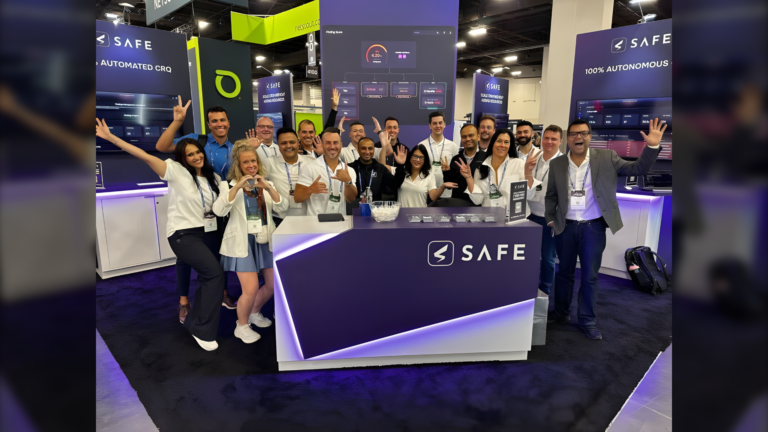
2025 in Retrospect: SAFE Steers the Industry Towards Autonomous Cyber Risk Management
By: Sweta Bhattacharya 2025 wasn’t just a milestone year for SAFE: it was the year the entire cyber risk management landscape shifted. Every major shift in the SAFEOne…
Blog
2025 in Retrospect: SAFE Steers the Industry Towards Autonomous Cyber Risk Management
By: Sweta Bhattacharya 2025 wasn’t just a milestone year for SAFE: it was the year the entire cyber risk management landscape shifted. Every major shift in the SAFEOne…