
Evidence-Based Vendor Risk Assessments | SAFE
Reduce Third-Party Breach Exposure

Generic vendor questionnaires
miss what matters

Most assessments rest on what each vendor says about itself. Documents, contracts, external findings and supplier dependencies sit in separate places, so vendor claims go unchecked. SAFE TPRM AI Co-Worker brings every source of evidence into one assessment and checks vendor answers against it.

The Problem

What evidence-poor assessment looks like today

  1. Answers are taken on trust

    Assessments lean on questionnaires and information each vendor reports about itself.

  2. Evidence is scattered

    SOC reports, policies, contracts, ratings, outside-in findings, and threat intelligence live in different tools.

  3. Claims are rarely corroborated

    Vendor answers are rarely checked against independent evidence of how they actually operate.

  4. Dependencies go unexamined

    Dependencies, the suppliers your vendors rely on, and the obligations in their contracts are missed.

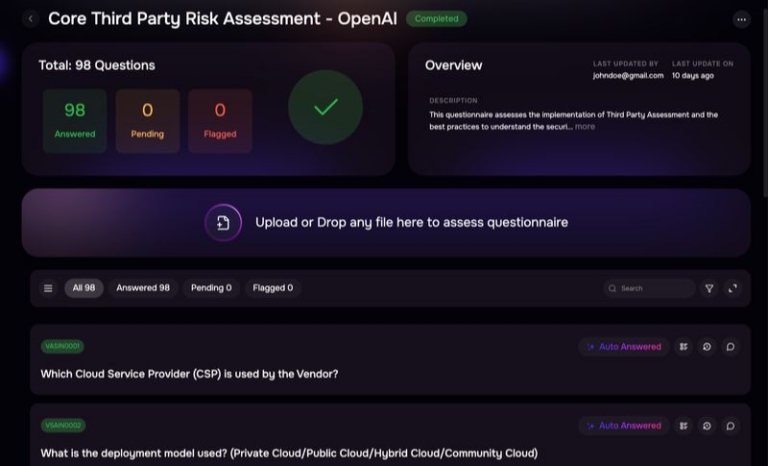
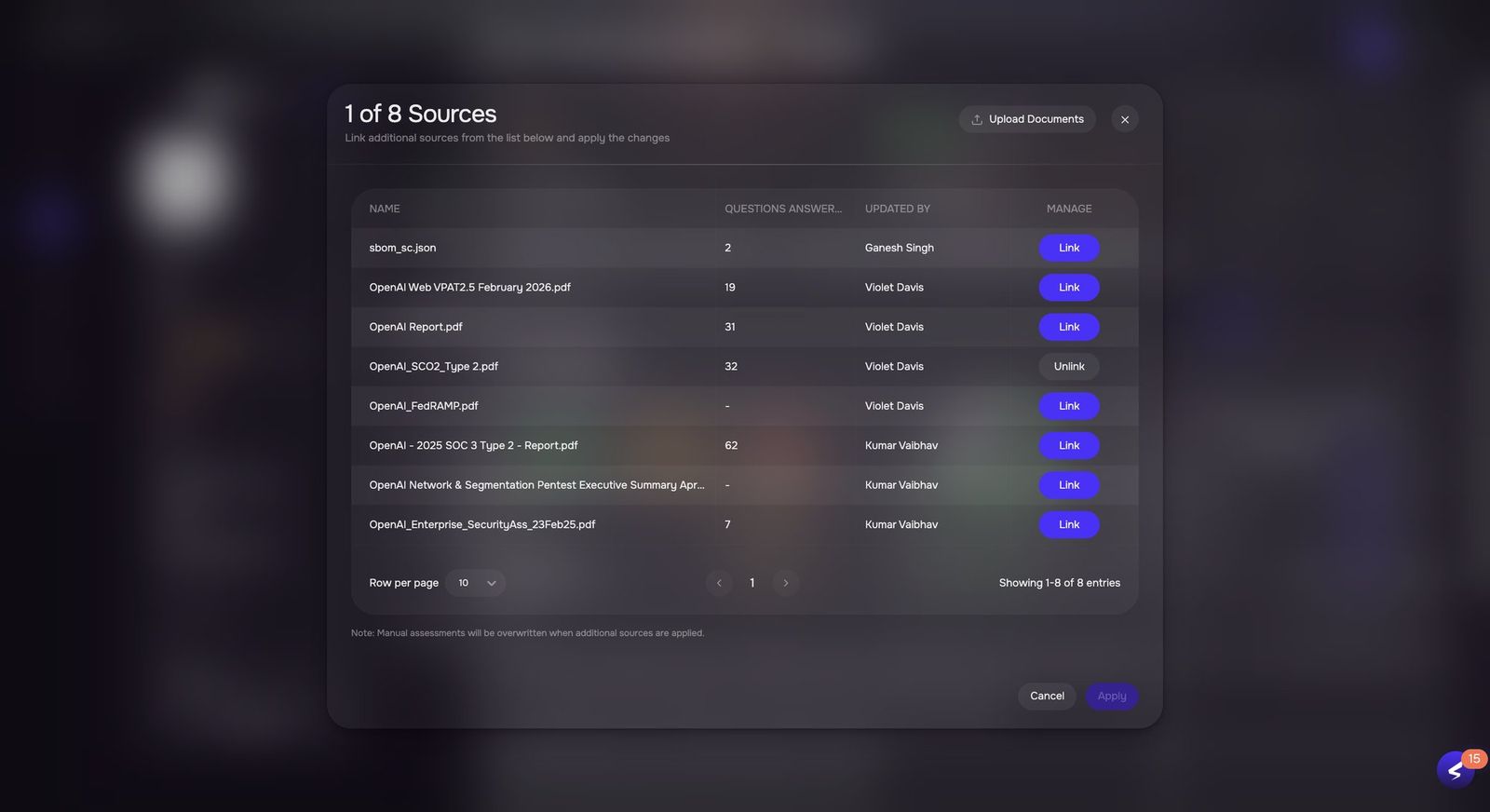
Vendor documents linked to questionnaire answers as evidence sources

From self-reported answers to corroborated evidence

When assessments rely on what vendors report

  • Material exposures stay hidden behind questionnaires and attestations.
  • Self-reported controls can overstate a vendor's security, or understate it.
  • Vendors are tiered and prioritized on incomplete evidence.
  • Risk acceptance and remediation decisions rest on partial information.

When every claim is checked against evidence

  • Exposures that questionnaires miss become visible and get acted on.
  • Risk decisions are backed by independently corroborated evidence.
  • Analysts focus on the vendors that create the most exposure.
  • Your program depends less on unverified security assertions.
How SAFE Helps

One assessment built from every source of evidence

Five capabilities work together so each vendor's risk picture combines what the vendor says, what its documents and contracts show, what can be observed from the outside, and the software, AI and suppliers the vendor depends on.

SOC 2 Type 2 report analysis with positives and negatives extracted by AI

Read every document the vendor sends

SAFE uses AI to analyze SOC 2 reports, ISO certificates, policies, penetration tests and completed questionnaires, and maps evidence to controls.

  • Exceptions, qualified opinions, audit periods and subservice organizations are pulled out for review.
  • SOC 2 reports are checked for authenticity and expiry.
  • Inconsistencies and weak evidence are flagged before an analyst starts.
  • Gaps become control-level findings, linked to the source document and page.
  • AI-BOM and SBOM findings bring software and AI dependencies into the assessment.
Vendor risk view comparing questionnaire, contract, configuration and outside-in evidence

Check vendor claims against independent evidence

SAFE combines questionnaire answers, documents, findings, external exposure and threat intelligence into one view of each vendor's risk.

  • Conflicts surface, such as a confirmed control that a SOC exception or outside-in finding contradicts.
  • Each conflict records why the sources disagree and how confident SAFE is.
  • AI proposes follow-up questions for the vendor.
  • AI recommends issues, priority controls and next steps, with the evidence behind each.
  • Recommendations are labeled as AI suggestions and wait for analyst approval.
Explore AI risk decisioning
AI contract analysis showing positives and negatives by risk category

Connect contract terms to the vendor's actual risk

SAFE reviews third-party contracts with AI for strengths, gaps and concerns across security, privacy, legal, operational and AI risk.

  • Contract insights sit next to the vendor's assessments, external exposure and findings.
  • Contract status and expiration dates are tracked across the portfolio.
  • An upcoming renewal can prompt a fresh look at the vendor's risk.
  • Contracts flow in directly from systems such as Ironclad.
  • Subprocessor and fourth-party clauses are surfaced from the contract text.
Explore contract risk and obligations
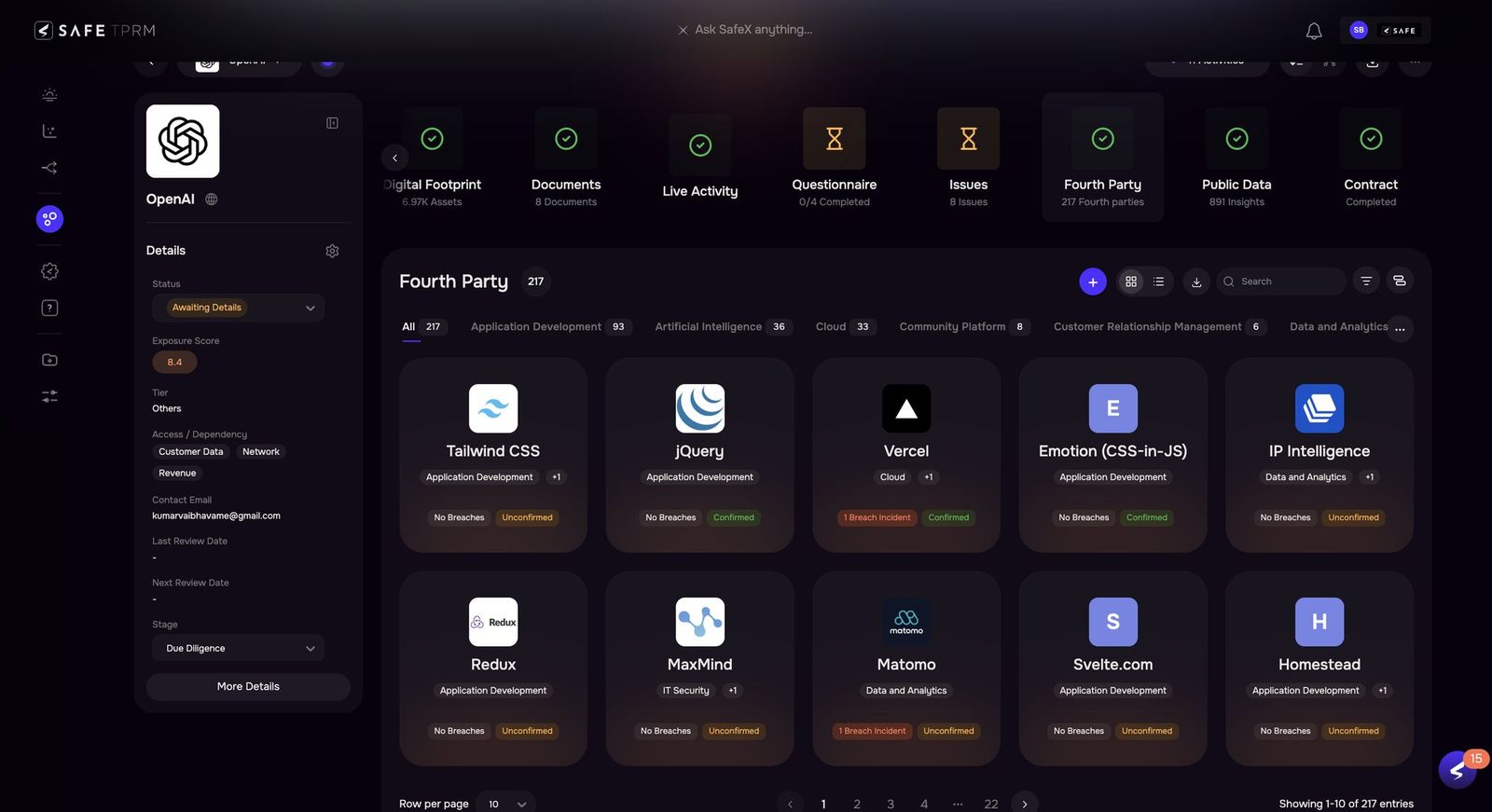
Fourth parties discovered behind a vendor, grouped by category

See the suppliers behind your vendors

SAFE discovers the fourth parties behind your vendors, including subservice organizations named in SOC reports.

  • Each relationship shows the signals behind it and a confidence level.
  • Each fourth party links to every third party that depends on it.
  • Coverage spans 8,000+ fourth parties.
  • Concentration scoring shows where one shared provider could create systemic exposure.
Explore fourth-party and concentration risk
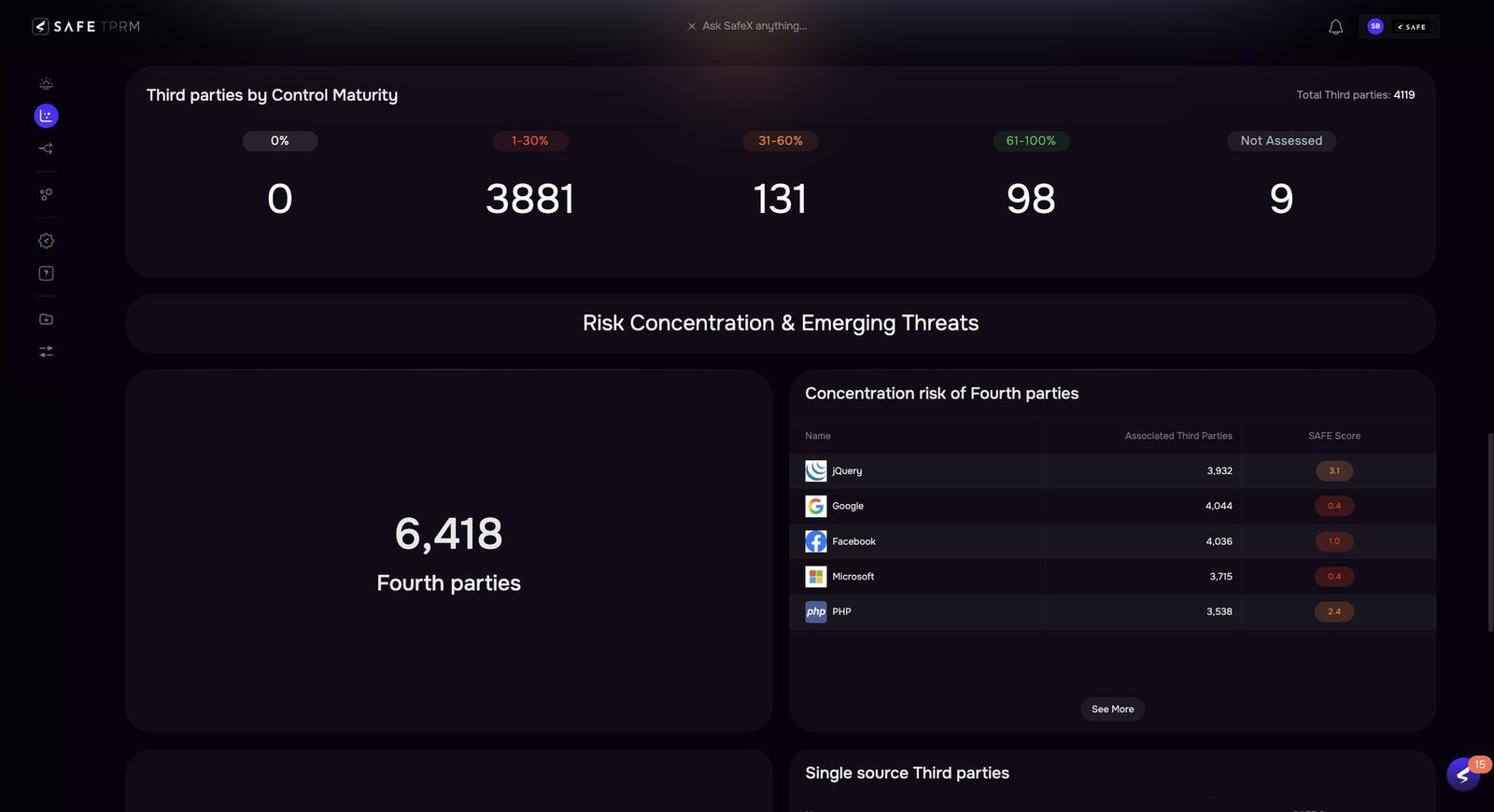
Portfolio view of third parties by control maturity and fourth-party concentration risk

Give leaders a view of risk they can trust

Pre-built and configurable dashboards show third-party risk, exposure and program metrics across the portfolio.

  • Leaders drill from any metric into the vendors, assessments, findings and issues behind it.
  • AI summaries highlight what changed and which vendors need attention.
  • Reports export as PDF and PowerPoint for executive review.
  • Schedule AI portfolio summaries, or generate reports from a SafeX chat prompt.
Explore dashboards and reporting
The Proof

Machine-Speed Defense. Measurable Results.

Instacart operationalizes enterprise-scale TPRM while reducing assessment effort.

Retail USA

Read the Full Story

The Challenge

Instacart's TPRM team managed hundreds of vendors through manual processes that slowed assessments and limited visibility. They needed a more automated, risk-based approach to scale the program.

The Results

30+
hours
of analyst work eliminated per assessment
3
weeks
to operationalize TPRM with 600+ vendors
100%
vendors
assessed and monitored with zero added headcount
Book a demo

Ready to meet your AI Co-Workers?

Get a Demo