
Point-in-Time Vendor Assessments | SAFE
Reduce Third-Party Breach Exposure

Annual vendor reviews
leave months of blind spots

Most third parties are assessed once a year, or only at onboarding. Their security changes every day. SAFE TPRM keeps every vendor's risk current between reviews and acts when something material changes.

The Problem

What point-in-time assessment looks like today

  1. Reviews run on a calendar

    Vendors are assessed annually or at onboarding, regardless of what happens in between.

  2. Posture between reviews is unknown

    New vulnerabilities, exposed services and leaked credentials go unseen until the next cycle.

  3. Change does not trigger action

    A breach, a control failure or a new way the vendor uses your data rarely prompts a reassessment.

  4. Decisions rest on old data

    The rating your team relies on today was often built from evidence collected months ago.

Vendor risk timeline: annual review vs continuous monitoring

From a yearly snapshot to a current view

When risk is checked once a year

  • A vendor's security can deteriorate for months without anyone knowing.
  • New vulnerabilities and breaches stay open with no response.
  • Risk ratings stop reflecting the vendor's real exposure.
  • Teams find out about problems after an incident, not before.

When risk is kept current

  • Material changes are found and addressed within days, not at the next review.
  • Teams step in on emerging threats before they become incidents.
  • Vendor decisions reflect today's risk, not last year's questionnaire.
  • Less time spent unknowingly exposed to a vendor whose security has slipped.
How SAFE Helps

Continuous oversight, built into every vendor relationship

Four capabilities work together so a vendor's risk is never older than the last thing that changed.

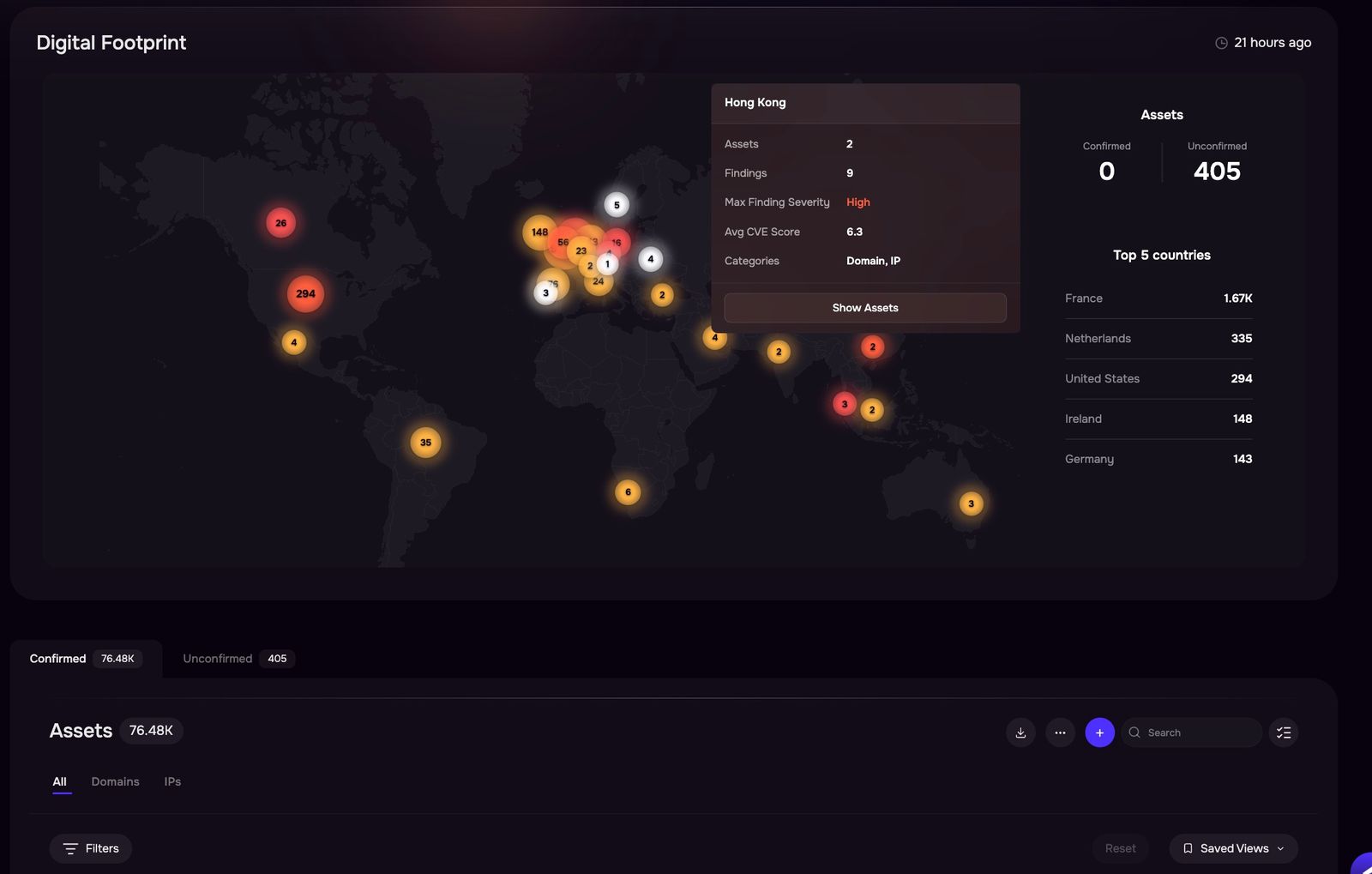
Digital footprint map for a vendor with findings by category

Watch every vendor's external attack surface

SAFE continuously monitors each vendor's internet-facing attack surface, starting from its primary domain.

  • Discovers the vendor's domains, subdomains and IPs, and shows why each asset is tied to it.
  • Checks for vulnerabilities, exposed services, email and TLS weaknesses, leaked credentials and malware.
  • Rolls findings into an Exposure Score that refreshes as the evidence does.
  • Refreshes on a regular schedule, and on demand for a priority vendor.
Explore external exposure monitoring
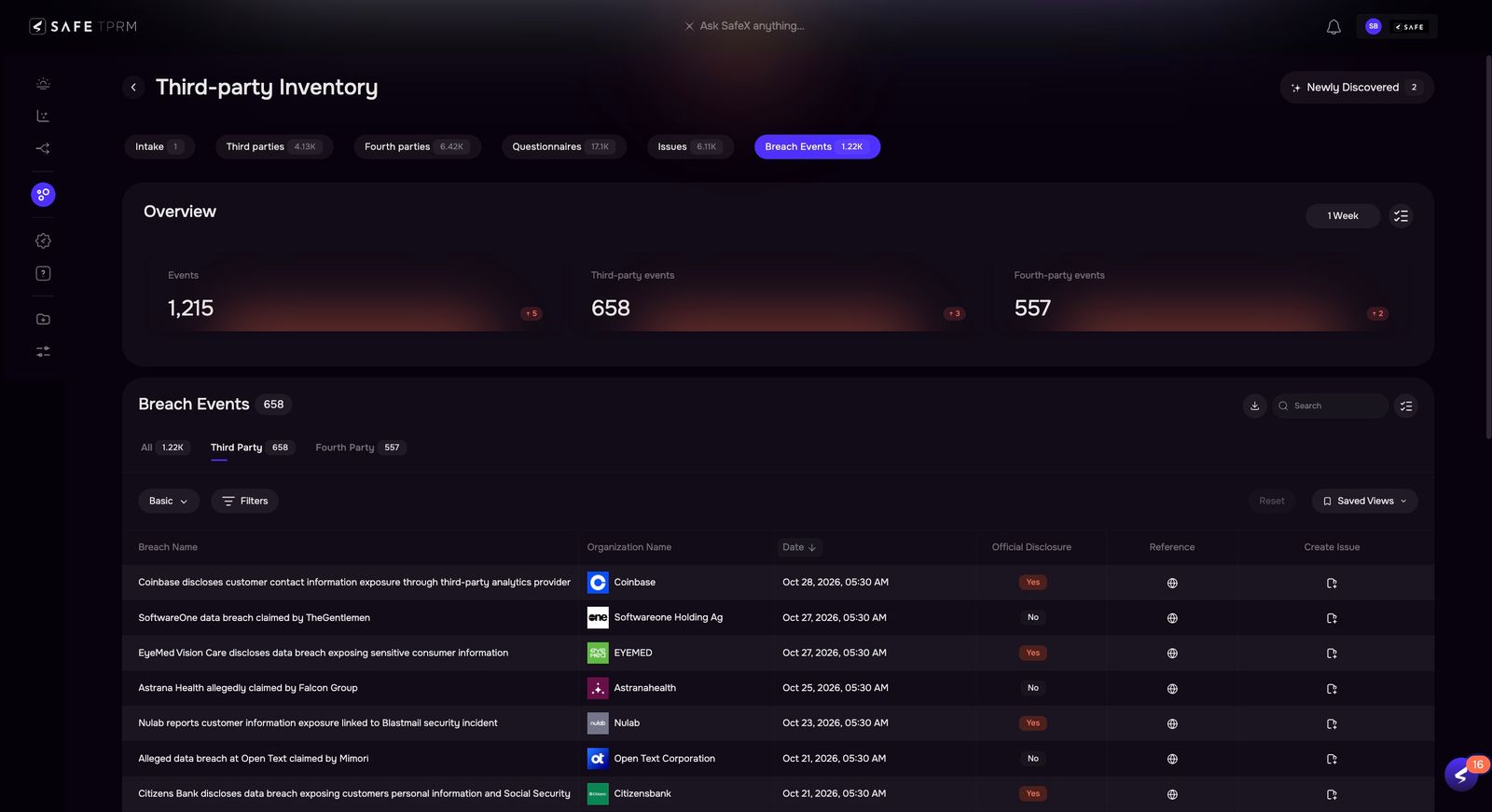
Breach event detail with affected third and fourth parties

Know when a vendor or its suppliers are breached

SAFE monitors breach intelligence, leaked credentials and public sources for incidents affecting your third and fourth parties.

  • Checks each event against the vendors you actually use.
  • Shows which relationships may be affected.
  • Separates the vendor from similarly named companies.
  • Filters out unconfirmed events, so alerts reflect real incidents.
Explore breach detection and response
Notification rule builder with a Tier 1 score threshold

Escalate what matters to the people who own it

SAFE routes each material change to the right owner and starts the right response.

  • Set rules by vendor tier, score change, breach event or finding, such as a score drop on a Tier 1 vendor.
  • Start anything from an issue to a reassessment.
  • Scope alerts by group, user or role.
  • Deliver alerts by email, in-platform notification, mobile push, Slack or Teams.
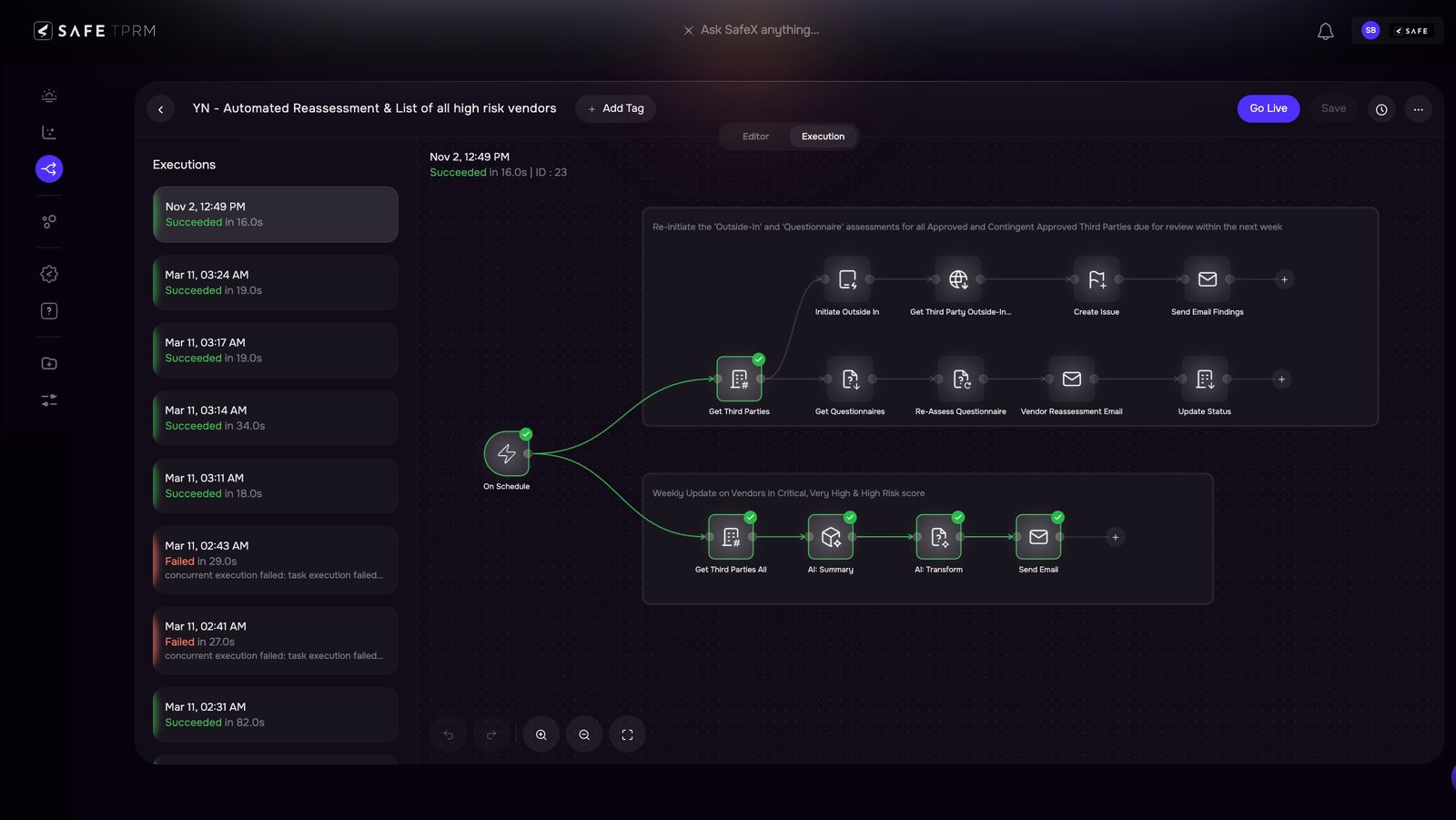
Workflow triggered by a material change, with a human approval step

Reassess on change, not on the calendar

Agentic workflows start a reassessment, an investigation or remediation when a change meets your policy.

  • AI agents flag material change as it happens.
  • Agents prepare the outreach or reassessment for your approval.
  • Each reassessment starts from the last one, so analysts review only what changed.
  • Approvals stay with your team.
Explore agentic workflows
The Proof

Machine-Speed Defense. Measurable Results.

Instacart operationalizes enterprise-scale TPRM while reducing assessment effort.

Retail USA

Read the Full Story

The Challenge

Instacart's TPRM team managed hundreds of vendors through manual processes that slowed assessments and limited visibility. They needed a more automated, risk-based approach to scale the program.

The Results

30+
hours
of analyst work eliminated per assessment
3
weeks
to operationalize TPRM with 600+ vendors
100%
vendors
assessed and monitored with zero added headcount

Book a demo

Ready to meet your AI Co-Workers?

Get a Demo