Security Rating Scores are not TPRM


Why Scores Can Signal Issues but Cannot Run a Risk Program


For too long, third-party risk management has relied on vague letter grades, black-box scores, and “trust us” risk signals that create more confusion than clarity.
If your third-party risk score is a “C” or a number like “553,” what does that actually tell you? Does it tell you if your vendor is about to get hit by ransomware? A data breach? A massive financial loss?
A security rating can be a useful signal. It can help teams spot potential issues, monitor external posture, and identify vendors that deserve a closer look. BUT…a security rating signal is not a strategy. Tools like Bitsight and RiskRecon were built to do exactly this, and they do it well. But that is a narrower job than TPRM, and conflating the two is where most programs stall.
It’s time to stop fortune-telling and start making real business decisions. Let’s break it down.
What Security Ratings Do Well
Security ratings services are useful because they give teams an outside-in view of vendor security posture. They scan publicly observable data and translate findings into a score, grade, or risk indicator.
That helps in two ways:
- Ratings give teams a faster starting point. Before sending a questionnaire or requesting evidence, teams can identify obvious external issues that may need review.
- Ratings support continuous monitoring. A vendor that looked fine during onboarding may develop new exposures months later. External scans can help detect changes between formal assessments.
So the point is not that ratings are not useful. The point is that ratings are incomplete.
When a Good Score Still Misses the Real Risk
The strongest argument against ratings-led TPRM has already played out in some of the most consequential third-party incidents of the last few years.
SolarWinds, MOVEit, and Change Healthcare are all reminders that a vendor can appear acceptable from the outside and still create material business risk when the actual compromise happens through trusted software, a zero-day vulnerability, privileged access, operational dependency, or a critical workflow failure.
In all three cases, an external score alone would not have been enough. A rating may show external posture, but it cannot tell you whether a vendor can disrupt operations, expose sensitive data, or create cascading risk across the business. The real questions were not just, “What was the vendor’s rating?” The real questions were:
- What business process depends on this vendor?
- What data or access do they have?
- What happens if they go down?
- What contractual rights do we have?
- What compensating controls exist?
- What is our exposure if they are compromised?
That is why security ratings can be useful, but they cannot be the foundation of TPRM. They can indicate that something may need attention, but they do not provide the full context needed to make a risk decision.
In a recent Forrester blog, the point becomes even sharper: the market is moving beyond ratings as the outcome and toward intelligence that drives “actual risk reduction.”
That is exactly the gap TPRM teams feel every day.
The TPRM Head’s Real Problem Is Not Visibility. It Is Actionability.
Most TPRM teams are not short on signals. They are short on decision-ready context. Without context, teams are left sorting through noise and manually translating technical findings into business decisions. That creates a familiar operating burden:
- Analysts spend time chasing scores instead of reducing risk.
- Vendors dispute findings without a clear remediation path.
- Business owners ask what the issue means for their process.
- Security teams struggle to connect findings to actual exposure.
- Risk leaders have to explain vendor risk to executives without a defensible business narrative.
Gartner states that effective TPRM depends on resource efficiency, risk management, resilience, and influence on business decision-making. However, only 6% of organizations are effective across all TPRM outcomes, even as ratings usage has grown. More scores have not produced better outcomes.
That is the problem with a ratings-led approach.
How SAFE Goes Beyond Security Rating Scores
Gartner describes TPRM solutions as tools that “identify, assess, manage, monitor, and report” on third-party risks, and lists mandatory capabilities such as fourth-party risk mapping, continuous monitoring, impact estimation, escalation, action plans, and risk tiering. That is much bigger than a score.
SAFE TPRM is built for this shift. It does not treat security ratings as the foundation of third-party risk management. It treats them as one input in a broader, autonomous TPRM operating model.
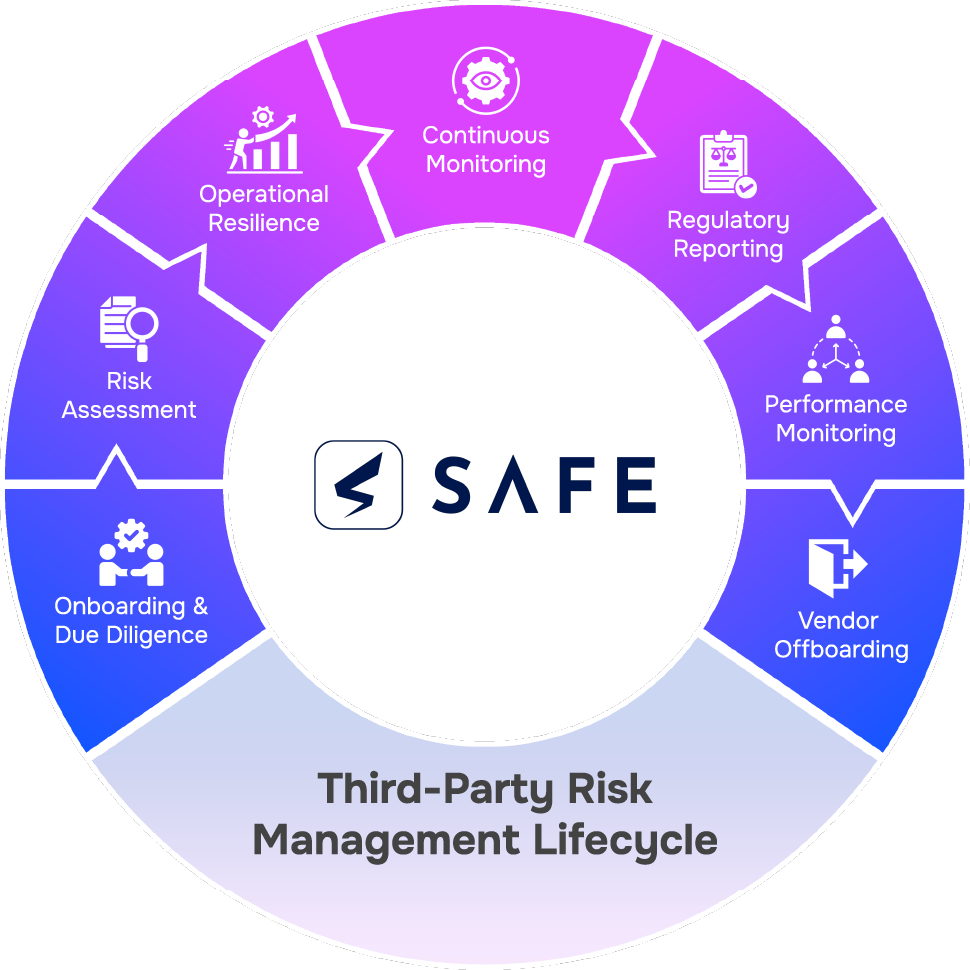
SAFE TPRM continuously measures, prioritizes, and reduces real risk. It brings together outside-in assessments, questionnaires, evidence review, contract intelligence, vendor workflows, continuous monitoring, remediation, and reporting into one integrated platform. SAFE’s positioning is clear: it delivers a complete, decision-ready view of vendor risk through continuous assessments, quantified risk, automated workflows, and board-ready reporting.
That is the difference: SAFE does not just help teams identify issues. It helps them decide what matters, act on it, and show measurable progress.
1. Prioritization Based on Business Impact, Not Just a Score
Security ratings often reduce vendor risk to a number or grade. SAFE goes further by helping organizations understand risk in terms of breach likelihood, financial loss, and business impact. That changes the conversation. You can move beyond inherent risk scoring and questionnaires toward understanding which vendors actually matter most to the business
Instead of asking, “Why did this vendor’s score drop?” teams can ask, “How much risk does this vendor create, what is driving that exposure, and which action will reduce it fastest?” That makes TPRM more useful to CISOs, CFOs, procurement teams, legal teams, and the board.
2. AI-Native and Agentic from the Ground Up
There is a big difference between adding AI on top of an existing scoring model and building an AI-native TPRM platform designed to automate the lifecycle.
TPRM is one of the most process-heavy, evidence-heavy, and repetitive functions. Analysts are stuck in a loop of manually onboarding vendors, reviewing documents, validating controls, monitoring changes, following up on issues, and tracking remediation. That makes it ideal for agentic automation.
SAFE TPRM’s autonomous approach provides users with customizable Agentic workflows. Flexible, trigger- and action-based workflows reduce manual effort, eliminate process variability, and shorten third-party onboarding, assessment, and remediation cycles. Teams can build workflows from scratch or leverage in-built templates, then tailor them to organizational policies, vendor risk tiers, and approval structures, enabling stronger oversight, faster decision-making, and measurable third-party risk reduction.
AI should not just summarize risk. It should help operate the process.
3. Faster Assessments for Your Team and Your Vendors
Traditional assessments are slow for everyone involved. In fact, 52% of companies say it takes 31–60 days to perform third-party control assessments, while another 38% say it takes 61–90 days. Imagine finishing all of that in under 10 minutes.
SAFE accelerates this process by using AI to analyze uploaded documents, pre-fill questionnaire responses, attach rationale, communicate with the vendor, and reduce the manual burden on both sides.
That means faster onboarding, less vendor fatigue, and fewer bottlenecks for the business.
4. More Than Third-Party Visibility
What SAFE TPRM Looks Like in the Real World
The shift from ratings-led TPRM to autonomous TPRM is not just a messaging change. It changes how fast teams can assess vendors, reduce manual effort, and make decisions. SAFE TPRM customer outcomes show what this looks like in practice:
- 95% faster vendor analysis
- 20-day reduction in assessment time
- Vendor assessments moving from hours to minutes
This is not an incremental improvement. It is a complete operating model shift — from manual reviews and disconnected scores to continuous, risk-based third-party risk management.
- 600+ vendors assessed
- 100% completion — zero extra headcount
Ratings Signal Risk. SAFE Manages It.
Modern TPRM cannot stop at an external score. Security ratings tell you something may need attention. SAFE tells you what matters, why it matters, what to do next, and how much risk you can reduce by acting on it.
That is the shift TPRM teams need now: from chasing scores to running a continuous, autonomous, risk-based program.
Because in third-party risk, the goal is not to know more.
The goal is to reduce risk.
SAFE helps you know what matters, what to do next, and how to do it continuously.
- Already using a security ratings tool? Learn how SAFE goes beyond.
- Building your TPRM program from scratch? See the blueprint.