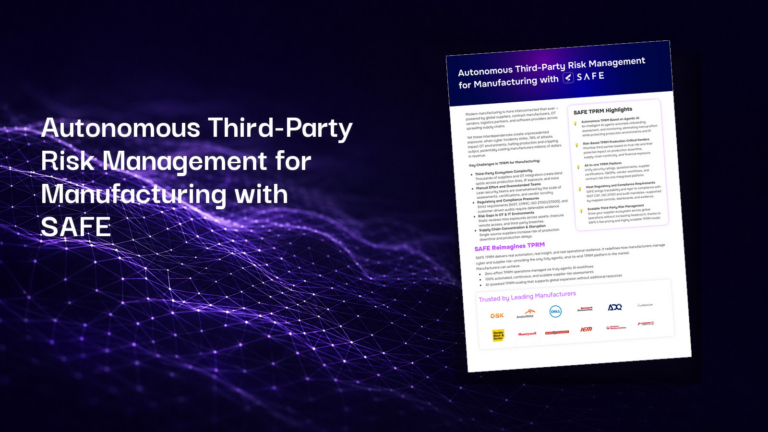
TPRM for Manufacturing and Operational Technology: Why the Standard Approach Doesn't Transfer

Why Third-Party Risk in Manufacturing Hits Differently
In most enterprise environments, a vendor breach means data exposure. In manufacturing and operational technology environments, a vendor breach can mean production shutdowns, safety system failures, and physical damage to equipment worth tens of millions of dollars. That is a fundamentally different risk equation, and it requires a fundamentally different approach to managing it.
The third-party attack surface in manufacturing extends well beyond the software vendors and SaaS providers that IT security programs are built to manage. It includes OEM equipment vendors whose remote access connections touch your production floor directly. It includes the industrial control system integrators who configure and maintain the systems that run your processes. It includes logistics and supply chain partners whose network connections create pathways between your IT environment and your OT network. And it includes the managed service providers who monitor and maintain equipment that, if compromised, could affect not just your data but your physical operations.
Managing this risk with a questionnaire-based TPRM program designed for enterprise software vendors is like using a smoke alarm to detect a gas leak. The tools are not built for the hazard.
Four Ways Standard TPRM Programs Fail in Manufacturing
Treating IT and OT Vendor Risk With the Same Framework
IT vendor risk and OT vendor risk have different threat models, different impact profiles, and different remediation options. An IT vendor with a critical vulnerability can usually be patched, isolated, or replaced on a timeline that matches the risk severity. An OEM vendor with a remote access connection to your production control systems may have a vulnerability that cannot be patched without taking the production line offline for a week. The risk calculation is entirely different, and TPRM frameworks that apply the same assessment criteria to both categories are producing misleading results. A Tier 1 classification in an IT-centric framework does not mean the same thing when the vendor has access to your SCADA systems.
Ignoring the Remote Access Problem
Manufacturing environments have a chronic third-party remote access problem. OEM vendors, integrators, and maintenance contractors routinely require persistent or on-demand remote access to production systems to provide support, push updates, and monitor equipment performance. Many of these access pathways were established informally, are poorly documented, and use credentials that have not been rotated in years. The Dragos Year in Review consistently identifies vendor remote access as one of the top initial access vectors in industrial cybersecurity incidents. A TPRM program that does not specifically address remote access inventory, authentication controls, and access scope for OT-connected vendors is missing one of the highest-risk vectors in the environment.
Assessing Security Without Assessing OT Expertise
Standard TPRM questionnaires ask about information security controls: SOC 2 status, penetration testing, data encryption, incident response procedures. These questions are meaningful for enterprise software vendors. They are insufficient for OT-connected vendors who may have excellent general cybersecurity practices but no specific expertise in industrial control system security, no understanding of safety instrumented system (SIS) boundaries, and no ICS-specific incident response capability. Assessing an OEM vendor’s general cybersecurity maturity without assessing their ICS security competency produces a risk picture that misses the most relevant dimension.
Failing to Account for Safety System Impacts
In regulated manufacturing, process, and energy environments, some systems are not just critical for business continuity. They are safety-critical. A compromise of a safety instrumented system or emergency shutdown system is not a business continuity event. It is a potential safety incident. TPRM programs that do not differentiate between vendors with access to safety systems and vendors with access to business systems are applying the same risk framework to situations with vastly different potential consequences. Safety system access should be the highest possible risk tier in any manufacturing TPRM program, regardless of the vendor’s size or relationship history.
An OT-Aware TPRM Framework for Manufacturing Environments
A TPRM framework that works in manufacturing needs to account for the operational realities of the environment. That means different tiering criteria, different assessment dimensions, and different monitoring approaches for OT-connected vendors versus purely IT or business vendors. SAFE TPRM supports OT-aware risk classification as part of its vendor tiering and assessment capabilities.
Step 1: Build an OT-Specific Vendor Inventory
Before you can manage OT vendor risk, you need to know which vendors have OT connectivity. This sounds obvious but is frequently not done. Many manufacturing organizations have OT-connected vendors that their TPRM program does not know about because the access was established through engineering or operations rather than procurement. Start with a complete inventory that categorizes vendors by access type: corporate IT access only, IT/OT bridging access, direct OT access, and safety system access. The tier classification follows from the access category, not the vendor’s revenue or name recognition.
Step 2: Apply Differentiated Tiering for OT Vendors
For OT-connected vendors, risk tiering needs to account for three factors that do not appear in standard IT vendor tiering: the network zone the vendor can access (enterprise, DMZ, OT, safety), the potential for physical impact (process disruption, equipment damage, safety system interference), and the vendor’s OT security competency specifically. A vendor with direct access to Level 2 or Level 3 OT networks is a Tier 1 vendor regardless of their general cybersecurity certification status. A vendor with safety system access should be in a separate category that triggers your highest-rigor assessment process.
Step 3: Assess OT-Specific Security Dimensions
In addition to standard information security controls, OT-connected vendor assessments should cover: ICS/SCADA security expertise and certifications (ISA/IEC 62443, NERC CIP for energy), remote access controls and session management practices specific to OT environments, patch management process for OT systems including testing requirements and change control, incident response capabilities specific to ICS incidents and safety system events, and subcontractor chain for any work performed on or near OT systems. These dimensions require OT-specific assessment criteria that most enterprise TPRM platforms do not include out of the box.
Step 4: Manage Remote Access as a First-Class Risk Item
Remote access by OT-connected vendors needs a dedicated control framework. At minimum: documented inventory of all active remote access pathways with vendor identity, access scope, authentication method, and last review date; requirements for multi-factor authentication on all OT remote access sessions; session recording for privileged OT access; access deprovisioning process for vendor staff transitions; and periodic access reviews, at least semi-annually for direct OT access and annually for IT/OT bridging access. Vendors who cannot meet these requirements for OT access should be either upgraded to on-site support arrangements or treated as Tier 1 regardless of their functional classification.
- 600+ vendors assessed
- 100% completion — zero extra headcount
What Breaks at Scale in Manufacturing TPRM
A large manufacturing organization may have 50 to 200 OT-connected vendors across its facilities, in addition to hundreds or thousands of purely IT and business vendors. Managing this portfolio has specific scale challenges that IT-centric programs are not designed for.
At 50 OT-connected vendors, manual tracking of remote access pathways and OT-specific assessment criteria is feasible but time-consuming. Most teams at this scale have a spreadsheet of known OT vendor connections that gets updated when someone remembers to update it. Gaps are common and usually discovered during incident investigations rather than proactive audits.
At 200 OT-connected vendors across multiple facilities, the manual tracking problem becomes critical. Centralized visibility into who has active remote access to which systems at which facilities requires either a dedicated OT access management platform or a TPRM platform that can track OT-specific vendor attributes alongside standard risk data. Without centralized tracking, the right hand does not know what the left hand is doing across facilities.
Across a geographically distributed manufacturing portfolio, the combination of OT vendor risk with supply chain risk creates a compounding problem that SAFE TPRM is specifically positioned to address: automated signal gathering across the full vendor portfolio, risk-based tiering that can incorporate OT access as a tiering criterion, and continuous monitoring that surfaces vendor risk changes across both IT and OT supplier categories without requiring separate programs for each.
Trade-Offs Unique to Manufacturing TPRM
Manufacturing TPRM involves trade-offs that do not exist in standard enterprise programs. Acknowledging them upfront prevents designing a program that looks good on paper but does not survive contact with operational reality.
Security requirements vs. operational availability. The standard TPRM response to a vendor with critical security gaps is to pause the relationship until the gaps are remediated. In manufacturing, a vendor who maintains your production-critical equipment may not have an equivalent replacement. You cannot pause the relationship without pausing production. The trade-off resolution is risk acceptance with compensating controls and a documented remediation timeline, not vendor replacement. Programs that apply IT-centric risk acceptance criteria to OT-critical vendors create either unrealistic demands or undocumented exceptions.
IT security standards vs. OT operational constraints. Many IT security best practices either do not apply in OT environments or actively create risk. Frequent patch cycles that are standard in IT environments can destabilize validated OT configurations. Network segmentation that IT security teams consider basic can break OT communication architectures that were not designed for it. Your TPRM program needs to assess OT vendors against OT-appropriate security standards, not IT security standards applied to an OT context.
Centralized control vs. site-level operational autonomy. Large manufacturing organizations often have significant operational autonomy at the facility level. OT vendor relationships are frequently managed by site engineering teams rather than central procurement. A centralized TPRM program that tries to own OT vendor decisions without site engineering buy-in will face resistance and workarounds that create exactly the blind spots the program is trying to eliminate. The right design gives central TPRM oversight and risk visibility while preserving site-level operational decision-making within a defined risk framework. SAFE TPRM supports both centralized portfolio visibility and site-level assessment workflows, which is why it shows up in manufacturing TPRM deployments alongside facility-level programs.
Why SAFE TPRM Fits Manufacturing and OT Environments
Manufacturing TPRM is harder than enterprise TPRM in almost every dimension: more complex vendor categories, higher physical impact potential, more constrained remediation options, and a more politically complex internal stakeholder environment. The platform needs to match that complexity.
SAFE TPRM supports manufacturing and OT risk management with capabilities built for the operational reality:
- Vendor tiering that incorporates OT access type, network zone, and physical impact potential alongside standard data sensitivity criteria.
- Assessment workflows that can be configured with OT-specific assessment dimensions, including ICS security competency and remote access control requirements.
- Financial risk quantification that translates OT vendor risk into production loss estimates, equipment damage exposure, and safety incident likelihood, not just data breach cost.
- Portfolio-level visibility across facilities, allowing central security teams to see OT vendor risk exposure across the full manufacturing footprint without requiring separate programs per site.
- Continuous monitoring that covers OT-connected vendors alongside IT vendors in a single platform view, surfacing vendor risk changes before they become production incidents.
If you are managing OT vendor risk with an IT-centric TPRM framework and experiencing the gaps described here, the SAFE TPRM walkthrough is a good place to see what OT-aware risk management looks like in practice. Or schedule a demo with your specific manufacturing environment in mind.
Frequently Asked Questions
Three things make OT vendor risk fundamentally different from standard enterprise vendor risk. First, the impact scope: a compromised OT-connected vendor can cause production shutdowns, equipment damage, and safety incidents, not just data exposure. Second, the remediation constraints: you often cannot pause an OT-critical vendor relationship the way you can pause an enterprise software vendor. Third, the vendor profile: OEM vendors, industrial integrators, and maintenance contractors who access OT environments need to be assessed against OT-specific security criteria, not just general information security frameworks. Standard TPRM programs built for IT and SaaS vendors systematically miss these dimensions.
OT-connected vendors should be tiered based on the network zone they access and the physical impact of a compromise, not just data sensitivity. Any vendor with direct access to Level 2 or Level 3 OT networks should be classified as Tier 1 regardless of general cybersecurity certification status. Vendors with safety system access belong in a separate category above standard Tier 1 that triggers your most rigorous assessment process. Vendors with IT/OT bridging access (connecting to both the enterprise and OT networks) should be classified at least as Tier 2 and often Tier 1 given the lateral movement risk they represent. Apply these OT-specific tiering criteria in addition to, not instead of, your standard data and system access criteria.
At minimum: multi-factor authentication for all remote access sessions, defined access scope limited to the specific systems and functions the vendor needs, session recording for privileged access sessions, a formal access review at least every six months, and documented deprovisioning procedures for vendor staff transitions. Beyond these baseline controls, require OEM vendors to provide evidence of OT-specific security training or certification for staff who access your systems, a documented patch management process for the equipment they maintain, and an ICS incident response procedure that covers events affecting your production environment. Vendors who cannot meet these requirements for direct OT access should be treated as Tier 1 regardless of contract size or relationship history.
Legacy OT vendors with poor security practices are among the most common and most difficult TPRM challenges in manufacturing. The realistic options are: compensating controls that limit what a compromised vendor can reach (network segmentation, jump servers, access control), a documented risk acceptance with a remediation timeline negotiated into the vendor relationship, migration to a replacement vendor on a timeline that accounts for production continuity requirements, or in cases where none of the above are feasible, formal risk acceptance by the appropriate executive authority with full documentation of the known exposure. Pretending the risk does not exist because the vendor is hard to replace is not a strategy. It is an undocumented exception that will surface during an audit or an incident.
SAFE TPRM supports OT vendor risk management through configurable tiering criteria that incorporate OT access type and physical impact potential, assessment workflows that can include OT-specific security dimensions, financial risk quantification that can model production loss and safety incident exposure alongside standard breach cost estimates, and portfolio-level visibility that consolidates OT and IT vendor risk in a single view. For manufacturing organizations managing both IT and OT vendor portfolios, SAFE TPRM provides a unified platform rather than requiring separate programs for each vendor category.
Related Posts
 Cybersecurity
10 Most Common Cybersecurity Blind Spots
Nearly 90% of cyberattacks are caused by human error, so it’s important to understand and address your organization’s cybersecurity weak spots. Many organizations struggle to maintain a clear…
Cybersecurity
10 Most Common Cybersecurity Blind Spots
Nearly 90% of cyberattacks are caused by human error, so it’s important to understand and address your organization’s cybersecurity weak spots. Many organizations struggle to maintain a clear…
 Blog
2025 in Retrospect: SAFE Steers the Industry Towards Autonomous Cyber Risk Management
By: Sweta Bhattacharya 2025 wasn’t just a milestone year for SAFE: it was the year the entire cyber risk management landscape shifted. Every major shift in the SAFEOne…
Blog
2025 in Retrospect: SAFE Steers the Industry Towards Autonomous Cyber Risk Management
By: Sweta Bhattacharya 2025 wasn’t just a milestone year for SAFE: it was the year the entire cyber risk management landscape shifted. Every major shift in the SAFEOne…