Weekly CVE Threat Landscape: Exploitation Clusters Around Enterprise Control Points

By SAFE Threat Research Team
This week’s CVE activity is concentrated around systems that attackers can use as entry points: Citrix NetScaler ADC and Gateway, Microsoft SharePoint Server and Langflow. These are systems that sit close to access, traffic flow, collaboration data, and application execution, which makes exploitation useful well beyond the affected product.
The strongest signal is the clustering of exploitation around internet-facing platforms that can expose sensitive memory, enable command execution, or create access into trusted enterprise environments. Citrix NetScaler points to continued attacker interest in edge and traffic-management systems, while SharePoint remains a high-value collaboration target because compromise can expose internal data and trusted workflows.
Langflow adds a newer dimension to this week’s activity. Its inclusion shows that AI application frameworks are moving into the same risk category as traditional enterprise platforms when exposed in production. In the observed activity, exploitation is not limited to initial access; it supports payload deployment, credential theft, persistence, and lateral movement.
Vulnerability Landscape
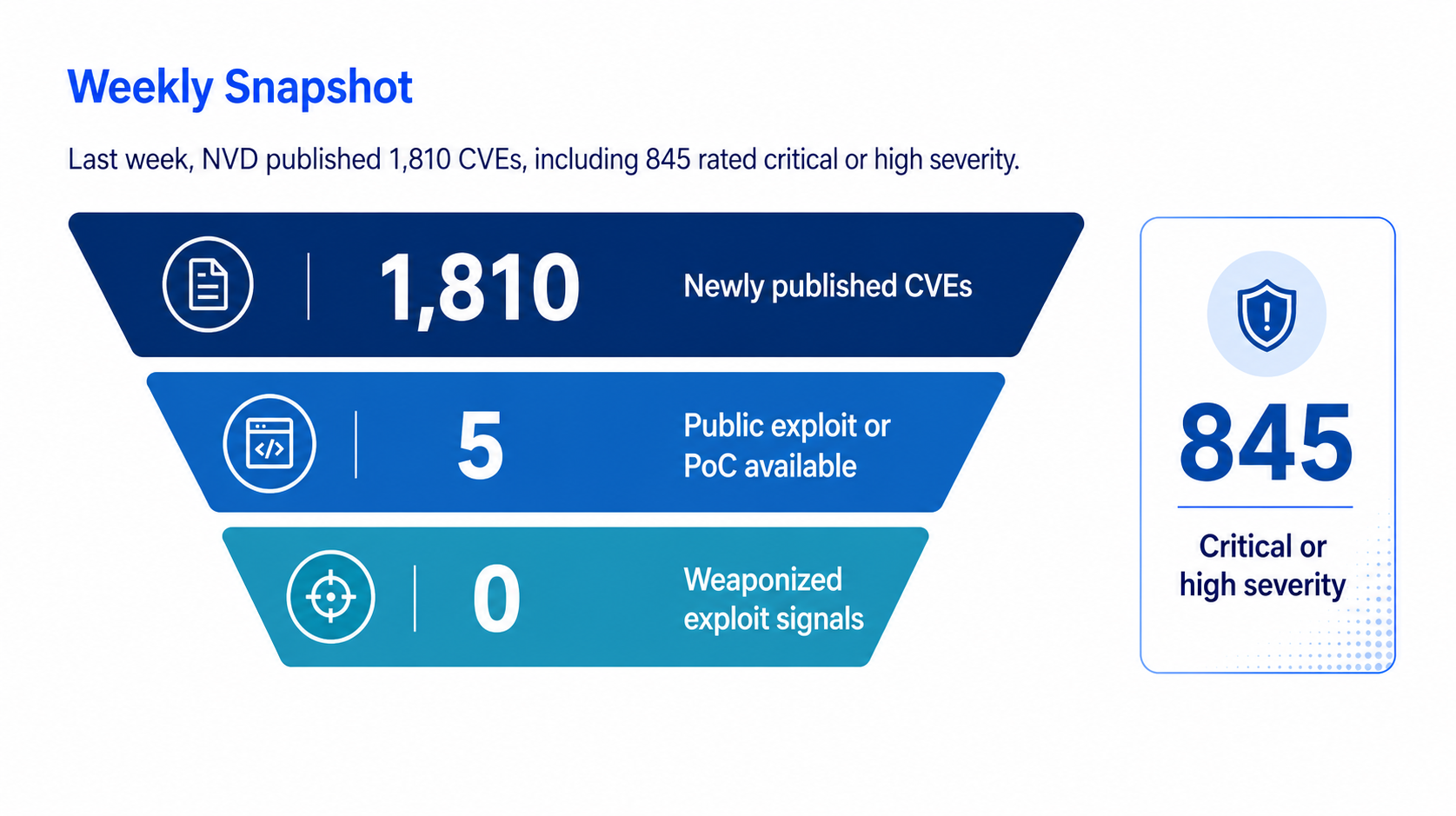
This week’s vulnerability landscape shows a broad disclosure base. The most useful signal comes from narrowing that volume into exploit-relevant categories. The snapshot below separates overall CVE activity from the subset that carries stronger remediation urgency based on severity, public exploitability, and weaponized exploit signals.
Trending Vulnerabilities
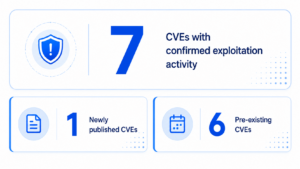 Confirmed exploitation remains the strongest indicator of immediate risk. This week, seven CVEs showed real-world exploitation signals, including one newly disclosed vulnerability and six older vulnerabilities that continue to be actively exploited. Their persistence highlights how exposed, widely deployed, and unpatched systems remain attractive targets long after initial disclosure.
Top CVEs to Watch
Langflow CVE-2025-3248: Code Injection Turns AI Workflows Into an Entry Point
CVE-2025-3248 affects Langflow versions prior to 1.3.0, where a missing authentication check in the /api/v1/validate/code endpoint allows unauthenticated remote code execution.
The threat signal is active ransomware use. The vulnerability has been leveraged in the JADEPUFFER ransomware campaign to deploy payloads, steal credentials, and escalate privileges inside compromised environments. This makes exposed Langflow instances a direct remediation priority, especially where the platform is reachable from the internet or connected to sensitive workflows.
Microsoft SharePoint CVE-2026-45659: Collaboration Platform Becomes an Execution Path
CVE-2026-45659 is a deserialization vulnerability in Microsoft SharePoint Server that allows low-privileged authenticated users to execute code remotely.
The risk is bigger than code execution alone. SharePoint often holds business documents, internal workflows, and trusted user activity. Exploitation can therefore create both data exposure and a path into broader enterprise compromise. Organizations running affected SharePoint Server versions should treat this as urgent because the flaw has confirmed in-the-wild exploitation and is listed in CISA KEV.
Langflow CVE-2026-33017: Public Flows Abused for Mining, Persistence, and Lateral Movement
CVE-2026-33017 affects Langflow versions prior to 1.9.0. The vulnerable endpoint executes attacker-controlled Python code through unsafe use of exec() without sandboxing.
This is not a theoretical AI application risk. Active exploitation has been tied to Monero mining, persistence attempts, disabling security controls, and lateral movement using compromised SSH keys. The key concern is exposed public flows, where weak operational controls can turn an AI application framework into a foothold for post-exploitation activity.
Citrix NetScaler CVE-2025-5777: Memory Disclosure Reopens Gateway Risk
CVE-2025-5777, widely tracked as “Citrix Bleed 2” is an out-of-bounds memory read vulnerability affecting Citrix NetScaler ADC and Gateway.
The attacker value lies in what the appliance protects. NetScaler often sits in front of remote access and enterprise applications, which means memory disclosure can become a route to sensitive data, unauthorized access, or session abuse. Reported exploitation by the ANUBIS ransomware group reinforces why exposed gateway appliances should be prioritized ahead of routine patching queues.
Windows LNK CVE-2025-9491: Shortcut Files Used as a Delivery Mechanism
CVE-2025-9491 affects how Windows handles shortcut .LNK files, allowing attackers to disguise malicious content that executes when a crafted shortcut is opened.
This CVE stands out because exploitation depends on user interaction and targeted delivery. Armored Likho has reportedly used the flaw in spear-phishing campaigns against government and utility organizations to deliver BusySnake Stealer. The risk is especially relevant for environments where phishing remains a common entry point and endpoint controls are inconsistent.
Citrix NetScaler CVE-2026-8451: SAML IdP Memory Overread Moves Fast After Disclosure
CVE-2026-8451 affects Citrix NetScaler ADC and Gateway appliances configured as a SAML Identity Provider. The flaw allows attackers to retrieve sensitive memory contents from affected systems.
The concern is speed. Exploitation was observed shortly after disclosure, with public PoC code lowering the barrier for broader activity. For organizations using NetScaler in SAML IdP configurations, this should be handled as an exposed identity-adjacent risk, not just another appliance vulnerability.
From Exploitation Signals to Business Risk
This week’s CVE activity is a reminder that not every vulnerability creates the same level of enterprise risk. The CVEs that matter most are the ones that sit on exposed, trusted, and operationally important systems: gateways, load balancers, collaboration platforms, and AI application frameworks.
Security teams should focus on the vulnerabilities that create the clearest path from external exposure to business impact:
- Prioritize exposed control points such as Citrix NetScaler, Progress Kemp LoadMaster, Microsoft SharePoint Server, and Langflow.
- Validate reachability before treating every affected asset the same.
- Move actively exploited CVEs to the front of the queue, especially where public exploit code or KEV signals are present.
- Pair patching with compromise review for systems already under exploitation.
- Monitor for post-exploitation behavior, including suspicious authentication, unexpected process execution, credential access, persistence, crypto-mining, and lateral movement.
- Use compensating controls where patching is delayed, including restricted management access, segmentation, MFA, and tighter outbound monitoring.
The priority is not to patch faster across the entire CVE backlog. It is to patch smarter by focusing on the vulnerabilities that attackers can realistically use to gain access, expand control, or disrupt business operations.
SAFE CTEM helps teams make that shift by connecting vulnerability intelligence, asset exposure, reachability, business context, and control effectiveness. This gives security teams a clearer view of which vulnerabilities are not just severe, but most likely to create real business impact.