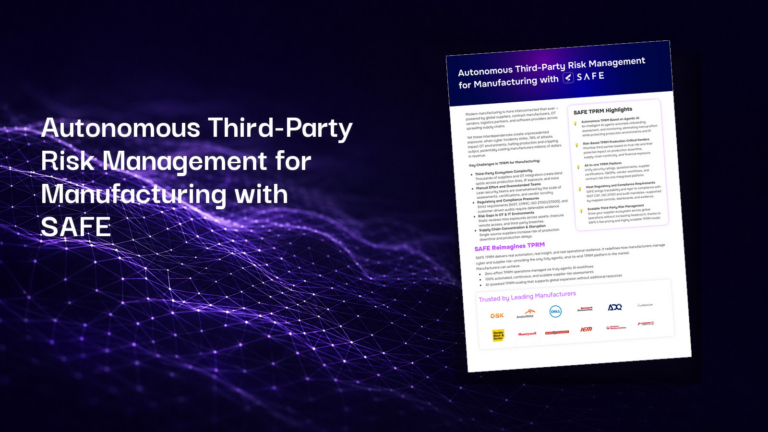
Why AI-First TPRM Is Now Mandatory


Learn how to Operationalize AI-First TPRM

By: Nick Sanna
Traditional third-party risk management is built for a slower world. Vendors are assessed at onboarding, reviewed periodically, and managed through questionnaires, emails, spreadsheets, and evidence requests.
This model cannot survive the AI era.
Anthropic’s Claude Mythos Preview is a clear signal of what is changing: AI-driven discovery is making exposure identification faster, cheaper, and easier. If you ask what is its implication on third-party risk management, the answer is simple: any vendor’s security gaps can very quickly become an entry point into your business.
The lesson for TPRM teams is clear: third-party risk now moves faster than manual processes can keep up with.
AI-Driven Risk Needs AI-First TPRM
Periodic assessments create snapshots. AI-driven threats create continuous change.
A vendor that looked acceptable during onboarding may become risky weeks later because of a new vulnerability, exposed service, leaked credential, misconfigured AI system, unsafe integration, or newly introduced fourth-party dependency. Traditional TPRM was not designed to detect and act on those shifts in real time.
This is why the future of TPRM must be built on three shifts:
- Continuous, not periodic: Risk must be monitored as it changes, not reviewed only at scheduled intervals.
- Autonomous, not manual: Repetitive triage, evidence review, vendor follow-up, workflow routing, and remediation tracking should not depend on analyst bandwidth.
- Risk-based, not signal-based: Teams need to know which issues materially affect business exposure, not just which vendors generated another alert.
Forrester’s TPRM platform research points in the same direction: platforms should automate processes from risk identification to corrective action, and strengthen ecosystem resilience.
Gartner has also noted that GenAI can improve enterprise risk management efficiency, insight, and mitigation, while warning that GenAI applications will face rising security incidents as adoption accelerates.
AI is therefore both the challenge and the answer. It expands the attack surface, but it also gives TPRM teams the only practical way to manage that surface at scale.
How You can Operationalize AI-First TPRM with SAFE
Instead of adding AI as a feature on top of legacy processes, you need to consider solutions that are built on the foundations of AI. The goal is not to just help analysts move faster. The goal is to remove the repetitive work that prevents them from focusing on material risk decisions.
SAFE TPRM is natively an AI-First TPRM solution, which uses Agentic workflows to automate the third-party risk lifecycle end-to-end.
SAFE enables this through four core capabilities:
1. Continuous Risk Visibility
SAFE continuously ingests third-party data and evaluates risk in real time, allowing teams to move beyond point-in-time assessments. This matters because modern vendor risk is dynamic. A questionnaire response, certificate, or security rating can become outdated quickly if the vendor’s environment changes.
SAFE gives teams a current view of third-party exposure by combining external signals, business context, evidence, questionnaires, contract data, and risk intelligence into one operating layer. This allows TPRM teams to understand not only that something changed, but whether it matters.
SAFE’s autonomous TPRM model is built around continuous ingestion of third-party data, real-time risk evaluation, automated assessment and remediation workflows, and persistent alignment to business impact.
- 600+ vendors assessed
- 100% completion — zero extra headcount
2. Agentic Workflows That Eliminate Manual Drag
In traditional TPRM, analysts spend too much time coordinating work: requesting evidence, sending reminders, assigning owners, tracking responses, escalating issues, and updating reports.
SAFE automates these steps through Agentic Workflows. That means teams can automate workflows such as:
- Vendor onboarding and smart tiering
- Questionnaire assignment and reassessment
- Evidence collection and analysis
- Outside-in issue creation
- Vendor follow-ups and reminders
- Audit-ready reporting
…and many more
This is where SAFE moves beyond basic workflow automation. The platform does not just route tasks; it uses AI to interpret context, determine materiality, and trigger the right action based on risk.
Forrester has emphasized that modern TPRM platforms should make context and control real by triggering workflows, escalating when thresholds are crossed, updating risk scores automatically, and mapping dependencies that static inventories miss. That is exactly the gap SAFE is built to close.
3. Risk-Based Insights, Not Raw Signals
More data does not automatically mean better TPRM. Security ratings, vulnerability feeds, breach intelligence, contracts, questionnaires, and compliance evidence all matter. But without business context, they can overwhelm analysts and bury the risks that actually deserve attention.
SAFE helps teams prioritize vendors and issues based on real risk to the business. Instead of relying only on arbitrary scores or static tiers, SAFE connects third-party findings to likelihood, impact, and business exposure.
This gives CISOs, TPRM leaders, procurement teams, compliance teams, and executives a shared view of what matters most.
The result is a major shift in how TPRM operates:
- Analysts focus on risk reduction, not repetitive review.
- Security teams focus on material exposures, not alert noise.
- Procurement adds vendors at the speed the business needs.
- Compliance gets defensible evidence.
- Executives get third-party risk visibility tied to business impact.
Move TPRM From Bottleneck to Business Enabler with AI-First TPRM
AI-first TPRM is now mandatory because manual programs cannot keep pace with AI-driven risk velocity. But the bigger opportunity is not just avoiding failure; it is transforming TPRM into a business enabler.
With SAFE, third-party risk management becomes continuous, autonomous, and risk-based. Teams can scale without adding headcount, reduce analyst overload, accelerate vendor decisions, and prove measurable risk reduction.
The future of TPRM is autonomous, and SAFE is how enterprises get there.
Related Posts
 Cybersecurity
10 Most Common Cybersecurity Blind Spots
Nearly 90% of cyberattacks are caused by human error, so it’s important to understand and address your organization’s cybersecurity weak spots. Many organizations struggle to maintain a clear…
Cybersecurity
10 Most Common Cybersecurity Blind Spots
Nearly 90% of cyberattacks are caused by human error, so it’s important to understand and address your organization’s cybersecurity weak spots. Many organizations struggle to maintain a clear…
 Blog
2025 in Retrospect: SAFE Steers the Industry Towards Autonomous Cyber Risk Management
By: Sweta Bhattacharya 2025 wasn’t just a milestone year for SAFE: it was the year the entire cyber risk management landscape shifted. Every major shift in the SAFEOne…
Blog
2025 in Retrospect: SAFE Steers the Industry Towards Autonomous Cyber Risk Management
By: Sweta Bhattacharya 2025 wasn’t just a milestone year for SAFE: it was the year the entire cyber risk management landscape shifted. Every major shift in the SAFEOne…