Changing the Economics of Third-Party Risk Management



By: Nick Sanna
For years, TPRM has operated under a simple assumption: More vendors = more analysts.
As organizations expanded their third-party ecosystems, most TPRM programs responded the only way they could: more questionnaires, more spreadsheets, more workflows, more outsourced services, and more headcount.
But AI has broken that model.
Today, enterprises depend on hundreds — often thousands — of third parties across SaaS, cloud, APIs, MSPs, data processors, and increasingly AI vendors like OpenAI ChatGPT, Anthropic Claude, Microsoft Copilot, and Google Gemini. The scale and speed of vendor adoption are accelerating faster than human-driven TPRM programs can keep up.
At the same time, boards and regulators are expecting organizations to continuously monitor third-party risk, demonstrate defensible oversight, and understand the business impact of vendor exposure — especially in the age of AI.
That creates a fundamental challenge for every CISO and Head of TPRM: How do you expand assessment coverage, continuously monitor vendor risk, and manage AI vendor exposure — without endlessly adding analysts and operational cost?
The answer is not incremental workflow automation. It’s changing the economics of TPRM entirely. That’s what SAFE TPRM was built to do.
- 600+ vendors assessed
- 100% completion — zero extra headcount
From Workflow Management to Autonomous TPRM
Most legacy TPRM platforms digitized workflows. But they didn’t eliminate the operational burden they left behind.
Analysts still spend enormous amounts of time chasing questionnaires, reviewing evidence, coordinating follow-ups, updating workflows, generating reports, and managing remediation activities.
In many organizations, TPRM has become an operational scaling problem. More vendors simply create more manual work.
SAFE changes the model entirely.
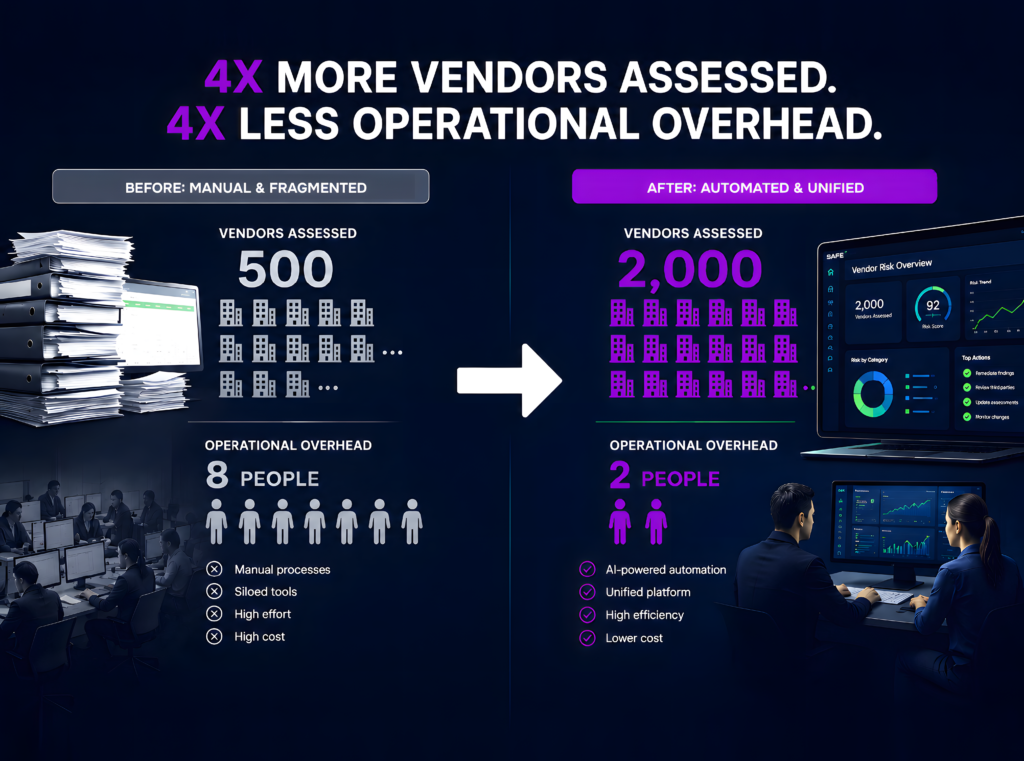
SAFE TPRM leverages agentic AI to automate much of the operational work that TPRM teams have traditionally performed manually — including vendor assessments, evidence analysis, continuous monitoring, vendor follow-ups, and reporting workflows.
Instead of helping analysts process work slightly faster, SAFE automates large portions of the assessment and oversight lifecycle itself.
The result is a scalable, continuous, AI-native approach to third-party risk management.
Reducing TPRM TCO by 45%
One of the biggest outcomes SAFE customers achieve is a fundamental reduction in the total cost of operating a TPRM program.
On average, SAFE customers reduce TPRM total cost of ownership by approximately 45%, making it the most cost-effective option in the marketplace today.
That reduction typically comes from two areas.
First, automation of manual labor. SAFE automates much of the repetitive operational work that consumes TPRM teams today:
- questionnaire processing,
- evidence collection and analysis,
- vendor communications,
- continuous monitoring,
- and reporting workflows.
This allows organizations to dramatically expand vendor coverage without proportional increases in staffing. In many cases, organizations can assess 4x more vendors with a fraction of the operational overhead.
Second, tool consolidation. Many TPRM programs operate across fragmented ecosystems that include:
- GRC platforms,
- security ratings providers,
- spreadsheets,
- point solutions,
- manual services,
- and disconnected workflows.
The result is lower operational complexity, lower tooling cost, and significantly greater scalability.
TPRM for the Age of AI
AI vendors are changing the nature of third-party risk. Organizations now need visibility not only into vendor controls, but also:
- how AI systems are configured,
- what data is being shared,
- how AI tools are being used,
- and what business exposure could result from compromise or misuse.
Traditional annual assessments cannot keep pace with that level of change. SAFE extends TPRM into continuous AI vendor risk management through:
- outside-in monitoring,
- configuration awareness,
- activity awareness,
- and exposure analysis tied to business impact.
This allows organizations to move beyond static compliance exercises toward real-time cyber risk management.
The Future of TPRM
The future of TPRM will not be built around larger analyst teams, annual reviews, and growing operational overhead.
It will be built around:
- automation,
- continuous visibility,
- quantified risk,
- and autonomous operations.
Organizations that modernize now will gain significant advantages: broader vendor coverage, faster onboarding, lower operating costs, continuous oversight, and more defensible risk management.
TPRM is evolving from a compliance workflow into a real-time cyber risk management capability. And the economics of that capability are changing fast.
SAFE TPRM was built for that future.
Related Posts
 Trends
12 Days of AI Risk Management: Days 1-4
Master model bias, shadow AI, high-velocity data and more. By Jacqueline Lebo SAFE presents a 12-part action plan (4 parts to start) to get your organization out in…
Trends
12 Days of AI Risk Management: Days 1-4
Master model bias, shadow AI, high-velocity data and more. By Jacqueline Lebo SAFE presents a 12-part action plan (4 parts to start) to get your organization out in…
 TPRM
3 Ways CISOs Can Escape TPRM ‘Program Death by Dashboards’
Calm the noise – get back to first principles in third-party risk management, Visibility, Prioritization and Scale By Jeff Copeland Security teams are now inundated with findings at…
TPRM
3 Ways CISOs Can Escape TPRM ‘Program Death by Dashboards’
Calm the noise – get back to first principles in third-party risk management, Visibility, Prioritization and Scale By Jeff Copeland Security teams are now inundated with findings at…
 Trends
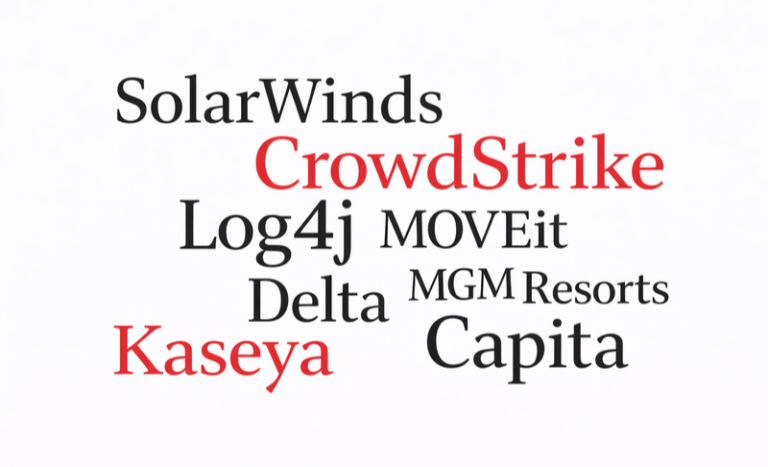
8 Third-Party Risk Examples Every 2026 Security Team Should Know
Identify, assess, and mitigate similar exposures before they cost millions Third-party vendors caused an estimated $12.5 billion in breach-related losses across Fortune 500 companies in 2023, yet most…
Trends
8 Third-Party Risk Examples Every 2026 Security Team Should Know
Identify, assess, and mitigate similar exposures before they cost millions Third-party vendors caused an estimated $12.5 billion in breach-related losses across Fortune 500 companies in 2023, yet most…