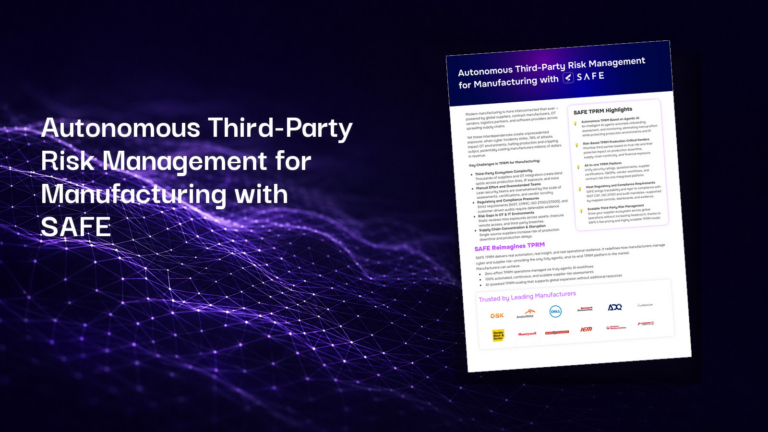
How to Choose a TPRM Platform: What the Sales Decks Won't Tell You

Why TPRM Platform Evaluations Go Wrong
Here is what usually happens. Your team spends six weeks evaluating three platforms. You sit through demos. You build a feature checklist. You issue an RFP. And then, twelve months after go-live, you realize the platform you chose handles questionnaire distribution beautifully but cannot tell you which of your 800 vendors actually represents material risk to the business.
The problem is not that the platforms lied. The problem is that most evaluations are optimized for the wrong things. Teams compare features that are easy to demo rather than capabilities that matter at scale. They score ease of onboarding without asking what breaks at 500 vendors. They evaluate how well a platform imports their existing questionnaire library without asking whether questionnaires should be the core of their program at all.
This guide is for practitioners who want to get the evaluation right the first time. Not a feature matrix. A thinking framework for the decision that will shape your program for the next three to five years.
Four Ways TPRM Platform Evaluations Fail
Optimizing for Ease of Onboarding Instead of Maturity at Scale
Every platform is easy when you have 50 vendors and a team of three. The real test is what happens at 500, 1,500, or 5,000 vendors. Platforms that look great in a pilot often rely on manual processes that the CSM team quietly absorbs during the trial period. Ask vendors to walk you through what happens when you double your vendor count with the same headcount. The answer tells you everything about the automation model underneath.
Selecting for Feature Count Rather Than Risk Signal Quality
A platform with 40 features and mediocre risk data is worse than a platform with 15 features and accurate, current risk quantification. The question is not “does it have a risk scoring module?” The question is “where does the risk score come from, how often is it updated, and how does it translate into a business-level number my CISO can explain to the board?” Feature counts obscure the signal quality gap between platforms.
Ignoring Integration Requirements Until After Selection
Your TPRM platform is not a standalone tool. It needs to connect to your GRC system, your procurement workflow, your contract management database, and potentially your SIEM. Teams that evaluate platforms in isolation discover integration costs post-contract that can equal or exceed the platform cost. Map your integration requirements before you issue the RFP, not after you sign the order form.
Treating Vendor Interaction as a Workflow Problem Instead of a Data Problem
Platforms that focus on making it easier to send questionnaires are solving the wrong problem. The bottleneck in most TPRM programs is not questionnaire distribution. It is getting reliable, current, actionable risk data back from vendors. Platforms that treat vendor interaction as a workflow problem will automate your questionnaire process beautifully while leaving you with the same data quality problem you had before.
The Five-Dimension TPRM Platform Evaluation Framework
When practitioners who have survived a bad platform selection evaluate their next one, they tend to converge on five dimensions that actually predict program success. SAFE TPRM is built around all five, which is partly why it shows up consistently in shortlists for mature programs.
1. Risk Quantification Depth
Can the platform produce a business-level risk number, not just a questionnaire score? The difference matters enormously when you are trying to prioritize across 800 vendors or justify budget to a CFO. Look for platforms that use quantitative models to translate technical vendor signals into financial exposure estimates. Ask specifically: what is the methodology, is it based on a recognized standard like FAIR, and can you show me an output that a non-technical executive can interpret in 30 seconds?
2. Automation Architecture
Where is the automation, exactly? “Automated TPRM” can mean anything from auto-sending questionnaire reminders to fully automated risk data ingestion and scoring without any manual data entry. Understand the automation model at each step of your current workflow: vendor identification, tiering, data gathering, assessment, monitoring, and reporting. For each step, ask the vendor what a human is still required to do and what happens if that human is unavailable.
3. Monitoring Continuity
Point-in-time assessments give you a snapshot. The question is what happens in between assessments. A vendor that passes your annual questionnaire can be compromised three months later. Platforms differ significantly in their continuous monitoring capabilities: what signals they ingest, how frequently they update, and how they surface changes in vendor risk posture without requiring you to kick off a new assessment cycle. Ask for a live demo of what an alert looks like when a vendor’s risk profile changes materially overnight.
4. Vendor Coverage and Data Sources
How does the platform handle vendors that are small, private, or non-responsive? Most enterprise vendor portfolios are dominated by mid-market and SMB vendors who do not have SOC 2 reports, do not have security rating profiles, and will not complete a 200-question questionnaire. A platform that is strong on large-vendor coverage but blind to your long tail of smaller vendors is covering maybe 20% of your actual risk surface. Ask specifically: what data sources does the platform use for vendors with no public footprint, and what is the coverage rate across your actual vendor list?
5. Reporting for Multiple Audiences
Your TPRM program serves at least three audiences: the program team that manages day-to-day assessments, the CISO who needs a risk portfolio view, and the board or executive team that needs business-level exposure numbers. Platforms that serve only one of these audiences create translation work that falls on your team. Evaluate the reporting layer for all three audiences explicitly, and ask for sample outputs that each audience would actually use, not sanitized demo dashboards.
- 600+ vendors assessed
- 100% completion — zero extra headcount
What Breaks at Scale: The Moments That Reveal a Platform’s Real Architecture
At 200 vendors, almost any platform works. At 1,000, the gaps start showing. At 3,000 or more, architectural weaknesses become program-defining constraints.
At 200 vendors, questionnaire-centric platforms look strong. Response rates are manageable. Follow-up is feasible. Manual review of responses is time-consuming but possible. Teams look at the output and think the platform is performing well.
At 1,000 vendors, questionnaire response rates become the primary bottleneck. You are chasing 300 non-responders. Your team is spending 60% of their time on follow-up rather than analysis. Platforms that lack automated data gathering from third-party sources, continuous monitoring signals, and risk-based prioritization of what actually needs human attention start showing their limits here.
At 3,000 or more vendors, the program either has strong automation or it does not survive. Manual review is completely infeasible. Questionnaire response rates drop to 40-50% for non-critical vendors. Without a platform that can ingest external risk signals, apply automated tiering, and surface only the vendors that require human action, the team is underwater and the program degrades into a compliance theater exercise. SAFE TPRM is designed specifically for this scale, with agentic AI that handles the data gathering, scoring, and monitoring layers that collapse in manual-heavy platforms.
The Real Trade-Offs in TPRM Platform Selection
Every platform evaluation involves genuine trade-offs. The teams that make good decisions acknowledge them rather than pretending the right answer is obvious.
Depth vs. breadth. Platforms that provide deep, quantitative risk assessment for critical vendors often struggle to extend that depth across your full portfolio. Platforms optimized for broad coverage often sacrifice depth on individual vendors. The question is where you need each. Most programs need deep quantification for the top 50 to 100 vendors and reliable continuous monitoring for the rest. Look for a platform that differentiates its assessment approach by vendor tier rather than applying one method uniformly.
Ease of deployment vs. capability ceiling. Platforms that deploy fast often have lower capability ceilings. The team that goes live in 30 days may find themselves at the edge of the platform’s capabilities within 18 months and looking at a second migration. Platforms with higher capability ceilings take longer to configure but have more room to grow with your program. Be honest about where your program will be in two years, not just where it is today.
All-in-one vs. best-of-breed. A TPRM platform that also handles GRC, compliance management, and IT risk gives you one interface and one data model. A specialized TPRM platform that integrates with your existing GRC gives you deeper TPRM capability but more integration complexity. Neither is universally right. The answer depends on your existing stack, your team’s integration capacity, and how central TPRM is versus other risk management functions in your program priorities.
SAFE TPRM is designed to resolve the depth-versus-breadth trade-off specifically. The platform provides financial risk quantification for critical vendors using FAIR-based modeling while applying automated continuous monitoring across the full vendor portfolio, without requiring you to choose between them.
Why SAFE TPRM Belongs on Your Shortlist
If you have been running a TPRM program for more than two years, you have probably already experienced the failure modes described on this page. The platform that handled the first 200 vendors hits a wall at 800. The questionnaire-centric approach produces risk registers that your CISO cannot explain to the board. The continuous monitoring tool surfaces alerts that nobody has time to investigate because the team is buried in manual follow-up.
SAFE TPRM was built to solve exactly these problems. Here is what that looks like in practice:
- Risk quantification using FAIR-based financial modeling, so every vendor assessment produces a business-level exposure number, not just a red-yellow-green score.
- Agentic AI that automates data gathering, vendor outreach, and risk scoring across your full vendor portfolio, including vendors with no public footprint or prior assessment history.
- Continuous monitoring that ingests external threat intelligence, dark web signals, and operational data to update vendor risk posture between assessment cycles.
- Multi-tier reporting that serves your program team, your CISO, and your board without manual translation between views.
- Integration with leading GRC platforms and procurement systems, so TPRM data flows into the workflows where risk decisions actually get made.
If you want to see how SAFE TPRM handles the specific failure modes your current program is running into, the SAFE TPRM walkthrough is the fastest way to get a concrete picture. Or schedule a demo and bring your real use cases.
Related Posts
 Cybersecurity
10 Most Common Cybersecurity Blind Spots
Nearly 90% of cyberattacks are caused by human error, so it’s important to understand and address your organization’s cybersecurity weak spots. Many organizations struggle to maintain a clear…
Cybersecurity
10 Most Common Cybersecurity Blind Spots
Nearly 90% of cyberattacks are caused by human error, so it’s important to understand and address your organization’s cybersecurity weak spots. Many organizations struggle to maintain a clear…
 Blog
2025 in Retrospect: SAFE Steers the Industry Towards Autonomous Cyber Risk Management
By: Sweta Bhattacharya 2025 wasn’t just a milestone year for SAFE: it was the year the entire cyber risk management landscape shifted. Every major shift in the SAFEOne…
Blog
2025 in Retrospect: SAFE Steers the Industry Towards Autonomous Cyber Risk Management
By: Sweta Bhattacharya 2025 wasn’t just a milestone year for SAFE: it was the year the entire cyber risk management landscape shifted. Every major shift in the SAFEOne…