SAFE AI Policy
At SAFE Security, we are committed to ensuring transparency, security, and reliability in the use of Artificial Intelligence (AI) and Machine Learning (ML) technologies across our products and services. This FAQ provides clear answers to common questions about how AI is integrated into our offerings, how we manage and protect customer data, uphold privacy standards, and ensure transparency on the use of AI and ML models.
Updated 2026-04-06
SAFE leverages a combination of open-source, self-hosted models, and third-party hosted models to deliver an AI powered experience tailored to you, your teams, and your workflows. AI within SAFE is used in three primary ways:
- Automatically ingest the information that you upload to the SAFE Platform;
- Agentic AI agents to optimise your workflows; and
- Generative AI to provide insight to your data and assist you in using the SAFE platform
The high level data flow is shown below:
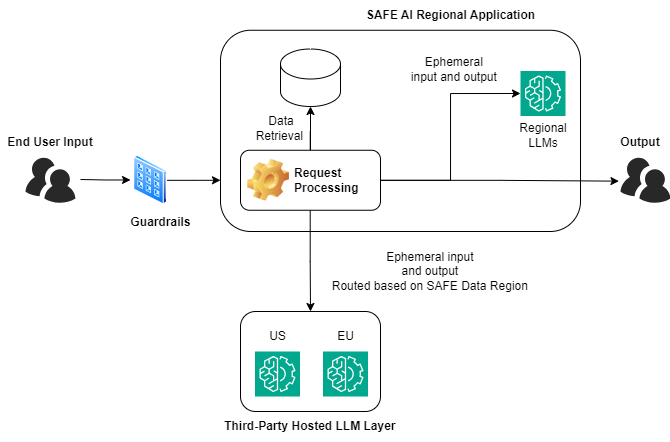
Prompts are stored by SAFE for usage history, limited to the user initiating the query. This approach ensures the privacy of your data is maintained throughout the entire process.
However, SAFE may use your data (excluding any PII, sensitive, or regulated data) to identify errors, improve performance, and enhance the Services, including its AI agents.
This usage is subject to the following stringent controls:
- No PII, PHI, or regulated data is used;
- No customer data is used to train shared or cross-tenant models;
- Data is processed in a tenant-isolated manner; and
- No data is shared across customers.
SAFE processes user inputs solely to generate the outputs that the user has requested. We may also process organizational data from within your tenant that the user has permission to view and include that data with the user inputs so that LLMs can provide more accurate, relevant, and contextual responses.
The LLM providers we use do not retain your inputs and outputs, or use them to improve their services.
In addition to the restrictive policies we have put in place for our LLM providers, we also limit the use and access of customer data within our platform. Customer inputs and outputs are used only to serve and improve individual customer experiences. They are not used for model training across customers.
SAFE may store your inputs and outputs for a limited period of time to reduce latency (e.g. when displaying a page summary), or when required to provide a specific feature (e.g. displaying a search history).
SAFE AI is designed to help organizations analyze cyber risk and review security signals across their environment. It is not intended to store or process sensitive information such as PII, PHI, or other regulated data. Customers should avoid submitting such data and ensure that information shared, if any, complies with applicable data protection laws.
We use a diverse range of open-source, AWS Bedrock hosting LLMs, including models from the Anthropic Claude Sonnet and Nova models, alongside third-party hosted LLMs from OpenAI’s GPT series of models, to deliver the best outcomes for customers. Our features use dynamic routing to select the appropriate mix of models that can deliver the best experience and accuracy.
The LLM providers we use do not retain your inputs and outputs, or use them to improve their services.
Customers can request our list of data sub-processors for more information on our third-party hosted LLM providers. While SAFE uses contractual safeguards with its LLM providers, including DPAs, customers acknowledge that these providers operate their own infrastructure, and SAFE does not have full operational control over their internal compliance practice.
No, the LLM providers we use do not retain your inputs and outputs, or use them to improve their services.
For third-party hosted models, each data request is sent to the third-party provider individually over an TLS encrypted service, to process and send back to SAFE.
Customer prompts barring any PII data are stored and may be processed by SAFE for individual user history, identifying and resolving errors, analysis of recurring issues and abuse prevention. Customers can request prompt removal from conversion history by contacting SAFE support.
No, SAFE leverages dynamic routing between models, and does not support provider selection.
SAFE is designed to analyze cyber risk and security signals and is not intended to store or process sensitive data such as PII, PHI, or other regulated information. Limited use of customer inputs may occur to support system functionality, such as troubleshooting errors and maintaining service performance. Customers should avoid submitting sensitive or regulated data into the SAFE platform.
No, the data you submit and the responses you receive are used only to support your experience, and only processes data specific to the querying SAFE tenant. This data is not used to train models across customers or shared across customers.
When using AI in the SAFE platform, data is transferred outside of the current site to third-party LLM providers in order to generate a response. Even though the data is transferred, it follows existing SAFE security practices and is not persisted. Each data request is sent to our LLM providers individually, over an TLS encrypted service, to process and send back to the SAFE platform.
Yes. If Internet Search is enabled in the settings, the agent may perform searches on the public internet to enhance response generation. This feature is disabled by default, access to enable it is restricted to admin. No personally identifiable information (PII) or sensitive data is used in this process, ensuring data protection and privacy.
Yes. If you are an admin, you can log into SAFE and go to “Advanced Settings” to manage AI usage in SAFE. Please note that where some products or features entirely rely on AI, this will result in them being deactivated. This includes SAFEs TRPM module with its integrated AI assistants and workflow processing.
User access to SAFE AI capabilities is governed through SAFE’s role-based access control (RBAC) model. SAFE X is available to users, but it can only retrieve data permitted by the user’s assigned roles and permissions.
AI Agents embedded within product modules (e.g., TPRM) are accessible only to users who have access to those modules. Agents operate strictly within the same permission boundaries as the underlying feature.
SAFE AI is built with a security-first architecture to ensure your data remains private, controlled, and protected at all times. Key safeguards include:
- Secure Cloud Infrastructure
All customer-specific data is stored within SAFE’s AWS infrastructure, protected by encryption at rest and in transit, and governed by ISO 27001 and SOC 2 Type 2 certified controls. - Data Residency and Encryption
All customer data is stored within AWS infrastructure, using encryption at rest and in transit. SAFE inherits AWS’s security best practices while layering on additional access controls specific to AI workloads. - No Data Sharing or Training on Customer Data
SAFE enforces tenant-level isolation and does not use any customer data to train AI models, ensuring privacy and strict data boundaries. - AI Usage Governance
SAFE AI operates within defined guardrails – its usage is continuously monitored and governed by internal security policies to prevent misuse or overreach of AI capabilities. - Bias, Accuracy, and Fairness Reviews
SAFE conducts targeted evaluations of AI outputs to identify potential bias, validate accuracy, and uphold fairness in outcomes – aligned with regulatory expectations like GDPR and CCPA. - Transparent and Auditable Logs
All AI interactions are logged in a tamper-evident format to support traceability, internal investigations, and customer audit requirements.
SAFE holds all customer data in the selected data region for the SAFE tenant. SAFE uses a diverse range of advanced LLMs to provide SAFE AI features which may not be available across all data regions. The current availability of supported LLMs are as follows:
- US Data Region – LLM processing occurs in the US;
- EU Data Region – LLM processing occurs in the EU; and
- Rest of World – LLM processing occurs in the US.
We are committed to helping our customers stay compliant with GDPR and their local requirements. As we do today for the SAFE Platform, we will process and transmit data for SAFE AI in accordance with GDPR.
SAFE AI is designed to support GDPR principles such as data minimization, access controls, and transparency. The platform is intended to analyze cybersecurity signals from integrated systems (e.g., cloud configurations, vulnerability management tools) and is not designed to store or process customer or consumer personal data that would typically fall within the scope of GDPR. SAFE processes security signals rather than underlying customer datasets, and customers remain responsible for ensuring that any information shared with the platform complies with applicable legal requirements.
SAFE AI is developed using infrastructure, processes, and code that are governed by our SOC 2 Type 2 and ISO 27001 certified controls. These certifications demonstrate that our security and compliance practices meet industry standards for protecting data and ensuring operational integrity.
SAFE AI operates within the same secure development lifecycle, access controls, encryption standards, and monitoring systems that are independently audited under these frameworks. This ensures that the way we build and manage AI at SAFE reflects our commitment to enterprise-grade security and trust.
SAFE AI is not designed to process Protected Health Information (PHI) and as such is not HIPAA compliant. Customers are advised not to submit healthcare or patient-related data to SAFE AI that falls within the context of HIPPA. SAFE does follow industry best practice around software design principles highlighted by HIPPA including Data Access Control, Encryption, Audit Trails, Data Security Protocols, Data Integrity and Software Updates/Maintenance.
Activating or deactivating AI lets you manage where AI experiences appear for your users. If you have AI activated, SAFE AI features can access and use data on the SAFE Platform.
Disclaimer. SAFE does not represent, warrant or otherwise guarantee that the output generated by SAFE AI will be accurate, complete, or current. As such, you should independently review and verify all output as to usefulness, appropriateness, accuracy, fitness for its purpose, and any other quality relevant to your use cases and/or applications. You are solely responsible for the content of the input and its use of output.