
The Architecture of Cyber Risk: Turn Security Spend into Business Decisions
Security tools answer technical questions well. They do not answer business ones.
In today’s digital landscape, cybersecurity is no longer defined by the number of tools deployed or controls implemented. Despite significant investment, many organizations still struggle to confidently answer a fundamental question:
Are we actually reducing cyber risk or just managing security activity?
Market data suggests that enterprises typically allocate 8–15% of their IT budgets to cybersecurity. This level of investment reflects how critical cyber resilience has become. Yet, the effectiveness of that spend depends less on tools and more on how cyber risk is architected, measured, and governed.
When Spending More Doesn’t Mean Being Safer
Consider a representative enterprise with $2 billion in annual revenue:
- IT spend at ~4% of revenue: $80 million
- Cybersecurity spend at ~10% of IT budget: $8 million
On the surface, this appears adequate. But for CISOs, the real challenge is not the size of the budget,it’s the absence of an architectural layer that turns spend into defensible decisions.
Security tools answer technical questions well. They do not answer business ones.
The Missing Layer in Most Security Architectures
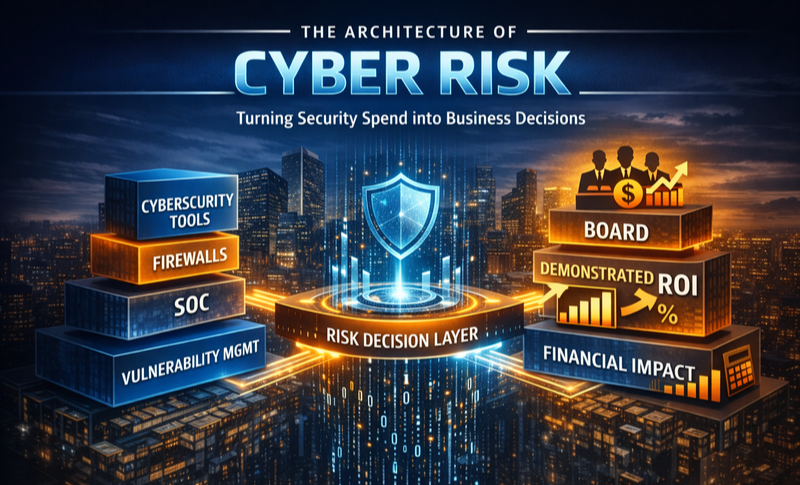
From an architectural perspective, most cybersecurity programs are built around controls and detection. What’s often missing is a risk decision layer that connects security signals to business impact.
Without this layer:
- CISOs struggle to prioritize effectively
- Boards receive subjective, qualitative updates
- Security investments are difficult to justify or optimize
This is where a relatively small reallocation, 5–10% of the cybersecurity budget into Cyber Risk Management can fundamentally change outcomes.
What That 5–10% Should Enable
1. Elevating the CISO from Security Leader to Business Leader
Modern CISOs are expected to operate as enterprise risk executives. That shift requires an architecture that supports board-level conversations, not in technical severity, but in business impact and financial exposure.
2. Translating Cyber Risk into Business Language
Boards and executives don’t think about vulnerabilities and alerts. They think in:
- Probability
- Financial loss
- Business disruption
An architecture that quantifies cyber risk in percentages and monetary terms ($) creates a common language between security, finance, and leadership.
3. Proving ROI on the Remaining 90–95% of Spend
The vast majority of cybersecurity budgets are consumed by tools and services. Yet CISOs are often asked:
“What did we get in return?”
Without quantification, this question is unanswerable.
With it, CISOs can demonstrate measurable risk reduction per dollar invested, transforming cybersecurity from a cost center into a value-driven function.
4. Enabling Smarter Cyber Insurance Decisions
Cyber insurance is increasingly data-driven. Quantified risk allows organizations to:
- Understand retained vs. transferred risk
- Reduce reliance on manual assessments
- Strengthen insurer negotiations with credible evidence
5. Managing Third-Party Risk Through a First-Party Impact Lens
Third-party risk programs often fail because they treat all vendors equally. An architecture that models how supplier risk translates into first-party financial loss allows CISOs to focus on what truly matters at scale.
Why This Is an Architectural Shift, Not a Tool Change
This approach doesn’t replace existing security tools. It sits above them. It aggregates signals, adds business context, and enables decision-making grounded in quantified risk. In other words, it completes the architecture. CTEM, vulnerability management, SOC operations, all become more effective when guided by a clear understanding of which risks are financially material.
Final Thought
Cybersecurity resilience is not achieved by spending more, it’s achieved by deciding better.
Organizations that invest in the architectural layer that connects tools to business outcomes empower CISOs to lead with confidence, credibility, and clarity.
In the end, tools generate data. Architecture enables decisions. And decisions are what truly reduce risk.
Get Started with SAFE
The only Agentic AI-driven Continuous Cyber Risk Management platform. Integrate and automate Third Party Risk Management (TPRM) and Cyber Risk Quantification. Schedule a demo.
SUBSCRIBE TO WEEKLY BLOG NEWSLETTER



SHARE THE PAGE

