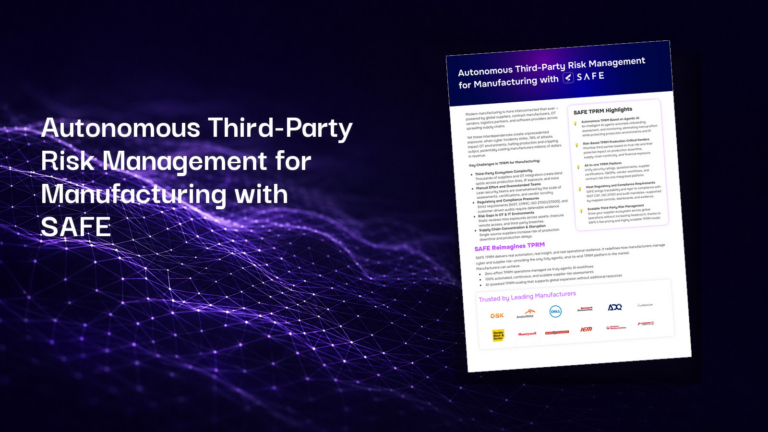
Vendor Risk Program Maturity: A Practical Model for Knowing Where You Stand and What to Fix Next

Why Most Programs Think They Are More Mature Than They Are
Ask a TPRM team lead to rate their program’s maturity and they will almost always land a level or two above where they actually operate. This is not dishonesty. It is a measurement problem. Most programs measure activity, and activity is easy to accumulate.
You sent 400 questionnaires last year. You completed 312 of them. You have a risk register with 180 vendors logged. You re-assessed your top 20 critical vendors on a 12-month cycle. These numbers feel like evidence of a mature program. They are evidence of an active one. The difference matters.
Activity metrics tell you what your team did. Outcome metrics tell you whether vendor risk is actually being managed. Can you show a board member the aggregate financial exposure your third-party portfolio represents today? Can you demonstrate that the findings from last year’s assessments led to measurable remediation? Do you have real-time visibility into risk changes between annual assessment cycles? If the answer to those three questions is no, your program is reactive regardless of how many questionnaires went out the door.
The honest version of program maturity starts with acknowledging this gap. Most programs are not where they think they are. And that is fine, as long as you have a clear picture of where the gaps actually are and what closing them requires.
Four Symptoms of a TPRM Program That Has Stalled
Maturity stalls are not dramatic. They happen quietly, usually after the program has achieved enough process to feel successful. Here are the four symptoms that show up most consistently in programs that have stopped progressing.
Your Risk Register Is a Spreadsheet With No Assigned Owner
Every TPRM program has a risk register. Most of them are spreadsheets that were last meaningfully updated six months ago. Vendors are listed. Risk scores are assigned. Findings are documented. And none of it has an owner, a due date, or a follow-up mechanism.
A risk register that does not drive action is not a risk management tool. It is a documentation artifact. The distinction is not semantic. When a vendor’s risk profile changes, when a new finding is identified, when a remediation deadline passes without action, a spreadsheet does not surface any of this. It sits there, quietly outdated, until someone remembers to update it manually.
The shift from a static risk register to a dynamic one is one of the clearest maturity signals in TPRM. Dynamic means risk scores update when evidence changes. Ownership is assigned and tracked. Escalation paths trigger automatically when thresholds are crossed. SAFE TPRM’s risk register operates this way: vendor risk profiles update as new evidence arrives, ownership workflows route action items to the right people, and the system surfaces overdue remediations without requiring a human to check.
Remediation Tracking Lives Entirely in Email Threads
Here is the practical test for this one. Pick three high-risk findings from your last assessment cycle and answer these questions: What was the agreed remediation timeline? What has the vendor done since the finding was issued? What is the current status of each finding? What happens on the day the remediation deadline passes?
If the answers require digging through email threads or chasing down an analyst who handled the original assessment, your remediation tracking is not a workflow. It is memory and luck. Neither scales, and neither is defensible when something goes wrong with a vendor who was supposed to have remediated a known critical finding.
Remediation tracking at maturity means findings generate structured action plans with deadlines and vendor-facing documentation. Vendor responses are tracked in a system, not an inbox. Escalations trigger automatically. Re-assessment happens when vendors claim completion, not when someone remembers to schedule it. SAFE TPRM handles all of this as part of the assessment workflow, so remediation tracking is built in rather than bolted on.
You Cannot Report Residual Third-Party Risk to the Board in Financial Terms
This is the maturity gap that most limits how seriously a TPRM program is taken at the executive level. If you can only describe your vendor risk in qualitative terms (high, medium, low, or red, yellow, green), you are not speaking the language that drives resource allocation and board-level decisions.
A board member looking at a heat map of vendor risk scores cannot answer the question that actually matters: what is our financial exposure if one of these vendors has a significant breach event? Without a financial model behind your risk ratings, the answer is “somewhere between bad and very bad,” which is not a defensible position for a governance body.
The programs that have genuine influence at the executive level can say: “Our aggregate third-party risk exposure, modeled across our top 50 vendors, is $120 million under a realistic breach scenario. Our three highest-exposure vendors represent $74 million of that. Here is what we are doing to reduce it.” This requires financial quantification infrastructure, not just risk scoring. SAFE CRQ provides this layer, translating vendor risk posture into probability-weighted financial exposure using FAIR-based modeling, so your board reporting moves from color-coded charts to defensible financial numbers.
Your Program Covers the Same 50 Vendors It Did Three Years Ago
Coverage stagnation is the most common maturity plateau and the least acknowledged one. Three years ago, you had 50 vendors in your formal assessment program. Today you have 400 active vendors, but your formal program still covers 50 of them. The other 350 are operating without assessment, without monitoring, and without documented risk status.
The usual explanation is headcount. “We can only run so many assessments with the analysts we have.” This is true but incomplete. It conflates assessment capacity with program coverage, as though the only way to cover more vendors is to hire more analysts. Automation changes this equation entirely. When evidence collection is automated, when scoring runs on a defined model rather than analyst judgment, and when monitoring operates continuously rather than annually, a team of five analysts can cover 500 vendors with the same depth that used to require a team of 15 covering 100. Coverage stagnation is a tooling problem, not a headcount problem.
The Five-Level TPRM Maturity Model: From Reactive to Autonomous
This model is built for honest self-placement, not aspirational positioning. Read each level description and place yourself where your current operations actually sit, not where your documented policies say you are. SAFE TPRM is designed to take programs from wherever they are today to Level 4 operations, and toward Level 5 over time.
Level 1 Ad Hoc: Reactive, Undocumented, Spreadsheet-Dependent
Level 1 programs respond to vendor risk events rather than anticipating them. Assessments happen when someone asks for them, usually when procurement needs sign-off on a new vendor or when legal needs to confirm a contract commitment. There is no formal assessment process. Risk decisions live in email threads and personal judgment. The vendor list is incomplete and not maintained systematically.
Honest indicators of Level 1: you could not produce a full list of your active vendor relationships in 24 hours. Risk decisions rely entirely on analyst intuition. There is no formal escalation path when a vendor assessment raises a critical finding. You learn about vendor security incidents from news, not from a monitoring system.
Most programs start here. The ones that stay here longest are usually those that achieved enough informal process to feel under control, without ever formalizing it into something repeatable and measurable.
Level 2 Defined: Documented Process, Manual Execution, Limited Coverage
Level 2 programs have the right intentions. There is a documented assessment process. Questionnaires are standardized. There is a risk register, usually a spreadsheet. Coverage exists for the most critical vendors. The program would survive an audit because the documentation is there.
What Level 2 lacks is scale and outcome tracking. Assessment coverage tops out at whatever volume the team can manually process. Remediation tracking is informal. Risk scores are assigned but not connected to financial exposure. Monitoring between annual assessments does not exist in any systematic way.
Level 2 is where the majority of enterprise TPRM programs currently operate. It is also where programs plateau most often, because the process is good enough to satisfy compliance requirements without being good enough to actually manage risk at scale. The gap between “good enough for the audit” and “good enough to catch the next vendor-caused breach” is the maturity problem nobody wants to name directly.
Level 3 Managed: Risk-Based Tiering, Consistent Assessment, Monitoring Gaps
Level 3 programs have made the move to risk-based thinking. Vendors are formally tiered. Assessment depth varies by tier. Coverage has expanded beyond the top 20 or 50 critical vendors into a broader portfolio. Risk scores are consistent because the methodology is documented and applied systematically.
The gap at Level 3 is almost always continuous monitoring. Assessments are point-in-time. Between the annual cycle and the next one, the program is essentially blind to risk changes. A vendor that scored well in January can have a significant security event in July without triggering any program-level response until the next annual cycle starts.
Level 3 is where many organizations with dedicated TPRM teams and reasonable tooling end up. It is genuinely better than Level 2 in ways that matter. It is still not managing risk continuously, which means it is managing risk history rather than risk reality.
Level 4 Quantified: Financial Risk Scoring, Continuous Monitoring, Board-Ready Reporting
Level 4 is the operating standard that risk governance expectations are increasingly pointing toward. Three capabilities define it: financial quantification of vendor risk, continuous monitoring between assessment cycles, and board-ready reporting in terms that executives can act on.
Financial quantification means vendor risk scores are connected to modeled financial exposure, not just qualitative ratings. A vendor scoring High risk is also carrying a specific estimated financial exposure under a defined breach scenario. This is what the board sees, and it is what makes the program influential at the governance level rather than just informative.
Continuous monitoring means risk changes between formal assessments are detected and surfaced in real time. New breach disclosures, vulnerability disclosures, financial distress signals, regulatory actions against the vendor: all of these update the risk picture without waiting for the next annual cycle.
Board-ready reporting means the CISO can walk into a board meeting and answer two questions: what is our current aggregate third-party risk exposure, and what are we doing about the highest-risk relationships? Both require the infrastructure that Level 4 builds.
Level 5 Autonomous: AI-Driven, Continuously Updated, Analyst-Augmented
Level 5 is where few programs currently operate and where the industry is heading. The defining characteristic is that the system drives the program rather than the program driving the system. Risk scores update continuously as new evidence arrives. Escalations trigger automatically when vendor risk crosses defined thresholds. Evidence collection runs without analyst initiation. Re-assessment is triggered by risk change signals rather than calendar schedules.
Analysts at Level 5 are not managing the assessment process. They are reviewing escalations, making judgment calls on complex risk scenarios, and driving strategic decisions about the vendor portfolio. The operational burden of the program sits with the platform. The human contribution is concentrated where human judgment is genuinely irreplaceable.
This is the model SAFE TPRM is built toward. The Agentic AI infrastructure that powers evidence collection, continuous monitoring, and automated scoring today is the foundation of autonomous TPRM operations.
- 600+ vendors assessed
- 100% completion — zero extra headcount
What Moving From Level 2 to Level 4 Actually Requires Operationally
Most programs want to go from Level 2 to Level 4. Few have a realistic picture of what that actually requires. Here is what the journey looks like in practice.
The first shift is evidence collection. At Level 2, evidence collection is entirely manual: questionnaires distributed, responses tracked, documents requested and reviewed. Moving to Level 4 requires automating outside-in evidence collection so that public records, breach history, regulatory filings, and external vulnerability data are gathered automatically. This alone eliminates 50 to 60% of the analyst time currently spent on each assessment. SAFE TPRM’s Agentic AI handles this layer without analyst initiation, running evidence collection in parallel across the portfolio.
The second shift is scoring consistency. Level 2 scoring relies on analyst judgment. Level 4 scoring applies a documented model consistently across all vendors. This is not about removing human judgment from risk decisions. It is about separating the scoring model (which should be consistent and auditable) from the risk decision (which requires human context and authority). Defining and implementing a consistent scoring model is the process investment required here.
The third shift is continuous monitoring. Adding continuous monitoring between assessment cycles is the capability that most directly distinguishes Level 3 from Level 4. It requires a platform that watches vendor risk signals continuously, not a team of analysts doing periodic manual checks. The monitoring layer is what turns point-in-time assessments into an always-on risk program.
The fourth shift is financial quantification. This requires connecting risk scores to financial models. For programs that have not done this before, it feels like a significant lift. In practice, the FAIR methodology provides a structured framework that is implementable without a team of actuaries. The key is having a platform that runs the models consistently rather than building them manually for each board report. SAFE CRQ handles this integration automatically, translating vendor risk posture into financial exposure scenarios that update as the underlying risk data changes.
Programs that try to make this journey without platform support typically take three to five years and stall at Level 3. Programs with the right platform infrastructure make the same journey in six to twelve months, because the enabling capabilities come with the platform rather than being built from scratch.
The Trade-Off: Investing in Program Depth vs. Expanding Vendor Coverage
This is the trade-off that limits most programs in practice. You have finite analyst capacity. You can use it to go deeper on the vendors you already assess, building more rigorous controls evaluation and better remediation tracking. Or you can use it to cover more vendors, accepting less depth per relationship. You cannot do both without either growing headcount or changing your tools.
The programs that choose depth over coverage often have excellent risk management for the vendors they cover and no visibility into the rest of their portfolio. The programs that choose coverage over depth often have broad but shallow assessments that are generating questionnaire completion rates but not meaningful risk data.
Neither is a good answer. The 200-vendor portfolio that is thoroughly managed is still leaving 800 unassessed vendors operating without oversight. The 3,000-vendor portfolio with shallow assessments is generating activity metrics that look good on a dashboard but are not managing risk.
SAFE TPRM eliminates this trade-off by automating the evidence collection and scoring layers that consume most analyst time. When those layers run automatically, the capacity that was being consumed by evidence gathering is freed up for coverage expansion. A team of five analysts that was previously running 200 thorough assessments per year can run 600 assessments at the same depth, or 1,000 assessments with tiered depth applied proportionally. Depth AND coverage. Not one or the other.
Why We Built SAFE TPRM to Enable Level 4 and Level 5 Program Maturity
SAFE TPRM was built specifically because the gap between where most programs operate (Level 2) and where risk governance is demanding they operate (Level 4) cannot be closed with more analysts and better spreadsheets. The infrastructure has to change.
Here is what SAFE TPRM delivers that moves programs up the maturity curve:
- Agentic AI Evidence Collection: Automated public records gathering, breach history aggregation, regulatory compliance status, and external vulnerability scanning run in parallel across your entire vendor portfolio without analyst initiation. This is the capability that cuts evidence collection from 60% of assessment cycle time to under 10%, freeing analyst capacity for coverage expansion and risk judgment.
- Standardized Automated Scoring: A documented, consistent scoring model that applies the same logic to the same inputs every time. Not analyst judgment varying by workload. Not subjective risk ratings that shift between assessment rounds. Defensible, repeatable risk scores that hold up in audits and post-breach investigations.
- Continuous Monitoring Infrastructure: Always-on monitoring of vendor risk signals between formal assessment cycles. Breach disclosures, vulnerability alerts, regulatory actions, financial distress indicators: all surface in real time rather than waiting for the next annual review. This is the capability that moves programs from point-in-time risk management to continuous risk visibility.
- FAIR-Based Financial Quantification with SAFE CRQ: SAFE CRQ translates vendor risk posture into probability-weighted financial exposure scenarios. Your board does not see a heat map. It sees a modeled aggregate exposure number, the highest-risk relationships, and the cost-benefit analysis of remediation investment. This is Level 4 board reporting.
- Remediation Workflow Automation: Findings generate structured remediation requests with deadlines and vendor-facing action plans. Response tracking lives in the platform, not in email. Escalations trigger automatically. Re-assessment initiates when vendors provide evidence of remediation. The remediation loop closes without manual coordination.
The programs that use SAFE TPRM to get to Level 4 are not just running faster assessments. They are running a fundamentally different kind of program, one where risk is managed continuously rather than audited periodically, where financial exposure is quantified rather than categorized, and where the platform drives operational workflow rather than an analyst’s task list.
See where your program currently stands against this model and what moving to Level 4 looks like in practice. Explore the SAFE TPRM walkthrough or schedule a demo to walk through the maturity gaps specific to your program.
Related Posts
 Cybersecurity
10 Most Common Cybersecurity Blind Spots
Nearly 90% of cyberattacks are caused by human error, so it’s important to understand and address your organization’s cybersecurity weak spots. Many organizations struggle to maintain a clear…
Cybersecurity
10 Most Common Cybersecurity Blind Spots
Nearly 90% of cyberattacks are caused by human error, so it’s important to understand and address your organization’s cybersecurity weak spots. Many organizations struggle to maintain a clear…
 Blog
2025 in Retrospect: SAFE Steers the Industry Towards Autonomous Cyber Risk Management
By: Sweta Bhattacharya 2025 wasn’t just a milestone year for SAFE: it was the year the entire cyber risk management landscape shifted. Every major shift in the SAFEOne…
Blog
2025 in Retrospect: SAFE Steers the Industry Towards Autonomous Cyber Risk Management
By: Sweta Bhattacharya 2025 wasn’t just a milestone year for SAFE: it was the year the entire cyber risk management landscape shifted. Every major shift in the SAFEOne…