
Fourth Party Risk Management: 2026 Best Practices for TPRM
Identify, assess, and mitigate risk from your vendors’ vendors

Your SaaS vendor gets breached, but the attacker never touched their systems. Instead, they compromised the cloud provider your vendor uses to host your data—a fourth party you didn’t know existed until regulators started asking questions during the audit.
Fourth party risk management is the process of identifying, assessing, and mitigating cybersecurity and operational risks posed by your vendors’ vendors—the subcontractors and service providers that sit one step removed from your organization but can still cause material harm if they fail or are compromised. This guide covers how to discover fourth parties in your supply chain, tier them by actual risk, embed oversight into vendor contracts, and use AI-driven automation to monitor thousands of subcontractors without adding headcount.
What Is Fourth Party Risk?
Fourth party risk management is the process of identifying, assessing, and mitigating cybersecurity and operational risks posed by your vendors’ vendors—the subcontractors and service providers that sit one step removed from your organization. While you contract directly with third parties, fourth parties operate in the background, often invisible until something goes wrong.
Think about your SaaS vendor that hosts all your customer data on AWS. AWS is a fourth party. Or your e-commerce platform that processes payments through Stripe—Stripe is a fourth party. Your software vendor might outsource development to contractors in another country, and you’ve never heard their names. Yet if any of these fourth parties experience a breach, outage, or compliance failure, your data and operations are still at risk.
The terminology gets used interchangeably, and that’s fine. “Fourth party,” “4th party,” and “fourth party vendor” all describe the same concept. Risks don’t stop at the fourth tier, either—they cascade through fifth, sixth, and what we call “nth parties.” For practical purposes, though, most organizations focus on the immediate subcontractors of their critical vendors, where visibility remains somewhat achievable.
Why It Matters for Extended Vendor Oversight
Supply chain compromises have affected more than 60% of organizations in recent years, and a single compromised fourth party can impact dozens of your vendors simultaneously. Unlike a direct attack on your systems, fourth party breaches spread faster because the compromised entity often serves multiple clients across industries. Your vendor’s security might look solid on paper, but if their subcontractor gets breached, your data is exposed anyway.
Regulators are paying attention. The Federal Reserve, OCC, and FDIC now expect financial institutions to understand critical fourth party dependencies. The EU’s Digital Operational Resilience Act (DORA) mandates that financial entities assess ICT third party risk, including all subcontracting arrangements. Ignorance isn’t a defense during audits—regulators want proof that you’ve asked the right questions and received satisfactory answers.
Cyber insurance carriers are also tightening requirements. Insurers increasingly ask about vendor risk management maturity during underwriting and may deny claims if fourth party risks weren’t assessed. The message is clear: if you can’t demonstrate that you understand your extended supply chain, you’re on your own when something breaks.
| Aspect | Third Party | Fourth Party |
| Contractual relationship | Direct | Indirect |
| Visibility into controls | High | Limited |
| Audit rights | Often included | Rarely included |
| Remediation authority | Direct influence | Indirect only |
Third Party vs Fourth Party: Key Differences
Third party risk management centers on vendors you contract with directly. You control vendor selection, you can audit their security controls, and you can enforce requirements through contract terms. If your payroll provider like ADP experiences a breach, you have direct recourse and likely contractual protections.
Fourth party risk management operates differently. Your vendor holds the contract with the fourth party, not you. You’re relying entirely on your vendor’s due diligence, and you typically have limited or no direct audit rights. The cloud infrastructure provider your payroll vendor uses to host your employee data? That’s a fourth party, and you probably can’t audit them even if you wanted to.
Here’s the key insight: fourth party risk management isn’t about managing fourth parties directly, because you can’t. It’s about making certain your third parties have solid TPRM programs of their own and that they’re cascading your risk standards down the supply chain. You’re managing risk through influence and contractual requirements, not through direct control.
The term “fourth-nth parties” acknowledges that risks extend beyond just one additional tier, but trying to manage every layer becomes impractical quickly. Most organizations focus on fourth parties tied to critical vendors—those supporting essential business functions or handling sensitive data—where the effort delivers measurable risk reduction.
Critical Threats and Vulnerabilities in the Fourth-Nth Supply Chain
Cybersecurity breaches top the list. When a fourth party maintains weak security controls, they become an entry point for attackers who can then pivot to your vendor and ultimately to you. The MOVEit file transfer vulnerability and SolarWinds-style supply chain attacks demonstrate how quickly compromise spreads through interconnected systems.
Operational failures cascade just as fast. The CrowdStrike incident in 2024 showed how a single fourth party’s software update can disable services across dozens of your vendors simultaneously, leaving you with limited options for recovery. Unlike a breach where you might have some warning, operational outages often strike without notice.
- Compliance gaps: Fourth parties operating in different jurisdictions may not meet your regulatory requirements for GDPR, HIPAA, or SOC 2
- Concentration risk: Multiple third parties relying on the same fourth party like AWS or Microsoft creates a single point of failure
- Data leakage: Fourth parties may access, process, or store your sensitive data without your knowledge
- Financial instability: A fourth party bankruptcy can disrupt your vendor’s ability to deliver services
The risks remain invisible until a breach or outage forces them into the open. By then, the damage is done, and you’re left explaining to executives or regulators why you didn’t know about a critical dependency.
Regulatory Expectations and Compliance for Fourth Party Vendor Management
Regulators don’t expect you to directly manage fourth party relationships—that would be impractical and often impossible. What they do expect is proof that you’ve made certain your vendors manage their subcontractors properly and that you understand which fourth parties could materially impact your operations.
The Interagency Guidance on Third-Party Relationships from the Federal Reserve, OCC, and FDIC requires financial institutions to understand critical fourth party dependencies and verify that vendors have sound risk management practices. DORA in the EU goes further, mandating that financial entities assess ICT third party risk, including all subcontracting arrangements. The NIST Cybersecurity Framework and NIST 800-161 recommend supply chain risk management practices that explicitly extend beyond direct vendors.
What does this look like in practice? Regulators expect you to identify critical fourth parties that could materially impact operations, include contractual requirements for third parties to disclose and manage fourth party relationships, maintain evidence that third parties perform due diligence on their subcontractors, and develop incident response plans that account for fourth party failures. Audit checklists increasingly include questions about fourth party risk management and 4th party risk management, making this a compliance requirement, not just a best practice.
The regulatory message is consistent: you own the risk, even if you don’t own the relationship. Demonstrating that you’ve asked the right questions and validated your vendors’ answers is the baseline expectation.

Fourth party discovery, SAFE One platform
Essential Steps to Implement 4th Party Risk Management
Building an effective 4th party vendor management program requires a systematic approach that balances thoroughness with practicality. Most organizations discover they have hundreds of unknown fourth parties once they begin mapping dependencies, so starting with a clear framework prevents the effort from becoming overwhelming.
1. Identify Subcontractors and Map Dependencies
Discovery is the foundation. You can’t manage risks you don’t know exist, and most organizations severely underestimate how many fourth parties touch their data or operations.
Start by requiring vendors to disclose critical subcontractors during onboarding and annually thereafter. Review SOC 2 Type II reports carefully—they include a section on “subservice organizations” that lists the fourth parties your vendor relies on. Conduct vendor interviews specifically focused on mapping dependencies, asking not just who they use but what functions those subcontractors perform.
Include contract language that mandates notification whenever your vendor adds or changes a fourth party relationship, especially for critical services. Many organizations stop here, assuming they’ve captured everything. They haven’t—vendors often use subcontractors they don’t think to mention because the relationship seems minor or temporary.
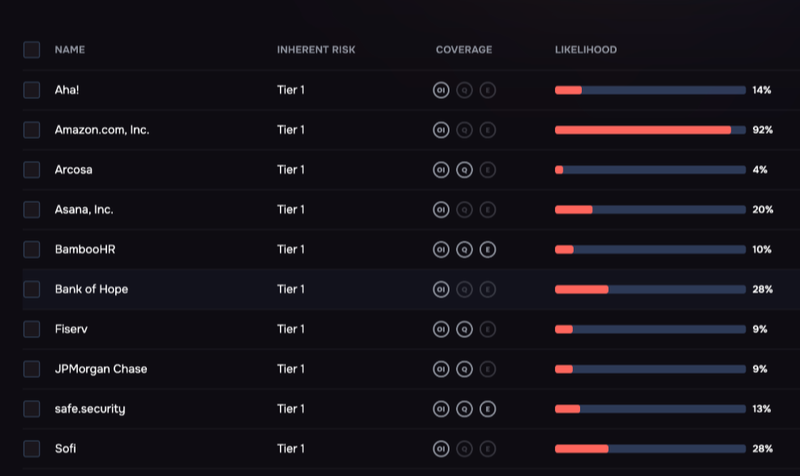
Tiering vendors by risk with the SAFE One platform
2. Classify Vendors by Risk Tier
Not all fourth parties require the same level of oversight, and trying to deeply assess every subcontractor your vendors use will quickly exhaust your resources. Risk-based tiering focuses effort where it matters most.
Tier fourth parties based on three factors: criticality (does the fourth party support a business-critical function?), data access (does the fourth party process, store, or transmit sensitive data?), and regulatory scope (is the fourth party subject to the same compliance requirements as your organization?). A simple three-tier model works for most organizations.
- Tier 1 (Critical): Requires active monitoring and assessment
- Tier 2 (Moderate): Requires periodic review
- Tier 3 (Low): Requires basic awareness only
The cloud provider hosting your customer data? Tier 1. The subcontractor handling non-sensitive internal tools? Probably Tier 3.
3. Incorporate Fourth Party Oversight in Contracts
Contractual rights are the foundation because without them, you have no leverage to influence how your vendors manage their subcontractors. Even if you identify high-risk fourth parties, you can’t do anything about them if your contracts don’t give you the right to ask questions or demand changes.
Include clauses that require third parties to perform due diligence on their subcontractors using standards at least as rigorous as your own. Mandate disclosure of fourth party relationships before engagement, not after the fact. Grant yourself the right to review third party assessments of fourth parties, such as SOC 2 reports or security questionnaires.
Require third parties to make certain fourth parties meet the same security and compliance standards you’ve imposed on the vendor. Include notification requirements for fourth party breaches, outages, or changes in subcontractor relationships. Without contractual rights, fourth party risk management becomes a voluntary exercise that depends entirely on vendor goodwill.
4. Automate Assessments with AI-Driven Tools
Manual fourth party risk management doesn’t scale. The math is unforgiving: if you have 200 vendors and each vendor has an average of five subcontractors, you’re now trying to monitor 1,000 fourth parties on top of your direct vendor relationships.
AI-driven tools can automatically ingest and analyze SOC 2 reports to identify fourth parties without manual data entry. They continuously monitor fourth party security posture using external ratings, breach databases, and threat intelligence feeds. They flag high-risk fourth parties based on breach history, financial health, or compliance gaps, and they generate risk-scored inventories of fourth-nth parties that prioritize where your team focuses attention.
Platforms like SAFE TPRM use Agentic AI to automate vendor and fourth party monitoring, reducing manual effort by up to 80% while increasing coverage across your entire supply chain. The AI handles routine tasks like data collection, risk scoring, and alert generation so your team can focus on high-value activities like vendor negotiations and remediation planning. Schedule a demo to see how autonomous TPRM transforms fourth party visibility from a compliance burden into a strategic capability.
5. Continuously Validate Security Controls
One-time assessments capture a moment in time, but fourth party risk changes constantly. Fourth parties are added, changed, or removed by your vendors without your knowledge. New vulnerabilities emerge, breaches occur, and regulatory requirements evolve.
Schedule annual reviews of critical fourth parties, but don’t rely solely on calendar-driven assessments. Monitor threat intelligence feeds for fourth party compromises and configure alerts when a fourth party appears in breach databases or suffers a security incident. Require vendors to re-attest to fourth party due diligence annually, and integrate fourth party risk into your enterprise risk dashboards so executives see the same real-time view of fourth party exposure that they see for direct vendor risk.

Automated assessment of standards compliance, SAFE One platform
Leveraging AI and Automation to Reduce Fourth Party Vendor Risk
AI and automation specifically address the scalability challenge that makes fourth party risk management feel impossible with traditional tools. Three capabilities stand out.
Autonomous discovery and mapping eliminate the manual effort of parsing vendor contracts, SOC 2 reports, and questionnaires to identify fourth parties. AI agents can read through hundreds of pages of documentation, extract subcontractor names and functions, and build dependency maps without human intervention. What used to take days or weeks per vendor now happens automatically and continuously.
Continuous risk quantification moves beyond compliance scores to calculate actual financial exposure. AI aggregates security ratings, breach databases, financial data, and threat intelligence to estimate the potential financial loss from each fourth party in dollar terms. This aligns fourth party risk with how executives think about risk—not as a red-yellow-green rating, but as a quantified exposure that can be compared against other business risks and insurance coverage.
Intelligent prioritization ranks fourth parties by actual risk and probable financial loss, not just compliance scores or arbitrary tier assignments. AI considers exploitability, business criticality, data sensitivity, and control coverage to surface the fourth parties that pose the greatest threat to your organization right now.
Ongoing Monitoring and Assessment for 4th Party Vendors
Point-in-time assessments create a dangerous illusion of control. You assess a fourth party today, assign it a risk rating, and move on—but that rating becomes outdated the moment the fourth party’s environment changes.
Continuous monitoring transforms fourth party risk management from a compliance checkbox into a proactive defense. Set up automated alerts that trigger notifications when a fourth party experiences a breach, receives a downgrade in security rating, or shows signs of financial distress. Review SOC 2 reports annually to verify subservice organizations remain compliant, but don’t wait for the annual report to learn about problems—supplement it with real-time monitoring.
Track fourth party incidents in a centralized log so you can identify patterns. If multiple vendors rely on the same fourth party and that fourth party has a history of outages, you’ve identified a concentration risk that deserves executive attention.
- Automated alerts: Trigger notifications for breaches, rating downgrades, or financial distress
- Annual SOC 2 reviews: Verify subservice organizations maintain compliance
- Incident tracking: Log fourth party outages or breaches affecting your vendors
- Threat intelligence integration: Cross-reference fourth parties against breach databases
Where to Go from Here: Building a Resilient TPRM Program
Fourth party risk is real, growing, and increasingly regulated, but it’s also manageable with the right approach and tools. Organizations can’t manage fourth parties directly—they don’t have contractual relationships or audit rights—but they can make certain vendors manage their subcontractors properly through contractual requirements, tiered risk assessments, and continuous monitoring.
Automation and AI are essential to scale fourth party oversight without adding headcount. Manual processes worked when TPRM teams managed dozens of vendors, but they break down when you’re trying to monitor hundreds of vendors and thousands of fourth parties. Continuous monitoring and financial quantification make fourth party risk measurable and actionable, transforming it from a vague concern into a concrete exposure that executives and boards can understand and prioritize.
The organizations that get fourth party vendor management right treat it as part of a mature, scalable TPRM program, not as a separate initiative. They embed fourth party risk into vendor onboarding, contract negotiations, ongoing assessments, and executive reporting. They use technology to automate routine tasks so their teams can focus on high-value activities like vendor negotiations and remediation planning.
To see how autonomous TPRM can reduce fourth party vendor risk while scaling your program, request a demo of SAFE TPRM. The platform’s Agentic AI continuously monitors your vendors and their subcontractors, quantifies risk in financial terms, and automates assessments so your team can focus on strategic risk reduction instead of data collection.
FAQs about Fourth Party Risk Management
What is the difference between third party and fourth party risk?
Third party risk comes from vendors you contract with directly, while fourth party risk comes from your vendors’ subcontractors and suppliers, over whom you have no direct control or contractual relationship.
How do I identify fourth party vendors in my supply chain?
You identify fourth parties by requiring vendors to disclose subcontractors in contracts, reviewing SOC 2 Type II reports for subservice organizations, and using automated tools to parse vendor documentation and map dependencies.
What is a SOC 2 report and how does it relate to fourth party risk?
A SOC 2 report is an audit that evaluates a service provider’s security controls, and SOC 2 Type II reports include a section on “subservice organizations”—the fourth parties your vendor relies on—making them a key source for identifying fourth party dependencies.
Can I audit fourth party vendors directly?
You typically can’t audit fourth parties directly because you lack a contractual relationship with them, but you can require your third party vendors to perform audits or assessments of their fourth parties and share the results with you.
What metrics prove the ROI of managing fourth party risk?
ROI can be measured by quantifying avoided losses from fourth party incidents, reduced breach probability across the supply chain, faster vendor onboarding through automated assessments, and lower cyber insurance premiums due to demonstrated risk management maturity.
How do I handle partial visibility of fourth party controls?
When full visibility is unavailable, require your third party vendor to attest to their fourth party due diligence, accept residual risk for non-critical fourth parties, and focus deep assessments only on fourth parties that support critical business functions or handle sensitive data.
SUBSCRIBE TO WEEKLY BLOG NEWSLETTER


SHARE THE PAGE

